
Discover how a professional deformulation lab enables high-precision chemical reverse engineering. A practical guide to formulation reverse engineering for rubber, plastics, and chemical manufacturers. Learn how advanced analytical systems help balance accuracy, turnaround time and cost for faster import substitution and product development.
Why a Deformulation Lab Matters: The Industrial “Accuracy–Speed–Cost” Dilemma
In modern chemical, rubber, and polymer industries, a deformulation lab plays a critical role in solving one of the most persistent engineering challenges: how to achieve high analytical accuracy, fast turnaround time and cost efficiency at the same time.
As global supply chains become more volatile and product cycles continue to shorten, manufacturers in coatings, adhesives, plastics, and electronic materials are increasingly relying on deformulation services to reverse engineer competitor or imported formulations.
However, most companies quickly encounter a structural limitation known as the “triple constraint problem”:
- High-precision chemical identification is expensive and time-consuming
- Fast analysis often sacrifices depth and reliability
- Low-cost approaches lack sufficient instrumentation and data support
This is where a professional deformulation lab becomes essential.
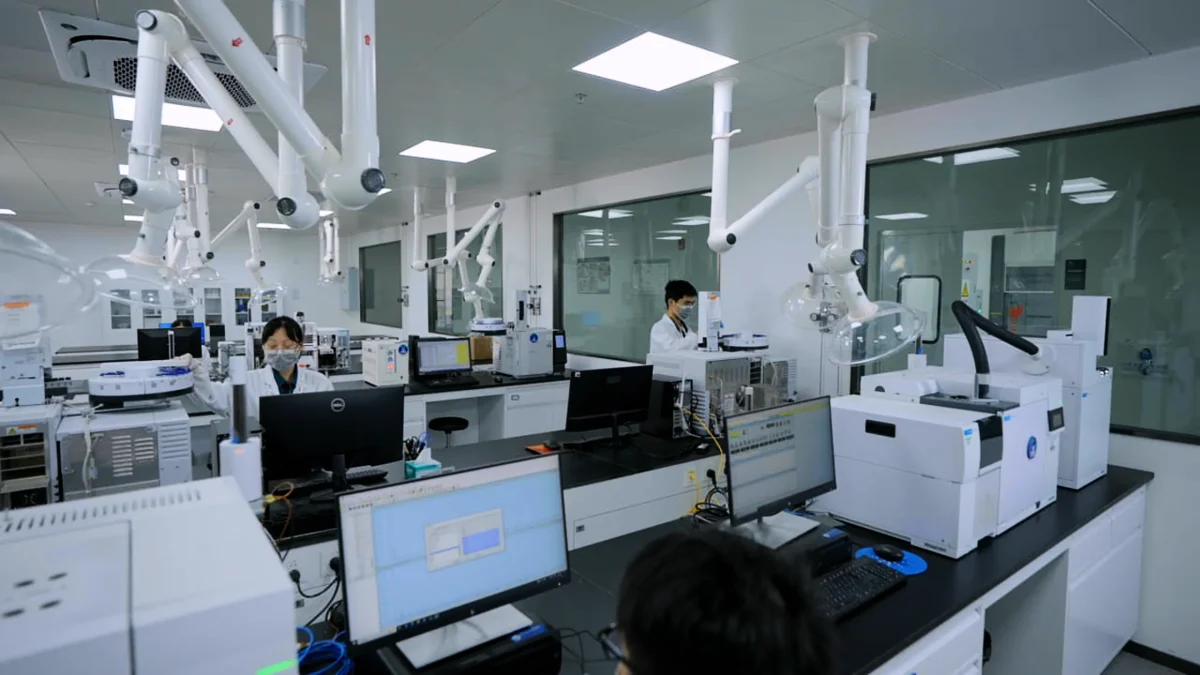
Why Companies Struggle with In-House Deformulation
Accuracy Challenge: Trace Components Drive Performance
In polymer and chemical systems, the final performance is rarely determined by the base resin alone. Instead, it depends on trace-level functional additives, often present at ppm concentrations.
These include:
- Antioxidants and stabilizers
- Plasticizers and dispersants
- Coupling agents and surfactants
Even minor deviations can significantly alter performance:
- A 0.05% additive difference may determine thermal stability failure
- Inconsistent filler dispersion can reduce mechanical strength
- Ignoring crystalline or molecular structure leads to incorrect replication results
A high-quality deformulation lab does not simply “identify composition”—it reconstructs functional equivalence.
Speed Challenge: Traditional Reverse Engineering Is Too Slow
Conventional deformulation workflows typically follow:
sample preparation → analytical testing → data interpretation → iterative validation
Even for moderately complex materials, the full cycle can take weeks to months, making it unsuitable for fast-moving industrial procurement and product development cycles.
Cost Challenge: High Barriers to Building an In-House Lab
Setting up an internal deformulation lab requires significant investment in:
- High-end analytical instruments (GC-MS, LC-MS/MS, FTIR, ICP-MS, NMR)
- Continuous maintenance and calibration costs
- Skilled chemists and analytical engineers
- Large-scale spectral databases and reference libraries
Without mature data infrastructure, companies often fall into inefficient cycles of repeated testing and delayed conclusions.
As a result, outsourcing to a specialized deformulation lab is often the more cost-effective strategy for mid-sized manufacturers.
How a Professional Deformulation Lab Works
A modern deformulation lab relies on a three-layer technical system, rather than a single instrument:
- Advanced analytical instrumentation
- Large-scale spectral and formulation database
- Expert interpretation and engineering logic
Analytical Instrumentation System
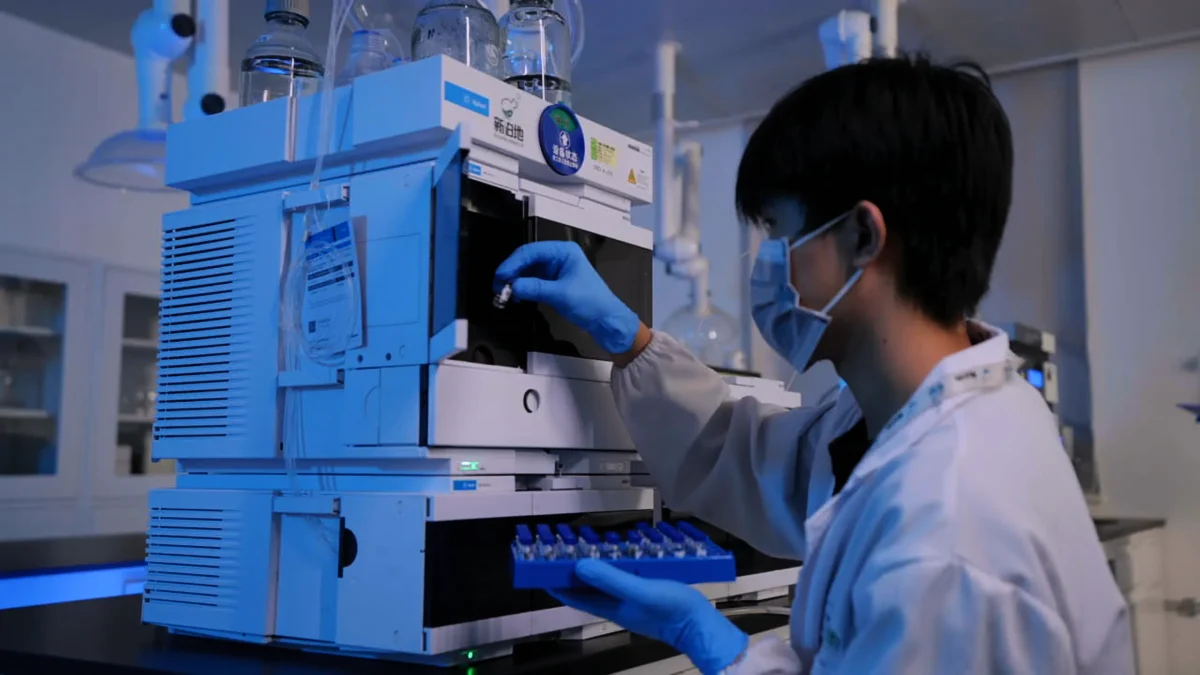
A high-performance deformulation lab typically integrates:
- GC-MS / LC-MS/MS: Identification of organic compounds and trace additives
- FTIR / NMR: Polymer structure and functional group analysis
- ICP-MS: Ultra-trace elemental composition detection
- TGA / DSC: Thermal behavior and material stability analysis
This multi-platform approach ensures cross-validation and reduces analytical blind spots.
Spectral Database as the Core Intelligence Engine
Instrumentation alone is not sufficient. The real value of a deformulation lab lies in its data infrastructure:
- Millions of validated spectral reference entries
- Cross-material and cross-industry matching capabilities
- Continuous updates for low-VOC, bio-based, and regulatory-compliant materials
This allows raw analytical signals to be translated into actionable chemical identities.
Expert Interpretation Beyond Composition
A mature deformulation lab does not stop at “what is inside the sample”.
It further provides:
- Process inference: identifying likely manufacturing routes (polymerization, blending, extrusion)
- Interaction analysis: detecting synergy or incompatibility between additives
- Failure prediction: anticipating aging, precipitation, or degradation risks
The output is therefore a production-ready formulation strategy, not just a report.
Why Choose Xinbodi Lab
Through standardized workflows and automation, Xinbodi labs achieve significant efficiency gains:
- Standardized sample pretreatment reduces variability
- Parallel instrument operation increases throughput
- Automated spectral matching accelerates identification
As a result:
- ~90% of common compounds are identified rapidly
- Only complex unknowns require expert intervention
- Full reports can be delivered in 5–7 working days, with urgent cases in 3–5 days
Key advantages of chooseing Xinbodi Lab:
- No capital investment in instrumentation
- No need for long-term expert staffing
- Faster iteration cycles for product development
- Lower total cost of experimentation
- Based in Shanghai, Xinbodi help global manufacturers compare supplier samples, evaluate China-based alternatives, and make informed sourcing decisions.
Xinbodi Lab Deformulation Case Study
Case 1: Metal Cleaning Agent — Import Substitution
A manufacturer relied heavily on imported cleaning agents with unstable supply and high costs.
A deformulation lab identified a nonionic–anionic surfactant system combined with organic amine corrosion inhibitors.
Result:
- Equivalent cleaning performance achieved
- 35% reduction in formulation cost
- Stable localized supply chain established
Case 2: Water-Based Anti-Corrosion Coating — Performance Optimization
A coating company faced issues with humidity resistance and film failure.
Deformulation analysis revealed:
- Improper filler particle size distribution
- Suboptimal curing ratio affecting crosslink density
Result:
- Salt spray resistance improved by over 100%
- Significant reduction in product failure rates
- Enhanced industrial application stability
Case 3: Electronic Potting Compound — Regulatory Compliance
A polyurethane-based material failed VOC compliance for export markets.
A deformulation lab quickly identified:
- Low-grade plasticizers
- Residual unreacted monomers
Result:
- Reformulated within 2 days
- Full compliance achieved
- Avoided production downtime and export delays
Conclusion: Why Deformulation Labs Are Becoming a Strategic Infrastructure
A deformulation lab is no longer just an analytical service provider—it is becoming a core infrastructure for modern chemical and materials innovation.
By integrating advanced instrumentation, large-scale data systems, and expert interpretation, deformulation labs enable companies to achieve a sustainable balance between accuracy, speed, and cost.
In an increasingly competitive global market, this capability directly translates into faster innovation cycles, stronger import substitution capability, and improved product competitiveness.