
What Is Material Failure Analysis?
Material Failure Analysis is the scientific process of determining why a material, component or finished product failed before, during or after use. A failure may appear as cracking, discoloration, odor, contamination, corrosion, deformation, delamination, abnormal residues, poor adhesion, unexpected aging, or performance loss.
For manufacturers, importers, brand owners and quality teams, the real value of Material Failure Analysis is not simply getting a laboratory report. The value lies in answering one business-critical question:
What exactly caused the failure, and how can we prevent it from happening again?
At Xinbodi Material Failure Analysis Lab, we investigate failed samples together with control samples, production background, storage conditions and customer complaint information. By combining chemical analysis, microscopic observation, comparative testing and root cause logic, we help clients turn an uncertain quality issue into evidence-based corrective action.
Why Material Failure Analysis Matters for Global Manufacturers
A product failure rarely affects only one batch. If the root cause is not identified quickly, the same defect may spread across production lines, suppliers, export markets and customer complaints.
Material Failure Analysis is especially important when:
A product changes color during storage or transportation. A plastic, rubber, coating or adhesive shows unexpected aging. Packaging materials release odor, residue or unknown substances. A component cracks, breaks or deforms under normal use. A customer complaint cannot be explained by routine QC inspection. A supplier dispute requires independent laboratory evidence. A brand needs to avoid recalls, shipment rejection or reputation damage.
For overseas trade and manufacturing, failure analysis is even more critical because products may experience long-distance transportation, high-temperature storage, humidity, sunlight exposure, chemical migration and complex end-use environments. A defect that is invisible at factory inspection may become obvious only after weeks or months in the target market.
Common Materials and Failure Problems We Analyze
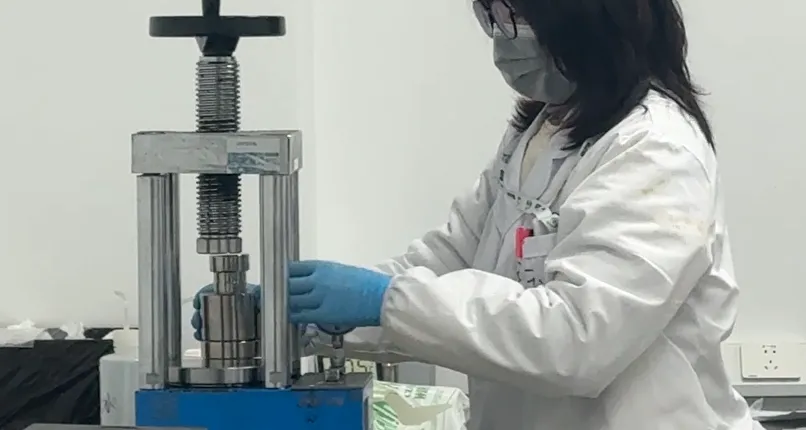
Xinbodi Lab supports a wide range of materials and product categories, including polymers, plastic films, packaging materials, coatings, adhesives, rubber parts, textiles, hygiene product materials, consumer goods, industrial components and composite materials.
Typical failure problems include discoloration, yellowing, fading, cracking, brittleness, contamination, foreign particles, abnormal odor, migration of additives, aging failure, poor bonding, corrosion, surface defects and unknown residue.
Instead of relying on one single test, our laboratory designs a testing route based on the failure phenomenon. For example, a discoloration problem may require solvent extraction, GC-MS screening, comparison between normal and failed samples, ion chromatography, microscopy and aging simulation. A cracking problem may require fracture observation, material composition testing, thermal analysis and mechanical property comparison.
Case Study: Packaging Material Discoloration in Female Hygiene Products
One overseas client contacted Xinbodi Lab after a large number of female hygiene product packaging materials showed severe discoloration and fading. The client had already conducted multiple checks, including aging tests and attempts to identify volatile substances, but the exact cause remained unclear.
The problem was commercially sensitive. The packaging material was used for personal hygiene products, and visible discoloration created an immediate quality and brand trust issue. The client needed more than a simple confirmation that the material had changed color. They needed to know where the abnormal substance came from and whether the problem was related to raw materials, additives, processing, storage or environmental exposure.
Step 1: Comparing Failed and Normal Samples
The first step in this Material Failure Analysis case was to compare the failed packaging material with a normal control sample. This comparative method is essential because a failed sample alone often cannot explain whether a detected substance is abnormal or part of the original material formula.
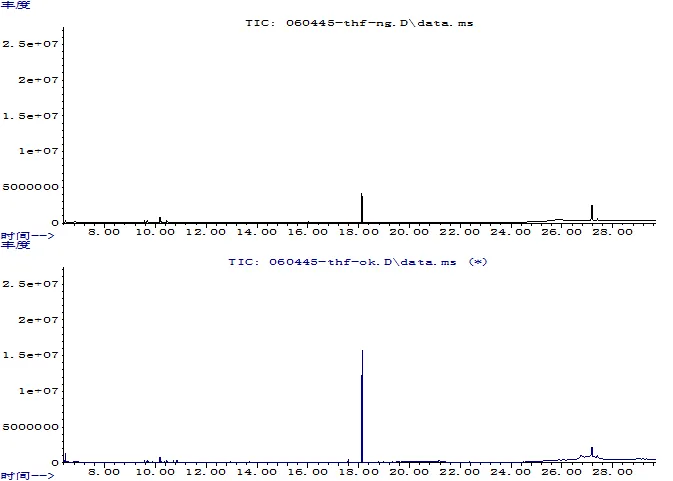
Xinbodi laboratory analyzed both the discolored sample and the normal sample under the same testing conditions. The chromatographic comparison showed that the failed material had a distinct abnormal peak that was not present, or was much weaker, in the normal sample. This difference provided an important clue: the discoloration was not random surface aging only, but was likely associated with a specific chemical difference between the two materials.
Step 2: Locating the Abnormal Chemical Signal
The laboratory further examined the abnormal peak region and compared the response intensity between the failed and normal samples. In the failed packaging material, a clear characteristic peak appeared at a specific retention time, indicating that an additional or enriched substance existed in the discolored material.
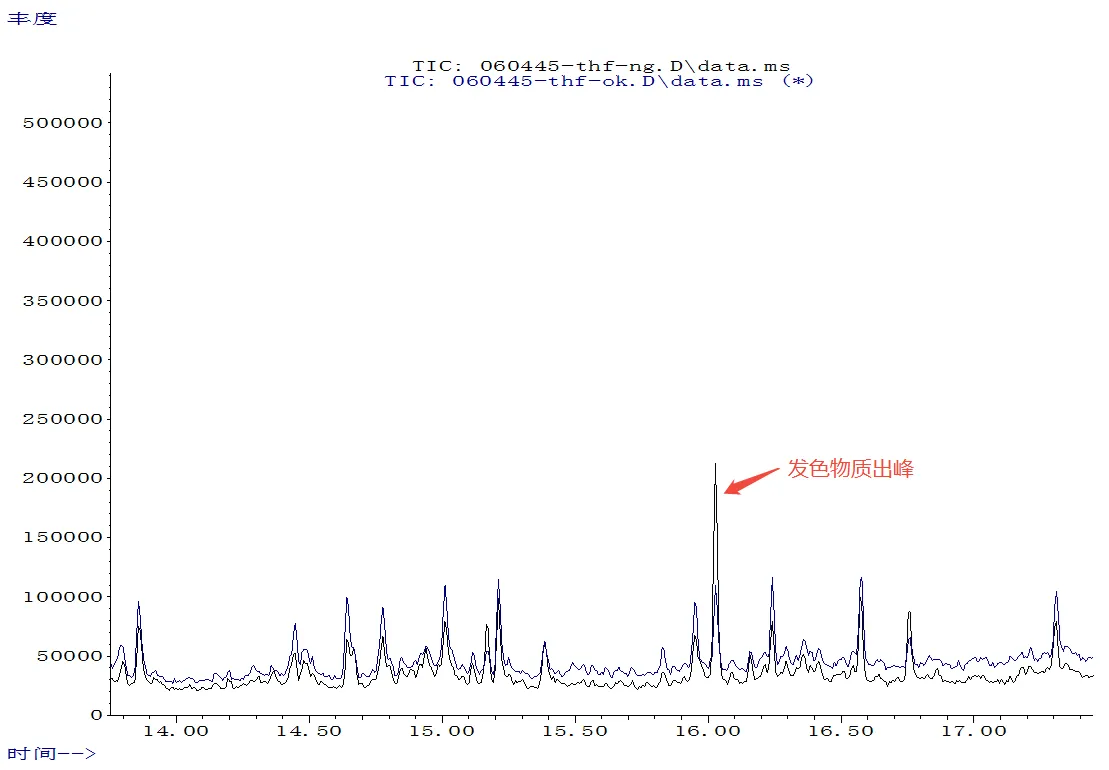
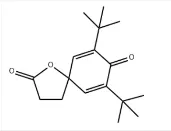
This finding helped narrow the investigation. Instead of treating the entire packaging film as a general aging problem, the analysis shifted toward identifying a possible contaminant, additive degradation product, migration substance or process-related residue.
Step 3: Ion Chromatography for Inorganic Ions
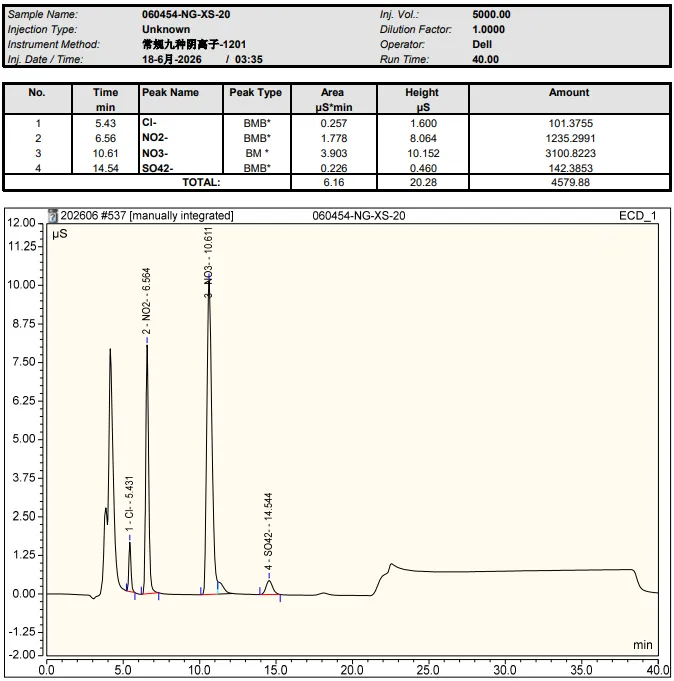
In addition to organic component screening, ion chromatography was used to detect inorganic ions in the sample. The test detected ions such as chloride, nitrite, nitrate and sulfate. These results provided another layer of evidence for evaluating whether inorganic residues, processing chemicals, environmental exposure or upstream contamination may have contributed to the discoloration.
For packaging materials, inorganic ions can be relevant because they may come from raw material residues, processing aids, cleaning agents, water sources, environmental exposure, storage conditions or interactions between packaging layers. When combined with organic analysis data, ion chromatography helps build a more complete root cause picture.
Step 4: Connecting Laboratory Data With the Real Production Chain
A strong Material Failure Analysis Lab should not stop at identifying peaks on a chart. The key is to connect analytical results with the client’s actual supply chain.
In this case, Xinbodi recommended that the client review several possible risk points: whether the raw film batches had changed, whether pigments or masterbatches came from different suppliers, whether printing ink, adhesive or coating systems had been adjusted, whether cleaning chemicals were used near the packaging line, whether the product had experienced high temperature or humidity during storage, and whether discolored samples came from the same production date or shipment.
By matching laboratory findings with batch records and production history, the client could move from “we see discoloration” to “we know which material or process factor should be controlled.”
What Makes a Good Material Failure Analysis Lab Different?
Many laboratories can run tests. A truly useful Material Failure Analysis Lab must be able to design the right testing strategy and interpret the results in the context of the actual failure.
The most important capabilities include comparative testing between failed and normal samples, chemical screening of unknown substances, microscopy for surface and structural defects, analysis of organic and inorganic contaminants, aging and environmental simulation, and root cause reasoning based on production information.
For global manufacturers, another key factor is communication. The laboratory report should be clear enough for quality managers, engineers, suppliers and overseas customers to understand. The conclusion should not be vague. It should explain what was found, why it matters, what the likely source is, and what corrective action should be considered.
Our Material Failure Analysis Workflow
Xinbodi follows a structured failure analysis workflow to ensure that each investigation is evidence-based and practical.
First, we collect background information, including failure description, product use, batch differences, raw material changes, storage conditions and customer complaint details. Then we inspect the failed samples and compare them with normal control samples. Based on the failure mode, we select suitable testing methods such as GC-MS, FTIR, ion chromatography, microscopy, thermal analysis or other material characterization techniques.
After testing, we compare the results between failed and normal samples, identify abnormal signals, evaluate possible sources and build a root cause hypothesis. Finally, we provide a report with analytical evidence, interpretation and recommended next steps for prevention.
This workflow is especially useful for complex cases where the failure may involve more than one factor, such as material formulation, production process, storage environment and chemical migration.
When Should You Contact a Material Failure Analysis Lab?
You should consider Material Failure Analysis when a product defect cannot be explained by routine inspection, when a failure repeats across batches, when customer complaints increase, or when the cost of not knowing the cause becomes higher than the cost of testing.
For example, if packaging materials fade after shipment, if a plastic component becomes brittle after aging, if a coating peels under normal use, or if a product emits an abnormal odor, waiting too long may make the investigation more difficult. Some volatile compounds may disappear over time, and some evidence may be affected by storage or handling.
The best time to start failure analysis is when both failed samples and normal samples are still available, and when batch records and production information can still be traced.
Why Choose Xinbodi Material Failure Analysis Lab?
When dealing with product failures, speed and practical experience matter. Xinbodi Lab provides fast, flexible and evidence-based Material Failure Analysis support for polymers, packaging materials, coatings, adhesives, films and consumer products.
Unlike many large testing institutions with longer queues, Xinbodi can usually respond within 24 hours after receiving project details. For many failure analysis projects, results can be delivered in about 7–10 working days after sample receipt, depending on sample complexity.
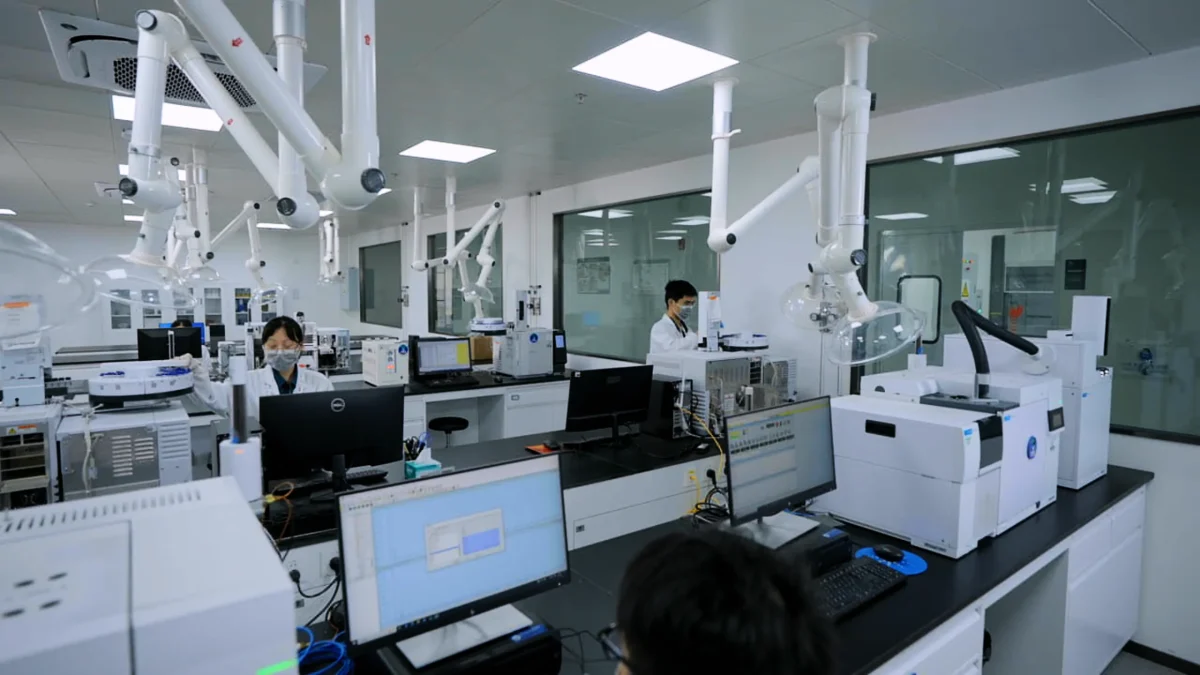
Xinbodi is supported by over 4,000 m² of R&D laboratories, 100+ precision instruments, and experience from more than 60,000 sample orders. This allows our team to combine GC-MS, FTIR, ion chromatography, microscopy, formulation analysis and comparative testing to identify abnormal substances and root causes more efficiently.
Beyond testing, Xinbodi also provides practical R&D support. We help clients understand whether a failure is related to raw materials, additives, processing residues, supplier changes, storage conditions or environmental exposure.
Based in Shanghai, Xinbodi also has a strong China supply chain advantage. We can help global manufacturers compare supplier samples, evaluate China-based alternatives and make better sourcing decisions while keeping formulas, samples and supplier information strictly confidential.
Get Reliable Material Failure Analysis for Your Product
If your product has failed unexpectedly, do not rely on guesswork. A professional Material Failure Analysis Lab can help you identify the root cause, reduce repeated defects, protect your brand reputation and improve product reliability.
Contact Xinbodi to discuss your Material Failure Analysis case. Send us your failed sample, normal sample and background information, and our technical team will help you design a targeted testing plan.
Need help with discoloration, contamination, odor, cracking or aging failure? Xinbodi Lab is ready to support your investigation.