
Introduction
Polymer products are rarely made from a single material. A plastic part, rubber product, coating film, adhesive layer or PVC sample may contain resin, plasticizer, filler, stabilizer, lubricant, antioxidant, pigment, flame retardant, impact modifier and other functional additives.
For manufacturers, understanding these components is critical. A small change in resin type, filler content or additive system can affect flexibility, hardness, heat resistance, aging behavior, processing performance, odor, discoloration, migration, cracking or product failure.
This is where polymer composition analysis becomes valuable. It helps manufacturers identify what a polymer material is made of, compare supplier samples, investigate quality problems, support product development and provide data for formulation improvement.
At Xinbodi Laboratories, polymer composition analysis is not treated as a single-instrument test. Complex polymer materials usually require sample pretreatment, organic and inorganic separation, multi-method testing and expert interpretation before a reliable formulation picture can be built.
What Is Polymer Composition Analysis?
Polymer composition analysis is the process of identifying and, when possible, quantifying the components in polymer-based materials. It is used to determine the resin system, additives, fillers, pigments, stabilizers, plasticizers and other substances in a sample.
It can be applied to many materials, including:
- Plastics
- Rubber materials
- PVC products
- Coatings
- Adhesives
- Films
- Cables
- Flooring materials
- Foams
- Industrial molded parts
- Packaging materials
- Polymer composites
A complete polymer composition analysis can help answer questions such as:
- What is the main polymer resin?
- Does the material contain plasticizers or impact modifiers?
- What inorganic fillers or pigments are present?
- Are there stabilizers, antioxidants or lubricants?
- Is the supplier sample different from the reference sample?
- Why does the product show odor, discoloration, cracking or performance loss?
- Can the material formulation support reverse engineering or product development?
For R&D teams, quality managers and sourcing professionals, polymer composition analysis provides a scientific basis for decision-making.
Why Polymer Materials Need a Separation-Based Workflow
Many polymer products are multi-component systems. If a laboratory only tests the original sample directly, strong signals from the main resin or filler may cover weaker signals from trace additives. This is why a reliable polymer composition analysis usually starts with sample pretreatment and separation.
In general, the analysis begins with FTIR screening to understand the approximate material system. Based on the result, the laboratory designs a suitable separation strategy. The sample may then be treated with selected solvents to separate organic components from inorganic components.
For many rubber, plastic, adhesive and coating materials, the workflow may include:
- Initial FTIR screening
- Solvent extraction or soaking
- Separation of soluble and insoluble fractions
- Further extraction of small-molecule organic additives
- Testing of inorganic fillers and elements
- Testing of resin and polymer fractions
- Cross-verification by multiple analytical methods
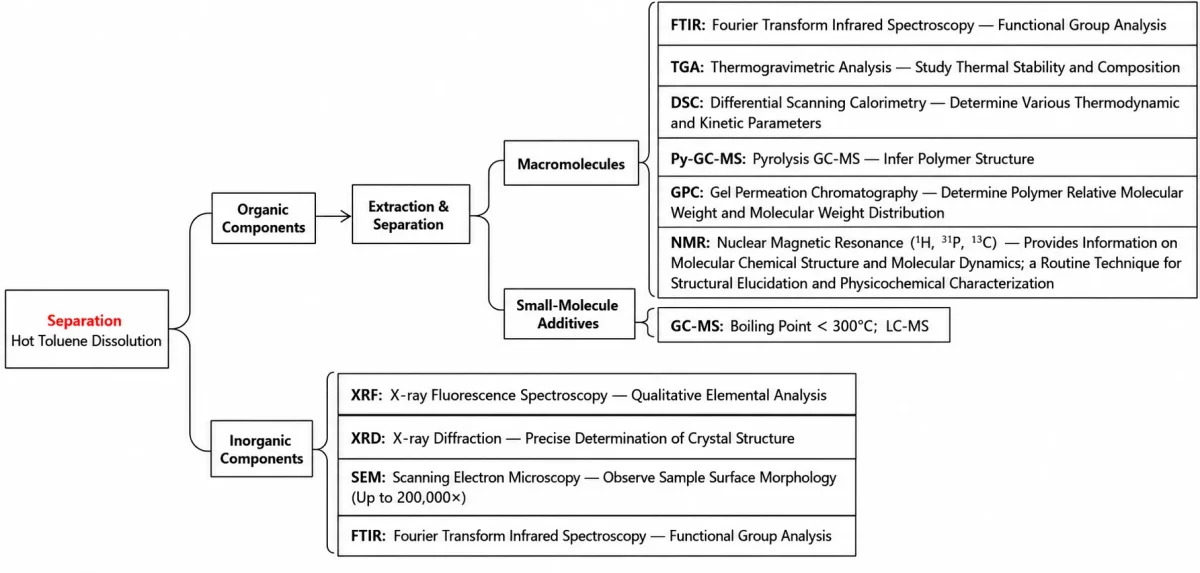
This approach is important because different components require different testing methods. A plasticizer may be better identified by GC-MS or NMR, while inorganic filler may require XRF, XRD, ICP or SEM-EDS. A polymer resin may require FTIR, TGA, DSC, Py-GC-MS or GPC for further confirmation.
Organic and Inorganic Separation in Polymer Composition Analysis
A key step in polymer composition analysis is separating the material into organic and inorganic fractions.
Organic Fraction Analysis
The organic fraction may include:
- Main polymer resin
- Plasticizers
- Small-molecule additives
- Antioxidants
- Lubricants
- Impact modifiers
- Processing aids
- Flame retardants
- Residual monomers or solvents
Common analytical methods include:
- FTIR analysis for functional group identification and material screening.
- GC-MS analysis for volatile and semi-volatile organic compounds.
- LC-MS analysis for non-volatile organic compounds and complex additives.
- NMR analysis for structural confirmation and additive ratio estimation.
- Py-GC-MS analysis for polymer backbone, rubber and cured resin analysis.
- GPC analysis for molecular weight distribution of polymers and resins.
- TGA and DSC analysis for thermal decomposition, filler estimation and transition behavior.
For crosslinked polymers, cured adhesives or insoluble rubber materials, direct dissolution may not be enough. In these cases, Py-GC-MS can help break down polymer chains into characteristic fragments, allowing the lab to infer resin structure and polymer type.
Inorganic Fraction Analysis
The inorganic fraction may include:
- Calcium carbonate
- Silica
- Titanium dioxide
- Mineral fillers
- Pigments
- Metal stabilizers
- Flame retardant fillers
- Catalyst residues
- Heavy metals or restricted elements
Common analytical methods include:
XRF analysis for elemental screening.
XRD analysis for crystalline structure and mineral phase identification.
ICP-MS or ICP-OES analysis for trace elements and metal analysis.
SEM-EDS analysis for surface morphology and elemental distribution.
FTIR analysis for carbonate, silicate or other inorganic functional group confirmation.
XPS analysis for surface elemental composition and chemical state analysis when surface chemistry is important.
This is where element determination becomes important. For polymer materials containing inorganic fillers, metal stabilizers, pigments or restricted substances, elemental analysis can help identify elements such as calcium, zinc, tin, lead, titanium, silicon and other trace metals.
Example: PVC Composition Analysis
PVC is a good example of why polymer composition analysis requires a structured workflow.
PVC products can be divided into soft PVC and rigid PVC. Their formulation systems are different. Soft PVC usually contains PVC resin, plasticizers, inorganic fillers, stabilizers and functional additives. Rigid PVC may contain PVC resin, impact modifiers, inorganic fillers, stabilizers and processing aids, while plasticizer content is usually low or absent.
PVC resin itself has poor stability under heat and light, so stabilizers are commonly added to improve processing and long-term performance. Depending on the application, PVC products may also contain lubricants, antioxidants, UV stabilizers, calcium carbonate, impact modifiers and other additives.
For PVC composition analysis, a common approach is to use THF as a solvent to separate the sample into different fractions.
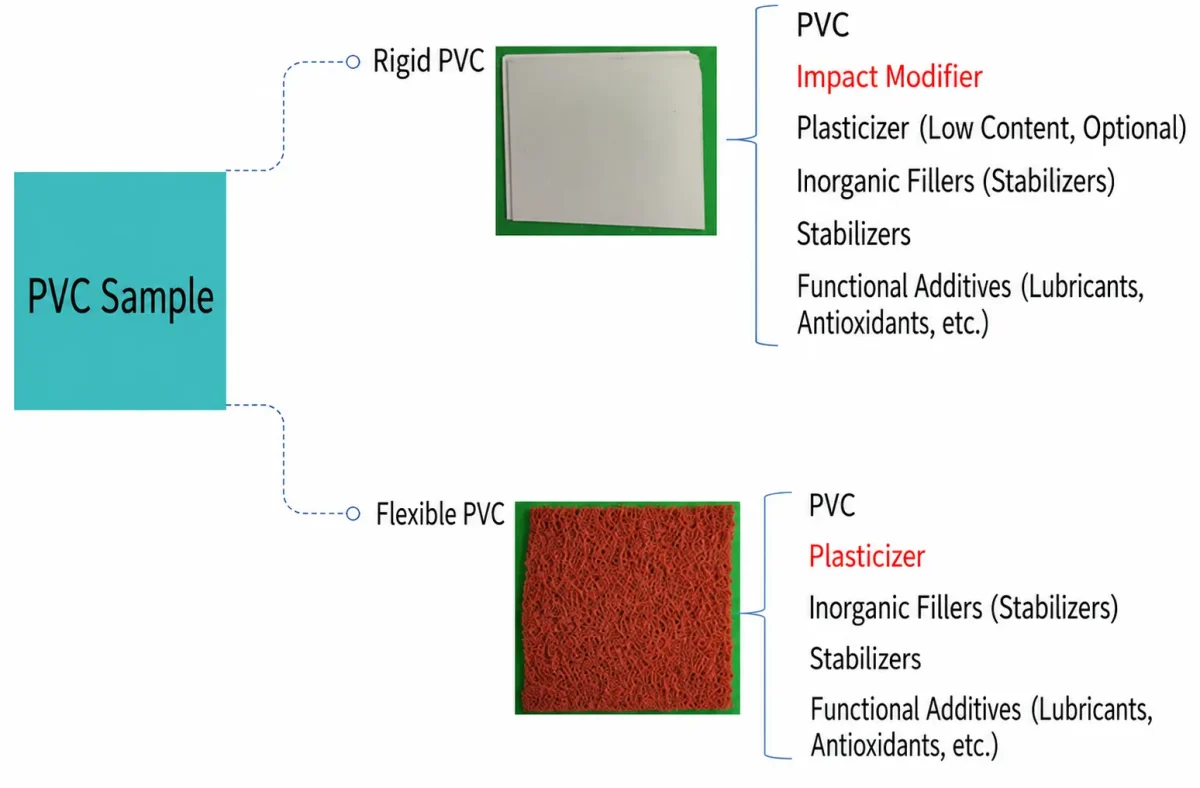
The sample may be divided into:
THF-insoluble fraction
This fraction often contains inorganic fillers, stabilizers and pigments. It can be analyzed by FTIR, XRF and XRD to identify inorganic components and crystalline phases.
THF-soluble ethanol-soluble fraction
This fraction often contains plasticizers and small-molecule functional additives. It can be analyzed by FTIR, NMR and GC-MS to identify additive types and estimate relative ratios.
THF-soluble ethanol-insoluble fraction
This fraction usually contains PVC resin and possible impact modifiers. It can be analyzed by FTIR and GPC to evaluate resin type and molecular weight distribution.
This separation-based workflow allows the laboratory to avoid relying on a single spectrum. Instead, each fraction is tested with suitable methods and then integrated into a complete formulation interpretation.
Key Techniques Used in Polymer Composition Analysis
Different techniques provide different information. A professional polymer composition analysis lab should select methods based on the material type, sample condition and project goal.
| Technique | What It Helps Identify |
|---|---|
| FTIR | Functional groups, resin type, carbonate fillers, material screening |
| GC-MS | Plasticizers, volatile additives, processing aids, residual solvents |
| LC-MS | Polar additives, stabilizers, antioxidants, complex small molecules |
| NMR | Molecular structure confirmation and additive ratio estimation |
| Py-GC-MS | Polymer backbone, cured resin, rubber and crosslinked material analysis |
| GPC | Molecular weight distribution of polymers and resins |
| TGA | Organic/inorganic ratio, filler content and thermal decomposition |
| DSC | Glass transition, melting behavior, curing and thermal transition |
| XRF | Elemental screening and inorganic filler identification |
| XRD | Crystalline structure and mineral phase identification |
| ICP-MS / ICP-OES | Trace elements, heavy metals and element determination |
| SEM-EDS | Surface morphology, particles and elemental distribution |
| XPS | Surface elemental composition and chemical state analysis |
By combining these methods, polymer composition analysis can identify both major components and minor additives that influence performance.
Qualitative and Quantitative Interpretation
Polymer composition analysis is not only about identifying components. For many projects, clients also need approximate ratios.
However, quantification in complex polymer systems requires careful interpretation. Different methods have different strengths and limitations.
For example, TGA can estimate organic and inorganic content based on thermal decomposition behavior, but sample size and material heterogeneity may create error. Solvent separation can provide useful recovery data, while NMR or GC-MS peak areas can help estimate small-molecule additive ratios. ICP can support inorganic element quantification, while XRF provides fast elemental screening.
Therefore, a reliable report should not depend on one data source. It should combine:
- Solvent separation recovery
- FTIR spectral interpretation
- TGA thermal data
- GC-MS or LC-MS component identification
- NMR structural confirmation
- XRF or ICP elemental results
- XRD crystalline phase identification
- SEM-EDS morphology and elemental distribution
- Practical formulation knowledge
This integrated interpretation is what turns raw test results into useful formulation insight.
Common Applications of Polymer Composition Analysis
Polymer composition analysis is used in many industrial situations.
1. Supplier Sample Comparison
Manufacturers often need to compare two materials from different suppliers. Even when two products look similar, their resin type, filler content, plasticizer system or stabilizer package may be different. Composition analysis helps identify these differences and supports sourcing decisions.
2. Product Development and Formulation Improvement
R&D teams can use polymer composition analysis to understand benchmark products and improve internal formulations. This can reduce blind trial-and-error testing and shorten development cycles.
3. Material Failure Analysis
If a polymer product cracks, discolors, emits odor, becomes brittle or loses performance, composition analysis can help determine whether the problem is related to raw material changes, additive migration, filler differences, contamination or degradation.
4. Import Replacement and Cost Reduction
When imported materials are expensive or difficult to source, composition analysis can provide a technical reference for local substitution. It helps identify key components and guide raw material selection.
5. Unknown Material Identification
When the material identity is unclear, FTIR, GC-MS, Py-GC-MS, XRF and other methods can help determine the material family and major components.
6. Restricted Substance and Elemental Screening
For materials used in electronics, automotive, medical devices, packaging and consumer products, elemental analysis and chemical testing may be required to screen heavy metals, restricted elements, VOCs or other regulated substances.
Polymer Composition Analysis vs. Deformulation
Polymer composition analysis and deformulation are closely related, but they are not exactly the same.
Polymer composition analysis focuses on identifying what components are present in the material and estimating their relative content.
Deformulation goes one step further. It uses composition analysis results to support formulation reconstruction, competitor product analysis, raw material selection and product development.
In many industrial projects, the two are combined. First, the lab identifies the resin, fillers, plasticizers and additives. Then the results are interpreted in the context of performance requirements, processing conditions and formulation goals.
For example, in a PVC product, identifying the resin, plasticizer, stabilizer and filler system may help determine whether the sample is soft PVC or rigid PVC. It may also explain why one product has better flexibility, heat stability or aging resistance than another.
What Samples Should You Submit?
To improve the accuracy of polymer composition analysis, clients should provide as much background information as possible.
Recommended samples include:
- Original material sample
- Reference or target sample
- Failed sample if failure analysis is involved
- Good sample for comparison
- Raw material information if available
- Production batch information
- Application environment
- Photos of the product or defect
- Known processing conditions
- Specific questions the analysis should answer
For example, if a product shows surface blooming, odor, discoloration or cracking, submitting both the failed sample and a normal control sample can significantly improve the quality of interpretation.
If the goal is supplier comparison, submit samples from both suppliers. If the goal is formulation reconstruction, provide information about performance requirements, application scenario and target properties.
Why Choose Xinbodi Laboratories?
Xinbodi Laboratories provides polymer composition analysis, chemical composition testing, deformulation analysis and material failure analysis for global manufacturers.
Our team combines advanced analytical instruments with practical formulation interpretation. We help clients identify material components, understand formulation differences, compare supplier samples, investigate defects and support product development decisions.
Xinbodi’s advantages include:
7×24 Customer Support: Fast technical response within 24 hours.
Fast 5–10 Day Delivery: Efficient project turnaround after sample receipt.
Advanced Lab Capacity: 4,000+ m² R&D labs and 100+ precision instruments.
60,000+ Samples Tested: Rich experience in industrial projects.
90%+ Reconstruction Accuracy: Reliable support for suitable deformulation cases.
R&D Insight: Actionable solutions and production guidance with protected formulas and sample data.
Need Polymer Composition Analysis?
If you need to identify polymer components, compare supplier samples, analyze plasticizers, determine inorganic filler content, investigate product failure or support formulation reconstruction, Xinbodi Laboratories can help.
Send us your sample and project background. Our technical team will design a suitable analytical workflow and provide practical interpretation for R&D, quality control, sourcing and production decisions.
Contact Xinbodi Laboratories for polymer composition analysis, chemical composition testing and deformulation support.