
A skincare formula may look perfect on paper and still fail after launch.
A cream begins to pill under sunscreen. A serum changes color after storage. A new raw material creates an unusual odor. Customers complain that a product feels different even though the ingredient list has barely changed.
The natural reaction is often to replace one ingredient.
But cosmetic formulas rarely fail because of one ingredient acting alone.
An emulsifier may be incompatible with the oil phase. Two thickeners may compete with each other. A preservative may react with an active ingredient. A supplier may change the carrier system of a raw material without changing its INCI name.
This is where cosmetic formulation analysis becomes useful. Instead of reformulating by guesswork, the product can first be examined to understand what has changed and why.
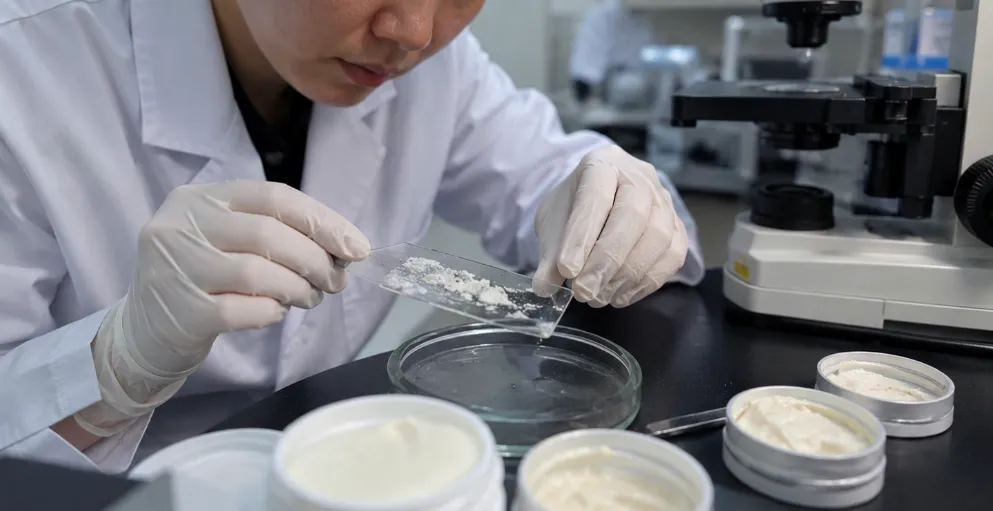
A Formula Is a System, Not an Ingredient List
A cream is not simply water, oil, emulsifier and preservative mixed together.
Its performance depends on relationships between:
- Oils and emollients
- Emulsifiers
- Polymeric thickeners
- Active ingredients
- Preservatives
- Fragrances
- Salts and minerals
- Manufacturing conditions
Changing one component can affect the whole system.
For example, replacing an imported emulsifier with a cheaper domestic alternative may change droplet structure, product appearance and compatibility with the thickener. The two materials may have the same general function but behave differently inside the finished formula.
That is why successful skincare product improvement usually starts with diagnosis rather than substitution.
Case: Rebuilding a Whitening Toothpaste
An oral care brand wanted to develop a whitening toothpaste based on a leading competitor.
The brand needed to understand the competitor’s abrasive system, whitening-support ingredients, antibacterial components, sweeteners and flavor materials.
What was analyzed
XRF, TGA and FTIR were used to examine ingredients such as hydrated silica and pyrophosphate-related materials.
Additional analytical methods were used to investigate lower-level antibacterial ingredients, sweeteners and fragrance-related compounds.
The results helped clarify how the competitor combined:
- Abrasives
- Whitening-support ingredients
- Antibacterial components
- Binders
- Sweeteners
- Flavor materials
How the formula was adapted
The reconstructed ingredient system was adjusted to use locally available raw materials. Laboratory trials were then used to refine the formulation before production transfer.
Project-reported outcome: analytical formulation similarity exceeded 90%, while raw material costs decreased by approximately 22%. Cleaning and whitening-related properties were later compared with the reference product through appropriate product testing.
This project shows that formulation analysis can support both competitor benchmarking and supply-chain optimization.
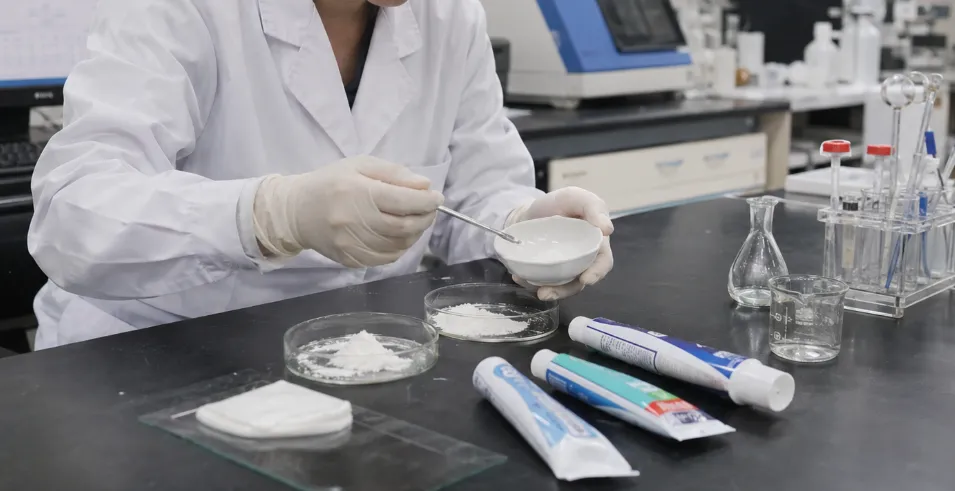
Case: A Sensitive-Skin Cream That Started Pilling
A skincare brand received complaints about a cream marketed for sensitive skin.
Users reported that the product formed small rolls or flakes during application. Some also experienced redness. The brand needed to understand whether the problem came from the raw materials, the formulation structure or the manufacturing process.
What the analysis found
The cream was screened for its major and minor components, with particular attention to:
- Emulsifiers
- Preservatives
- Polymeric thickeners
- Oil-phase materials
- Potentially irritating ingredients
Particle-size analysis and microscopic examination showed aggregation within the oil phase. The thickening system also appeared poorly matched with the rest of the formulation.
The pilling was therefore not caused by a single “bad” ingredient. It was related to how the oil droplets, polymers and emulsifier system interacted.
How the formula was improved
The emulsification process was adjusted, and the thickener combination was redesigned. Ingredients considered unsuitable for the intended sensitive-skin positioning were replaced with more appropriate alternatives.
The new formula then went through laboratory prototype verification.
Project-reported outcome: the pilling problem was eliminated, the identified higher-risk ingredients were replaced, and the finished-product inspection pass rate increased to 99%.
The important lesson was simple: removing one silicone or adding more moisturizer would not have solved the problem. The complete formulation system had to be understood first.
Rather than adjusting ingredients randomly, modern formulation optimization follows a systematic workflow involving ingredient characterization, analytical testing, prototype verification and iterative refinement. This approach is consistent with optimization methodologies discussed in the AIChE Journal cosmetic formulation study
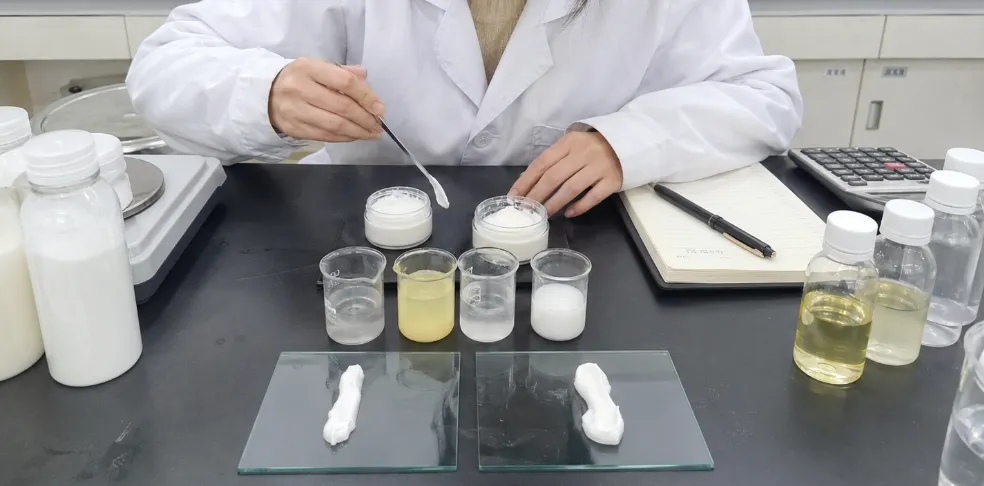
What Can Cosmetic Formulation Analysis Reveal?
Depending on the product and project objective, analysis may help identify:
- Main oil- and water-phase ingredients
- Surfactants and emulsifiers
- Thickeners and polymers
- Preservative systems
- Fragrance-related compounds
- Active ingredients
- Pigments and inorganic materials
- Unknown particles or sediment
- Differences between normal and abnormal batches
- Differences between original and replacement raw materials
Several techniques may be combined. GC-MS can help examine volatile ingredients and fragrances, while LC-MS or HPLC may be used for preservatives and selected active ingredients. FTIR, NMR, XRF, TGA and microscopic methods can provide additional information about polymers, oils, minerals and particles.
The objective is not to create the longest possible test list. It is to answer the product question.
Sometimes the Problem Is the Raw Material, Not the Formula
Two materials with the same INCI name are not always equivalent.
They may differ in:
- Purity
- Active concentration
- Carrier solvent
- Molecular weight
- Particle size
- Impurity profile
- Supplier production process
This explains why a formula may suddenly behave differently after a supplier change.
A useful comparison project should include both the original and replacement raw materials, as well as finished products made with each material where possible.
The laboratory can then determine whether the difference is connected to chemical composition, concentration, impurities or another material characteristic.
Product Improvement Can Also Begin with a Competitor
Not every optimization project starts with a failed product.
Sometimes a brand has a clear benchmark and wants to understand why the competing product performs well.
In that situation, formulation analysis can help reveal the competitor’s main ingredient systems and provide direction for product development.
The goal should not be blind copying. The useful question is:
Which parts of the benchmark formula create value, and how can they be adapted to our own raw materials, cost target and supply chain?
What Analysis Cannot Replace
Chemical analysis can explain composition and identify meaningful differences, but it cannot prove every product claim.
After reformulation, the product may still require:
- Stability testing
- Microbiological testing
- Packaging compatibility testing
- Safety assessment
- Consumer or sensory evaluation
- Efficacy testing
- Regulatory review
For example, analysis may identify why a product pills or which preservative is present. It cannot independently prove that a finished product is suitable for all sensitive-skin users.
The most effective development process combines analytical evidence with formulation trials and the appropriate validation tests.
Need Help Understanding a Cosmetic Formula?
Xinbodi Laboratories provides cosmetic formulation analysis, ingredient identification, supplier comparison, competitor product analysis and formulation reconstruction support.
Send us the product sample, available ingredient information, a normal or benchmark sample and the problem you need to solve. Our technical team will recommend an analytical workflow based on the product and project objective.