
A resin formulation can meet initial strength requirements and still fail when exposed to humidity, low temperature, or long-term service conditions.
A Southeast Asian industrial adhesive manufacturer experienced this problem while developing a two-component polyurethane structural adhesive for automotive interior parts and electronic assemblies.
The self-developed adhesive met its initial room-temperature bonding target, but three problems prevented it from replacing an imported benchmark:
- bond-strength retention fell below 50% after 85°C/85% RH aging;
- full curing required approximately 24 hours;
- low-temperature initial adhesion was insufficient.
Repeatedly adjusting the NCO/OH ratio and curing-agent dosage did not solve the problem.
The manufacturer therefore commissioned a resin reverse engineering and formula reconstruction project to understand the imported formulation, identify the missing functional systems, and use the results to guide development of a localized alternative.
For projects like this, deformulation and reverse engineering services can help manufacturers move beyond basic ingredient identification and understand how resin chemistry, curing systems, fillers, and functional additives work together.
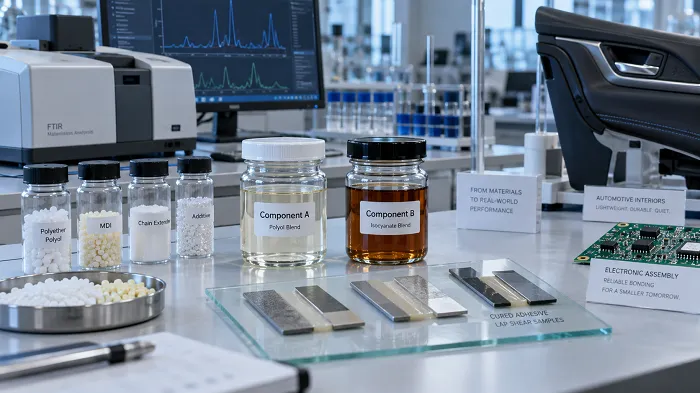
Project Challenge: Initial Strength Passed, but Long-Term Performance Failed
Two samples were submitted:
- a German imported two-component polyurethane structural adhesive as the benchmark;
- the customer’s self-developed two-component polyurethane adhesive.
The benchmark consisted of a polyol-based A component and an isocyanate-based B component.
The customer’s formulation looked acceptable during routine testing. However, real application performance revealed clear gaps.
After 1,000 hours at 85°C and 85% relative humidity, bond-strength retention dropped to approximately 47%.
The material also required about 24 hours to reach full cure, while initial tack and bonding strength at low temperature were not sufficient for higher-end applications.
This indicated that the problem could not be solved simply by adjusting one NCO/OH ratio.
The laboratory needed to answer a more useful question:
How was the imported resin and curing system constructed, and which formulation elements were missing from the customer’s product?
Resin Reverse Engineering Strategy
Complex polyurethane adhesives contain multiple chemical systems that cannot normally be reconstructed with a single analytical technique.
The project combined:
- FTIR
- GC-MS
- LC-MS/MS
- GPC
- TGA
- DSC
- solvent extraction
- column chromatographic fractionation
The sample-preparation strategy first separated:
- lower-molecular-weight additives;
- fillers;
- higher-molecular-weight polyol fractions.
Derivatization and targeted analysis were then used where appropriate to evaluate isocyanate-related components and residual species.
This multi-technique workflow allowed the laboratory to reconstruct the functional architecture of the formulation, rather than relying on a single spectrum.
Xinbodi’s chemical composition analysis services are used in similar projects to identify resin systems, additives, fillers, selected component levels, and differences between benchmark and customer samples.
Formula Reconstruction of the Imported Resin System
The imported benchmark contained a more complex A-side polyol system than the customer initially expected.
A-Side: Polyol and Additive System
| Component | Approx. Content | Functional Role |
|---|---|---|
| Polyether diol, MW ~2000 | 38.0% | Flexibility and toughness |
| Polyester polyol, MW ~3000 | 22.0% | Adhesion, water resistance and mechanical balance |
| Surface-treated nano-CaCO₃ | 28.0% | Reinforcement and rheology control |
| Fumed silica | 2.5% | Thixotropy and viscosity adjustment |
| γ-Aminopropyltriethoxysilane | 1.2% | Interfacial adhesion promotion |
| Hindered phenolic antioxidant | 0.6% | Oxidative stabilization |
| Benzoate-type retarding component | 0.2% | Cure-rate adjustment |
| Organic catalyst | 0.1% | Cure reaction control |
| Other minor components | 7.4% | Supporting formulation functions |
The most important finding was that the benchmark did not rely on a single polyol.
It combined polyether and polyester polyols to balance flexibility, toughness, moisture resistance, and adhesion.
B-Side: Isocyanate Curing System
| Component | Approx. Content |
|---|---|
| Liquefied modified MDI, NCO ~28% | 85.0% |
| TMP-based crosslinking component | 12.0% |
| Organotin catalyst | 0.3% |
| Other minor components | 2.7% |
GPC results for the polyol fractions were consistent with the expected molecular-weight ranges, while DSC of the cured benchmark gave a glass-transition temperature of approximately −32°C.
The result was not an exact proprietary manufacturing recipe. Instead, the analysis reconstructed the major resin, filler, curing, adhesion, and stabilization systems that controlled product performance.
Resin Reverse Engineering Identified Four Formulation Gaps
Comparison with the customer’s formulation revealed that its performance gap came from several interacting weaknesses.
Single Polyol System Limited Durability
The customer relied mainly on a conventional polyether polyol.
The imported benchmark combined polyether and polyester polyols.
The missing polyester component reduced the balance between moisture resistance, interfacial adhesion, and mechanical strength, contributing to faster performance loss during hygrothermal aging.
The issue was therefore not simply the overall amount of polyol, but the polyol architecture itself.
The Curing System Was Too Simple
The customer primarily used MDI as the curing component but lacked the modified crosslinking structure found in the benchmark.
This limited control over:
- crosslink density;
- cure rate;
- low-temperature initial strength;
- final network uniformity.
As a result, changing the NCO/OH ratio alone provided only a narrow optimization window.
Adhesion and Cure-Control Additives Were Missing
The imported benchmark contained a silane coupling agent together with antioxidant and cure-control additives.
The customer formulation lacked this coordinated system.
Without adequate interfacial modification, bonding between the adhesive matrix and substrate was weaker.
At the same time, insufficient control of the curing reaction could create an unfavorable balance between cure speed, internal stress, and long-term bond durability.
Untreated Filler Reduced Interface Stability
The customer used conventional calcium carbonate filler.
The benchmark used surface-treated nano-calcium carbonate, together with a rheology-control system.
The untreated filler showed poorer compatibility with the resin matrix, making the interface more vulnerable under humid and thermal conditions.
This illustrates why formula reconstruction needs to go beyond identifying “calcium carbonate” or “polyurethane.”
The grade, surface treatment, polymer combination, and supporting additives can all influence final performance.
From Formula Reconstruction to Targeted Formulation Optimization
Before the analysis, the customer mainly adjusted:
NCO/OH ratio + curing-agent amount.
After resin reverse engineering, the optimization strategy became much more specific.
The customer focused on:
- rebuilding the polyether/polyester polyol balance;
- improving the crosslinking structure;
- introducing suitable interfacial coupling;
- controlling cure kinetics;
- improving filler compatibility;
- strengthening long-term stabilization.
The imported formulation was not copied directly.
Instead, the reconstructed formulation architecture was used as an R&D reference, and the final material was adapted to locally available raw materials and the customer’s own manufacturing process.
This is an important distinction between simple composition testing and resin formula reconstruction.
The objective is not merely:
“What chemicals are present?”
It is:
“Which formulation systems are responsible for the performance difference, and how can that knowledge guide a practical replacement formulation?”
Performance Validation After Resin Formula Reconstruction
The optimized adhesive was then evaluated against the original customer formulation.
| Performance Indicator | Original Formula | Optimized Formula |
|---|---|---|
| Room-temperature lap shear strength | 8.2 MPa | 12.5 MPa |
| Strength retention after 85°C/85% RH, 1000 h | 47% | 89% |
| Room-temperature working time | 40 min | 60 min |
| Full cure time | 24 h | 12 h |
| −20°C low-temperature bond-strength retention | 35% | 72% |
The revised adhesive reached approximately the performance level of the imported benchmark in the main validation items.
At the same time, the raw-material cost of the localized formulation was approximately 34% lower than directly purchasing the imported product.
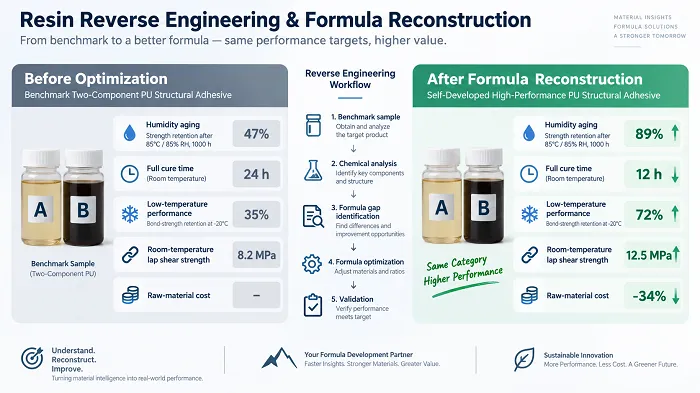
The development cycle was shortened by approximately four months.
Business Value of Resin Reverse Engineering
The main value of the project was not the ingredient table itself.
Before the analysis, the customer knew that its polyurethane adhesive underperformed, but did not know which formulation decisions were responsible.
Resin reverse engineering clarified four areas:
- the polyol system was too simple;
- the curing architecture lacked sufficient crosslinking flexibility;
- interfacial and cure-control additives were incomplete;
- filler surface treatment was inadequate.
This converted a broad performance problem into specific R&D actions.
For manufacturers, this type of formula reconstruction can support:
- competitor benchmarking;
- imported-product replacement;
- supplier localization;
- resin formulation development;
- performance troubleshooting;
- raw-material substitution;
- cost optimization.
Xinbodi’s polymers and plastics analysis services support similar projects involving resin identification, polymer characterization, additive analysis, material comparison, and resin deformulation.
When Is Resin Formula Reconstruction Useful?
A manufacturer may consider resin reverse engineering when:
- an imported resin or adhesive performs better than the internal formulation;
- repeated ratio adjustments fail to improve performance;
- supplier formulation information is incomplete;
- a resin must be localized or replaced;
- aging, curing, adhesion, or low-temperature performance is unstable;
- competitor formulation logic needs to be understood;
- formulation costs need to be reduced without sacrificing performance.
Reference-versus-customer sample comparison is especially valuable because it shows not only what is present, but what is different.
Technical Limits of Resin Reverse Engineering
Resin and adhesive formulations can contain trace catalysts, inhibitors, coupling agents, and proprietary additives at very low concentrations.
Components below approximately 0.2% may, depending on chemistry and analytical sensitivity, sometimes only be identified by chemical category or estimated range rather than accurately quantified.
Formula reconstruction also cannot completely reproduce every manufacturing variable.
Final adhesive performance may still depend on:
- raw-material grade;
- substrate surface treatment;
- mixing sequence;
- moisture content;
- application thickness;
- curing temperature;
- curing time;
- dispensing and assembly conditions.
For this reason, reconstructed composition data should be treated as an R&D basis and followed by laboratory and application validation.
Conclusion
This project began with a polyurethane adhesive that appeared acceptable in initial testing but failed to meet long-term durability, curing-speed, and low-temperature performance targets.
Resin reverse engineering and formula reconstruction showed that the problem was not simply an incorrect NCO/OH ratio.
The imported benchmark relied on a more complete formulation architecture combining:
- complementary polyol chemistries;
- a modified crosslinking system;
- surface-treated fillers;
- silane coupling;
- cure-control additives;
- antioxidant stabilization.
After these formulation gaps were identified and the customer rebuilt the system around locally available materials, humid-aging strength retention increased from 47% to 89%, full cure time decreased from 24 to 12 hours, and raw-material cost was reduced by approximately 34%.
For manufacturers trying to understand why a reference resin performs better, formula reconstruction turns an unknown formulation into actionable R&D information — not by blindly copying a recipe, but by identifying the chemical systems that actually drive performance.