
An NBR rubber compound can pass routine mechanical checks and still fail in demanding sealing applications.
A Southeast Asian automotive rubber manufacturer encountered this problem while developing an NBR compound for crankshaft oil seals. Compared with an imported benchmark, the self-developed material showed excessive compression set, greater hardness change after heat aging, and higher volume change after hot-oil exposure.
Repeated adjustments to sulfur and accelerator dosage did not solve the problem.
The customer therefore commissioned rubber compound testing and analysis to determine whether the performance gap came from the base elastomer, cure system, reinforcement, aging-protection package, or other formulation differences.
The investigation showed that the issue was not a single additive. Several parts of the compound formulation needed to be rebalanced.
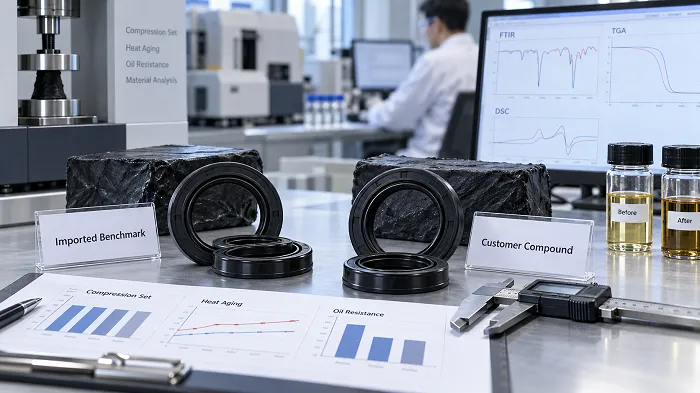
Project Challenge: Routine Properties Passed, but Sealing Performance Fell Short
The customer submitted two materials:
- an imported high-performance NBR compound used as the benchmark;
- the customer’s self-developed NBR compound.
The main performance gaps were clear.
| Performance Indicator | Imported Benchmark | Customer Compound |
|---|---|---|
| 120°C × 22 h compression set | ≤14% | 27% |
| 120°C × 70 h hardness change | +4 Shore A | +11 Shore A |
| 120°C oil immersion, 70 h volume change | +8.2% | +15.8% |
For an oil-seal material, these differences were commercially important.
Higher compression set meant poorer elastic recovery after prolonged compression. Greater hardness change indicated weaker thermal-aging stability, while excessive volume change after oil exposure suggested that the elastomer and formulation package were not sufficiently matched to the application.
The original R&D approach focused mainly on changing the cure-agent dosage. The laboratory investigation instead examined the complete rubber compound system.
Xinbodi provides rubber testing laboratory services for material characterization, performance comparison, failure investigation, and formulation-related troubleshooting.
Rubber Compound Testing and Analysis Strategy
A vulcanized rubber compound is a crosslinked system containing an elastomer matrix together with fillers, plasticizers, accelerators, antioxidants, activators, processing aids, and other additives.
No single instrument can reliably characterize all of these components.
The project therefore combined several analytical approaches:
- solvent extraction for low-molecular-weight components;
- Py-GC/MS and complementary chromatography for polymer and organic additive characterization;
- FTIR for chemical fingerprinting;
- TGA for carbon black and inorganic residue;
- ICP-OES for selected elemental components;
- comparative physical and aging tests.
The workflow followed a practical separation + identification + quantification + performance comparison approach.
For technical context, ISO 9924-2 describes thermogravimetric methods for determining compositional groups in vulcanized and unvulcanized rubber compounds, including applications to NBR materials. ASTM D6370 also addresses compositional analysis of rubber compounds using thermogravimetry.
The laboratory used the analytical data together rather than treating each test result independently.
What the Imported NBR Compound Contained
The benchmark formulation was reconstructed into several functional systems.
| Compound System | Key Component | Approx. Content | Function |
|---|---|---|---|
| Base elastomer | NBR, acrylonitrile content ~34% | 57.7 wt% | Oil resistance, elasticity and mechanical properties |
| Vulcanization agent | Sulfur | 0.4 wt% | Crosslinking |
| Accelerators | CBS + TMTD | 0.7 wt% | Cure-rate and network control |
| Activators | ZnO + stearic acid | 1.9 wt% | Cure activation |
| Reinforcing filler | N330 carbon black | 23.1 wt% | Reinforcement and mechanical stability |
| Plasticizer | DOP | 8.7 wt% | Flexibility and processing |
| Aging-protection system | IPPD + TMQ | 1.2 wt% | Heat and oxidative aging resistance |
| Processing components | Wax + zinc stearate | 0.5 wt% | Processing and surface protection |
| Extender filler | Light calcium carbonate | 5.8 wt% | Hardness and cost adjustment |
The important finding was not simply the ingredient list.
The imported material used a coordinated combination of:
NBR grade selection + low-sulfur cure system + reinforcing carbon black + plasticizer + dual aging protection.
These systems together explained why changing sulfur dosage alone could not reproduce the benchmark performance.
For broader projects involving elastomers, resins, fillers, and additives, Xinbodi’s chemical composition analysis services can be used to compare normal, failed, supplier, and benchmark samples.
What the Rubber Compound Comparison Revealed
Comparative analysis identified four formulation differences that were especially relevant to the performance gap.
Lower Acrylonitrile Content Reduced Oil Resistance
The imported benchmark used NBR with an acrylonitrile content of approximately 34%, while the customer material used a grade closer to 26%.
This was a fundamental material-selection difference.
Changing accelerators or sulfur cannot compensate fully for an elastomer whose polarity and oil-resistance characteristics are different from the target material.
The lower-acrylonitrile NBR was consistent with the higher volume change observed during hot-oil exposure.
The investigation therefore moved the discussion from:
“Which additive should we increase?”
to:
“Is the base elastomer grade appropriate for the application?”
The Cure System Used a Different Crosslinking Strategy
The imported compound used a relatively low-sulfur semi-efficient vulcanization system with CBS and a smaller amount of TMTD.
The customer compound relied on a higher-sulfur curing approach.
The two systems can produce different crosslink structures and therefore different balances of elasticity, heat resistance, and compression behavior.
For oil-seal applications exposed to elevated temperatures, the type of cure network can matter as much as the nominal sulfur dosage.
The comparison helped explain why repeated adjustments to cure-agent quantity had produced only limited improvement.
The Aging-Protection Package Was Incomplete
The imported material contained a combination of:
- IPPD-type antidegradant;
- TMQ antioxidant.
The customer formulation relied primarily on a single TMQ-type antioxidant system.
This difference was consistent with the larger hardness increase after 120°C aging.
The issue was therefore not simply “antioxidant concentration.” The benchmark used complementary protective components rather than relying on one antioxidant chemistry.
Carbon Black and Plasticizer Selection Also Differed
The imported compound used N330 carbon black, while the customer material used N550.
The customer also used a different plasticizer system.
Carbon black grade affects reinforcement, structure, processing behavior, and mechanical response. Plasticizer chemistry can influence flexibility, migration, extraction, and compatibility with both the elastomer and service fluid.
These differences provided additional evidence that the performance problem came from the overall compound architecture, not a single defective raw material.
From Rubber Composition Analysis to Formulation Optimization
Before testing, the customer mainly adjusted:
- sulfur content;
- accelerator dosage.
After the compound comparison, the optimization strategy expanded to include:
- selection of a more suitable NBR grade;
- redesign of the cure system;
- restoration of a complementary aging-protection package;
- adjustment of carbon black reinforcement;
- optimization of plasticizer selection and balance.
The benchmark formula was not copied directly.
Instead, the analytical results were used to understand which formulation variables were most likely to control heat aging, oil resistance, compression recovery, and long-term sealing performance.
This is where rubber compound analysis provides more value than a simple pass/fail test.
A conventional test tells the manufacturer:
The material does not meet the target.
Composition and formulation analysis helps answer:
Why is it different, and what should R&D investigate next?
Performance Validation After Compound Optimization
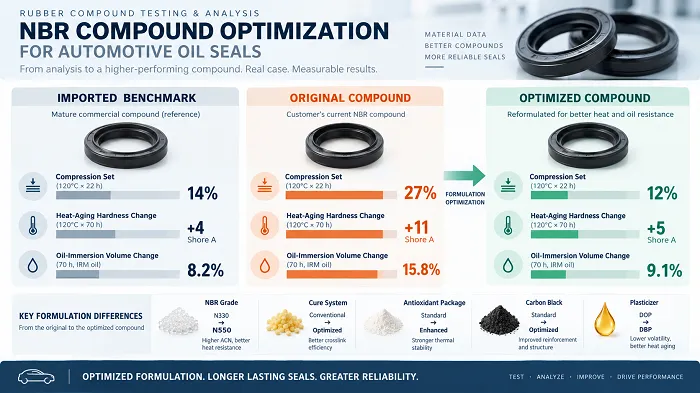
The customer adjusted the compound according to the identified formulation logic and then performed application-oriented validation.
| Performance Indicator | Original Compound | Optimized Compound | Imported Benchmark |
|---|---|---|---|
| 120°C × 22 h compression set | 27% | 12% | ≤14% |
| 120°C × 70 h hardness change | +11 Shore A | +5 Shore A | +4 Shore A |
| 120°C oil immersion, 70 h volume change | +15.8% | 9.1% | +8.2% |
The optimized material approached the imported benchmark in the key validation items.
Compression set decreased from 27% to 12%, heat-aging hardness change improved substantially, and hot-oil volume change fell from 15.8% to 9.1%.
The resulting compound met the customer’s automotive oil-seal performance requirements.
Raw-material cost was also approximately 30% lower than directly purchasing the imported compound.
What This Rubber Compound Analysis Changed for R&D
The customer originally treated the problem primarily as a vulcanization issue.
The laboratory evidence showed that the performance gap involved several formulation layers:
- base NBR grade;
- cure architecture;
- aging-protection system;
- carbon black selection;
- plasticizer balance.
This changed the R&D process from repeated single-variable adjustments to a more systematic formulation strategy.
The customer identified four main formulation gaps, shortened the subsequent development cycle by approximately four months, and developed a localized compound that approached the benchmark in the key performance tests.
For manufacturers working with plastics, elastomers, resins, and related materials, Xinbodi’s polymer and rubber materials analysis can support supplier comparison, formulation development, material identification, and performance troubleshooting.
When Manufacturers Need Rubber Compound Testing and Analysis
Rubber compound testing and analysis can be useful when:
- two supplier compounds carry similar specifications but perform differently;
- compression set is higher than expected;
- rubber hardens or becomes brittle after thermal aging;
- seals swell excessively in oil or other fluids;
- curing behavior becomes unstable;
- a competitor or imported compound performs better;
- the formulation of an unknown rubber compound needs to be characterized;
- repeated formulation adjustments fail to solve the problem.
For troubleshooting projects, submitting both a problem sample and a known-good reference generally provides stronger evidence than testing the abnormal sample alone.
If the issue involves cracking, premature aging, contamination, swelling, or another field failure, material failure analysis may also be combined with compound characterization.
Technical Limits of Rubber Compound Analysis
Crosslinked rubber is a complex material, and complete formula reconstruction is not always possible.
Some trace accelerators, antioxidants, or processing aids may only be identified by chemical category or estimated range. Component quantification may also depend on suitable reference standards and separation methods.
Laboratory composition data do not reproduce all manufacturing variables. Final rubber properties can also depend on:
- mixing sequence;
- dispersion quality;
- cure temperature and time;
- molding conditions;
- raw-material grade;
- storage history.
For this reason, compound analysis should be used as an R&D and troubleshooting tool and followed by appropriate processing and performance validation.
Rubber Compound Testing and Analysis at Xinbodi Lab
Xinbodi Lab provides rubber compound testing and analysis for manufacturers, material suppliers, R&D teams, and quality departments that need to understand rubber composition, compare compounds, investigate performance differences, or support formulation development.
Depending on the material and project objective, our laboratory can combine chemical composition analysis, polymer identification, thermal analysis, additive characterization, filler and carbon-black analysis, elemental analysis, and comparative performance testing.
Typical projects include:
- NBR, EPDM, SBR, natural rubber, silicone rubber, and other elastomer compounds;
- polymer and elastomer identification;
- filler, carbon black, plasticizer, and additive analysis;
- cure-system and formulation comparison;
- supplier or batch comparison;
- heat-aging and oil-resistance troubleshooting;
- rubber failure investigation;
- competitor benchmarking and formulation development.
For broader testing requirements, see our rubber testing laboratory services. For projects focused on identifying compound ingredients and formulation differences, Xinbodi also provides chemical composition analysis and polymer and rubber materials analysis.
The purpose of the analysis is not simply to produce a list of detected substances. The laboratory results are interpreted together with the customer’s performance data and reference samples to determine which material or formulation differences are most likely to explain the observed behavior and what R&D should investigate next.