
Polyurethane formulation analysis helps manufacturers understand the chemical structure and component system of an unknown or finished polyurethane material.
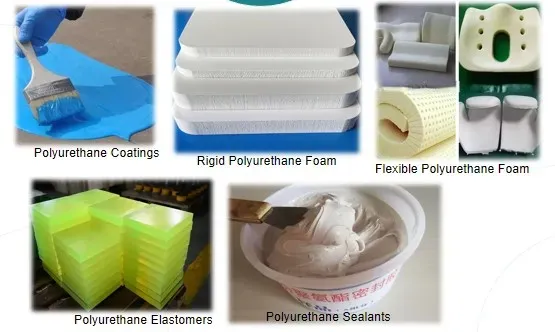
A polyurethane product may contain an isocyanate-derived component, one or more polyols, catalysts, chain extenders, crosslinkers, plasticizers, fillers and functional additives. Once the material has reacted or cured, these ingredients may no longer be directly separable or identifiable as their original raw materials.
This creates a practical problem for manufacturers: identifying a sample as polyurethane is relatively straightforward, but determining which polyurethane chemistry was used and how the formulation was constructed requires deeper analysis.
At Xinbodi Laboratories, polymer and resin composition analysis can be combined with structural characterization and deformulation to investigate unknown polyurethane systems, compare formulations and support raw-material selection or product development.
This article explains how polyurethane formulations are analyzed and presents an MDI/PPG-based analytical example drawn from Xinbodi’s technical training materials.
Polyurethane Formulation Analysis: Identifying Polyols, Isocyanates & Additives
Polyurethane formulation analysis helps manufacturers identify the chemical components, polymer structure and formulation characteristics of an unknown polyurethane material.
Unlike simple chemical mixtures, polyurethane products are formed through reactions between isocyanates, polyols and other functional ingredients. Once the reaction is complete, the original raw materials may no longer be directly separable from the finished polymer.
A product labeled “polyurethane” may contain different isocyanate structures, polyol systems, molecular-weight distributions, catalysts, chain extenders, plasticizers, fillers and stabilizers. These differences can influence curing behavior, flexibility, adhesion, hardness and long-term durability.
For manufacturers developing a replacement material, comparing suppliers or investigating an unknown product, basic polymer identification is therefore not enough.
Polyurethane formulation analysis combines chemical identification, structural characterization and quantitative or semi-quantitative testing to understand how the material was formulated.
At Xinbodi Laboratories, chemical composition analysis and deformulation services help manufacturers investigate polyurethane systems and translate analytical results into practical formulation information.
This article explains the analytical methods used in polyurethane deformulation and presents an MDI/PPG polyurethane analysis example showing how multiple techniques contribute to formulation interpretation.
What Is Polyurethane Formulation Analysis?
Polyurethane formulation analysis is the process of investigating the chemical building blocks, functional additives and structural characteristics of a polyurethane material.
Its purpose is to answer questions that cannot be resolved through routine material identification alone.
For example:
- Which isocyanate system was used?
- Is the polyurethane based on polyether or polyester polyols?
- What is the approximate relationship between the main components?
- What molecular-weight characteristics are present?
- Are catalysts or other functional additives detectable?
- Does the sample contain residual reactive isocyanate groups?
- What information can support the development of a comparable formulation?
The required analytical depth depends on the material and the manufacturer’s objective.
A liquid polyurethane prepolymer may retain measurable reactive groups and extractable components. A fully cured polyurethane elastomer, coating or adhesive presents a different challenge because its components are incorporated into a polymer network.
Consequently, the laboratory must select a method combination appropriate to the sample rather than apply the same test package to every polyurethane product.
What Components Can Be Identified in a Polyurethane Formulation?
Polyurethane formulations are built around an isocyanate and polyol system, with additional ingredients selected according to processing and final application requirements.
A review published in Polymer, A comprehensive review of polyurethane: Properties, applications and future perspectives, examines the structural characteristics and properties of polyurethane foams, elastomers, coatings, adhesives and functional materials.
Isocyanates
Isocyanates provide reactive NCO groups that participate in polyurethane formation.
Common isocyanate systems include:
| Isocyanate | Abbreviation | Common Application Areas |
|---|---|---|
| Methylene diphenyl diisocyanate | MDI | Foams, elastomers, adhesives and rigid polyurethane systems |
| Toluene diisocyanate | TDI | Flexible foams and selected elastomer systems |
| Hexamethylene diisocyanate | HDI | Coatings and specialty polyurethane systems |
| Isophorone diisocyanate | IPDI | Coatings, adhesives and specialty resins |
| Hydrogenated MDI | H12MDI | Selected light-stable polyurethane systems |
Identifying the isocyanate family is an important first step in reconstructing the formulation.
However, the analysis may also need to distinguish different forms or mixtures of the same isocyanate family.
An MDI-based material, for example, may involve different MDI isomers, polymeric MDI or combinations of commercially available MDI raw materials.
These differences can affect the resulting polymer architecture and reaction behavior.
Polyols
Polyols form another major part of the polyurethane structure.
Two important categories are polyether polyols and polyester polyols.
| Polyol Type | Structural Characteristic | Relevant Material Properties |
|---|---|---|
| Polyether polyols | Ether linkages in the polymer backbone | Flexibility, low-temperature behavior and hydrolysis resistance |
| Polyester polyols | Ester linkages in the polymer backbone | Polarity, strength, adhesion and abrasion-related performance |
A polyurethane formulation may contain more than one polyol.
The molecular weight, functionality and structure of those polyols can be just as important as their chemical family.
For this reason, identifying a sample as a polyether polyurethane does not establish the complete polyol formulation.
Further investigation may be needed to determine whether the system contains polypropylene glycol (PPG), polytetramethylene ether glycol (PTMEG) or another polyol family.
Catalysts, Chain Extenders and Functional Additives
Polyurethane products may also contain components that control processing, reaction behavior and final properties.
| Component | Main Function |
|---|---|
| Amine or organometallic catalysts | Influence polyurethane reaction kinetics |
| Chain extenders | Increase chain length and modify polymer structure |
| Crosslinkers | Contribute to network formation |
| Plasticizers | Modify viscosity and flexibility |
| Antioxidants | Reduce oxidation-related degradation |
| Flame retardants | Modify fire-related performance |
| Silicone surfactants | Control foam cell formation and stability |
| Inorganic fillers | Modify selected properties, processing and cost |
Some additives remain extractable after polyurethane formation. Others are incorporated into the polymer structure or are present at concentrations that make identification difficult.
A reliable formulation report should therefore distinguish directly identified substances from components inferred through characteristic chemical fragments or supporting analytical evidence.
Why Polyurethane Reverse Engineering Requires Multiple Methods
The central challenge in polyurethane reverse engineering is that the finished product is not simply a physical mixture of its original ingredients.
During polymerization, isocyanate and hydroxyl groups react to form urethane linkages. Chain extenders and crosslinkers may become part of the polymer structure, while other components remain as residual or extractable substances.
A single FTIR spectrum may identify polyurethane chemistry but cannot normally determine every original raw material or its exact percentage.
Likewise, GC-MS may identify selected organic compounds without fully characterizing the polymer backbone.
The most useful analytical approach combines methods that provide complementary evidence about composition, structure, molecular weight and reactive-group content.
Research published in the Journal of the American Society for Mass Spectrometry demonstrates the use of pyrolysis GC-TOFMS to investigate structural features associated with polyurethane monomers.
The broader analytical challenges of isocyanate and polyol characterization are also discussed in the peer-reviewed review Mass Spectrometry of Polyurethanes.
Analytical Methods Used for Polyurethane Formulation Analysis
Different analytical techniques answer different questions about the polyurethane system.
| Analytical Method | Main Analytical Purpose |
|---|---|
| FTIR | Identify polyurethane chemistry and characteristic functional groups |
| GC-MS | Investigate selected organic components, residual substances and additives |
| Py-GC/MS | Investigate polymer building blocks through characteristic pyrolysis products |
| NMR | Characterize molecular structure and support component-ratio interpretation |
| GPC | Determine molecular-weight characteristics of suitable soluble polymer fractions |
| MALDI-TOF | Provide complementary molecular-species and oligomer information |
| NCO content determination | Measure reactive isocyanate content in suitable samples |
| ICP | Investigate selected elements associated with catalysts or inorganic components |
| TGA | Evaluate thermal mass loss and selected compositional characteristics |
FTIR: Identifying Polyurethane Chemistry
Fourier-transform infrared spectroscopy is frequently used as the initial screening method.
It can provide evidence of urethane bonds, ether or ester structures and residual isocyanate groups.
Characteristic regions may include:
| Approximate Region | Structural Information |
|---|---|
| 2260–2270 cm⁻¹ | NCO stretching |
| Around 1535 cm⁻¹ | Urethane-related absorption |
| Around 1100 cm⁻¹ | Ether-related absorption in suitable polyether systems |
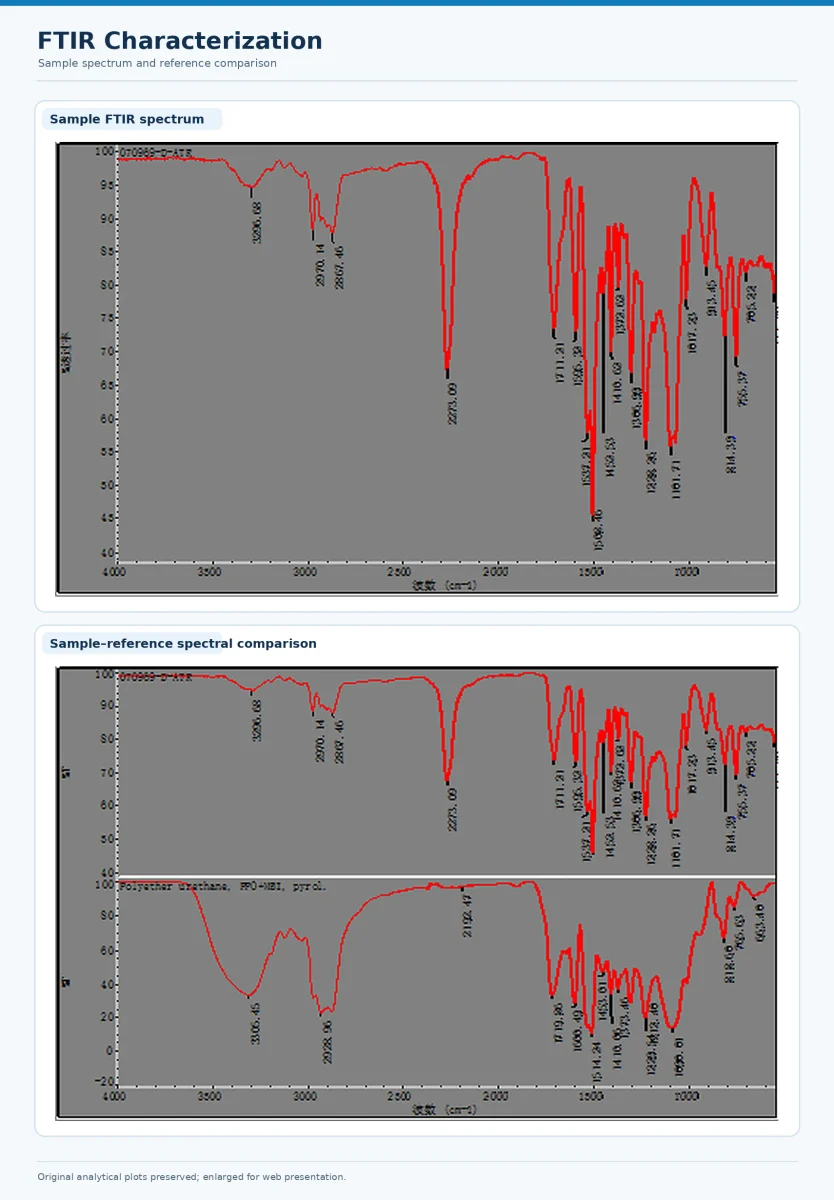
These assignments must be interpreted with the complete spectrum because different functional groups can produce overlapping absorption bands.
FTIR is especially useful for distinguishing a polyurethane from other polymer families and comparing an unknown sample with reference materials.
However, FTIR alone generally cannot reconstruct the complete formulation or provide reliable percentages for every ingredient.
GC-MS and Py-GC/MS: Investigating Organic Components
Gas chromatography–mass spectrometry can investigate selected extractable, volatile and semi-volatile substances.
Depending on the sample, these may include residual organic compounds, solvents, catalysts and certain additives.
Pyrolysis GC-MS is useful when the polyurethane structure itself must be investigated.
Controlled thermal decomposition generates characteristic products that can provide information about the polymer’s chemical building blocks.
This is particularly valuable for cured or poorly soluble polyurethane materials.
Research published in the Journal of Analytical and Applied Pyrolysis, Characterization of polyurethanes by high-resolution pyrolysis-capillary gas chromatography, demonstrated that characteristic pyrolysis products can provide information about the diisocyanate and polyol structures within polyurethane materials.
The study also showed that some liberated compounds may not be completely recovered because of secondary reactions during pyrolysis. This supports an important principle in polyurethane reverse engineering: pyrolysis results should be interpreted as structural evidence rather than a direct measurement of the original manufacturing recipe.
However, a pyrolysis product should not automatically be interpreted as an unchanged original raw material. Identification requires chemical interpretation and confirmation with complementary techniques where appropriate.
NMR: Understanding Molecular Structure and Component Relationships
Nuclear magnetic resonance spectroscopy can provide structural information that is difficult to establish from FTIR alone.
For suitable samples or separated fractions, NMR may help characterize:
- Isocyanate-derived structures
- Polyol-related structures
- Characteristic molecular environments
- Relative relationships between major components
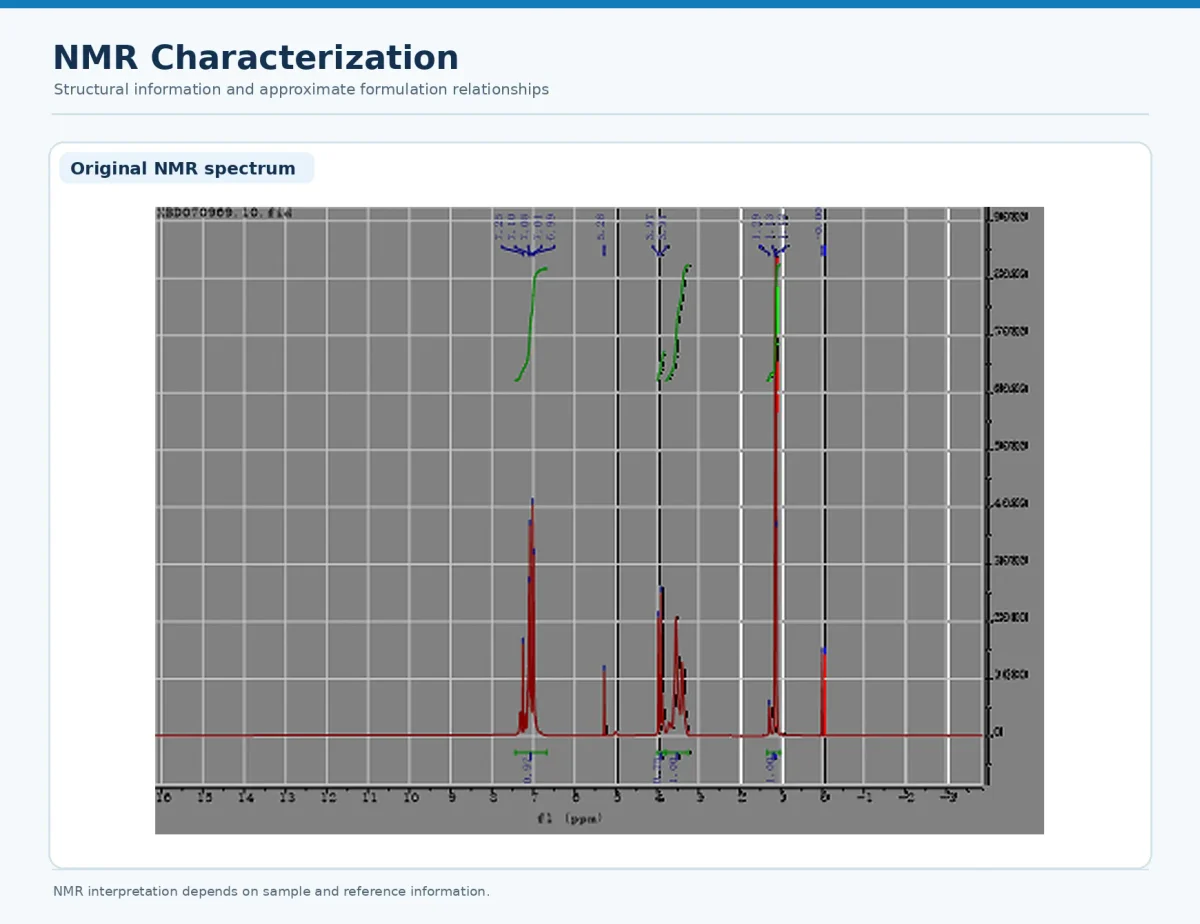
When the spectrum allows quantitative interpretation, NMR can also contribute to an approximate formulation model.
Its usefulness depends on sample solubility, spectral overlap and the availability of appropriate reference information.
GPC and MALDI-TOF: Molecular-Weight Characterization
Gel permeation chromatography evaluates the molecular-weight characteristics of suitable soluble polymer systems.
MALDI-TOF can provide complementary information about molecular species and oligomer distributions.
These methods can help distinguish formulations that contain similar chemical building blocks but differ in molecular-weight characteristics.
One important distinction must be maintained:
The measured molecular weight of a polyurethane prepolymer is not necessarily the molecular weight of the original polyol raw material.
The two values describe different aspects of the formulation and should not be used interchangeably.
Analytical Example: MDI/PPG Polyurethane Formulation Analysis
An MDI/PPG polyurethane sample was investigated to characterize its main chemical components, approximate formulation relationships and molecular-weight characteristics.
The analytical program combined FTIR, GC-MS, NMR, GPC, MALDI-TOF and supporting chemical measurements.
Rather than relying on one instrument to identify the entire formulation, the results were interpreted together to establish a consistent picture of the polyurethane system.
Step 1: Identification of Polyether Polyurethane
FTIR analysis identified characteristic polyurethane-related absorption and evidence consistent with a polyether-based system.
The spectrum also showed an NCO-related absorption region, indicating that reactive isocyanate chemistry remained relevant to the sample.
This established the broad polymer family and provided the direction for further investigation.
At this stage, the analysis could identify the material as a polyurethane system but could not determine the complete raw-material composition.
Step 2: Identification of the Isocyanate and Polyol System
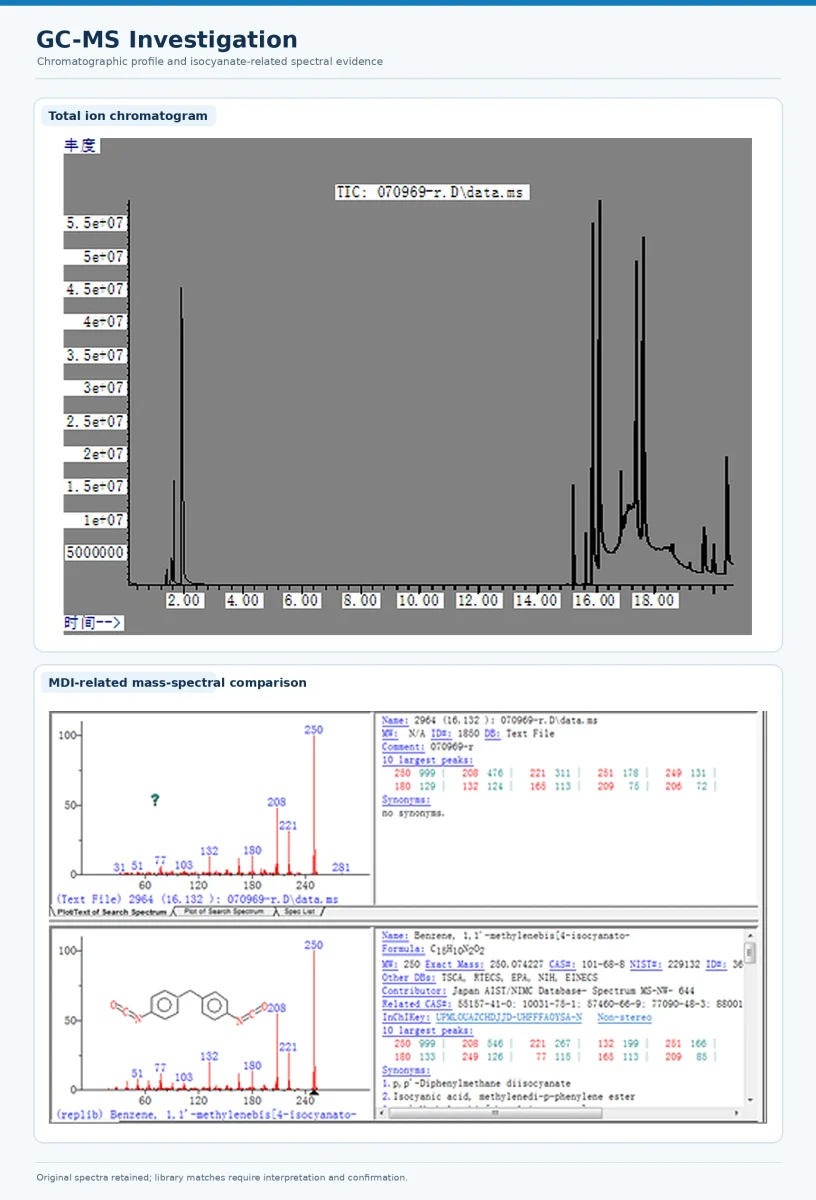
GC-MS and structural analysis provided evidence consistent with an MDI-based polyurethane.
Further analysis indicated a polypropylene glycol (PPG) polyol system.
NMR interpretation supported an approximate MDI-to-PPG formulation relationship of 6:4.
The isocyanate-related evidence also indicated a mixture consistent with MDI-50 and crude MDI, with an estimated relationship of approximately 6:4 between those components.
These findings provided a more specific formulation model than a general identification of “MDI-based polyurethane.”
Step 3: Molecular Weight and NCO Analysis
The investigation also included molecular-weight and reactive-group characterization.
Selected analytical findings are summarized below.
| Analytical Parameter | Finding |
|---|---|
| MDI-derived formulation portion | Approximately 61–62% |
| PPG-derived formulation portion | Approximately 38–39% |
| NCO content | 16.75% |
| Number-average molecular weight of the analyzed polymer system by GPC | Approximately 3,659 |
| Approximate PPG molecular weight considered for raw-material selection | 2,000 |
The MDI and PPG percentages represent approximate formulation estimates derived from the analytical interpretation, not independently verified original manufacturing charge weights.
The distinction between the two molecular-weight values is also important.
The GPC result characterizes the analyzed polymer system, whereas the approximately 2,000 molecular-weight PPG represents a possible raw-material characteristic inferred during formulation interpretation.
Step 4: Investigation of Minor Components
The analysis also identified evidence of minor catalyst-related components.
The formulation interpretation included a low-level organometallic catalyst component and a possible morpholine-related catalyst system.
For minor ingredients, the chemical family may be established more confidently than the exact commercial product or original dosage.
Further confirmation may require suitable reference standards or additional targeted analysis.
What the Combined Results Reveal
Each technique contributed a different part of the formulation picture.
| Evidence | Formulation Information |
|---|---|
| FTIR | Polyurethane and polyether-related chemistry |
| GC-MS | MDI-related and selected organic component evidence |
| NMR | Structural relationships and approximate component ratios |
| GPC | Polymer molecular-weight characteristics |
| MALDI-TOF | Complementary molecular-species information |
| NCO analysis | Reactive isocyanate content |
| Elemental analysis | Supporting information for selected minor components |
The combined evidence supported an MDI/PPG polyurethane formulation model and helped narrow the selection of possible raw materials.
This is the practical value of polyurethane deformulation: analytical results become a structured basis for formulation reconstruction rather than an isolated list of detected compounds.
From Chemical Analysis to Polyurethane Formula Reconstruction
Identifying the major ingredients is only the beginning of formulation reconstruction.
Manufacturers must also consider how the components interact and whether a proposed replacement formulation delivers the required processing and product performance.
For an MDI/PPG system, relevant variables may include:
- Isocyanate raw-material type and distribution
- Polyol molecular weight and functionality
- NCO/OH relationship
- Catalyst selection
- Chain-extender or crosslinker system
- Additive compatibility
- Reaction and curing conditions
A formulation reconstructed from analytical evidence should therefore be treated as a candidate for validation.
The analysis can help reduce uncertainty in raw-material selection, but it cannot independently prove that a new formulation will reproduce every property of the original product.
For manufacturers seeking broader chemical deformulation and reverse engineering, the analytical results can support subsequent laboratory formulation trials and performance comparison.
Polyurethane Analysis for Different Materials and Products
The analytical strategy changes according to the type and condition of the polyurethane sample.
| Polyurethane Material | Typical Analysis Objectives |
|---|---|
| PU prepolymer | Isocyanate chemistry, polyol system, NCO content and molecular weight |
| PU foam | Main building blocks, surfactants, blowing-agent-related chemistry and additives |
| PU adhesive | Resin system, reactive components, catalysts, fillers and formulation differences |
| PU sealant | Polyol/isocyanate system, plasticizers, fillers and curing-related chemistry |
| PU coating | Binder chemistry, curing components, solvents, pigments and stabilizers |
| PU elastomer | Polymer structure, chain extenders, fillers and material differences |
A liquid prepolymer may allow investigation of residual reactive groups and extractable components.
A fully cured coating, adhesive or elastomer may require additional separation, pyrolysis or structural characterization.
Manufacturers should therefore provide the sample condition and technical objective before selecting the analytical methods.
For related material systems, explore Xinbodi’s polymer and plastic material analysis and resin testing and analysis services.
When Do Manufacturers Need Polyurethane Formulation Analysis?
Competitor Product Benchmarking
Two polyurethane products may share the same broad chemical identity but use different raw-material systems.
Formulation analysis can help identify differences in isocyanate chemistry, polyol type, molecular-weight characteristics and selected additives.
These findings provide a technical basis for evaluating possible development directions.
Supplier and Batch Comparison
Changes in a polyurethane product may be related to differences in raw materials, reactive-group content or molecular structure.
Comparing a qualified reference with a new or abnormal sample can help identify chemical differences relevant to further investigation.
Raw-Material Replacement
When an existing isocyanate, polyol or additive becomes difficult to source, formulation analysis can support the evaluation of alternative materials.
The objective is to identify the chemical characteristics that should be considered before selecting replacement candidates.
Product Failure Investigation
Unexpected brittleness, adhesion loss or premature degradation may involve changes in polymer chemistry, formulation, processing or service conditions.
The review Degradation and stabilization of polyurethane elastomers, published in Progress in Polymer Science, examines how polyurethane structure, chemical composition and stabilizer systems influence degradation under thermal, oxidative, hydrolytic and environmental exposure.
For manufacturers, this highlights the importance of combining chemical characterization with materials testing and failure analysis when investigating unexpected changes in polyurethane performance.
What Are the Limits of Polyurethane Reverse Engineering?
Polyurethane formulation analysis can reveal substantial structural and compositional information, but it does not always recover the exact original manufacturing recipe.
Important limitations include:
- Fully reacted ingredients may no longer exist as separate compounds.
- Trace catalysts and additives may require targeted analysis.
- Commercial raw-material grades may have similar chemical signatures.
- Original charging order and reaction conditions cannot always be reconstructed.
- Analytical component estimates may differ from original manufacturing proportions.
- A structurally similar formulation may still require performance optimization.
These limitations are particularly important for crosslinked, aged or chemically complex polyurethane products.
The most useful deliverable is a formulation interpretation that clearly distinguishes confirmed findings, approximate estimates and proposed next steps.
Polyurethane Formulation Analysis at Xinbodi Lab
Xinbodi Laboratories provides polyurethane formulation analysis, chemical composition analysis and deformulation support for manufacturers, material suppliers and R&D teams.
Depending on the sample and project objective, analytical work may include:
- Polyurethane identification
- Isocyanate and polyol characterization
- Molecular-weight analysis
- Reactive-group investigation
- Additive and catalyst analysis
- Formulation comparison
- Supplier and batch verification
- Reverse engineering and raw-material selection support
Our approach combines complementary analytical techniques to investigate both the chemical composition and structural characteristics of complex polyurethane systems.
For formulation-focused projects, the objective is to help manufacturers understand what the material contains, how its components relate to one another and which formulation variables may require further investigation.
Need to identify or reconstruct an unknown polyurethane formulation?
Send Xinbodi Laboratories your sample type, available reference material and technical objective. Our team can review the project and recommend an appropriate analysis approach.