
An oil seal manufacturer contacted Xinbodi Lab after white powder began appearing on the surface of newly produced NBR oil seals after vulcanization. The deposits affected product appearance and raised concerns about whether the material came from external contamination, incomplete curing, or migration of ingredients from the rubber compound.
Xinbodi Lab analyzed the surface deposits and compared the findings with the rubber formulation and production conditions. The investigation ultimately pointed to a zinc-containing surface bloom associated with the vulcanization system and processing conditions.
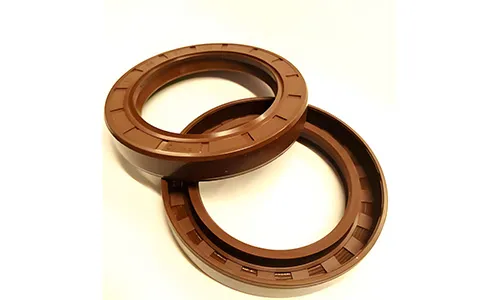
The White Deposits on the NBR Oil Seals Were Zinc-Containing Surface Bloom
The first question was whether the white material was an external contaminant or originated from the rubber compound itself.
SEM-EDS analysis of the deposits showed that zinc, sulfur and oxygen were the dominant detected elements. This immediately shifted the investigation away from ordinary environmental contamination and toward zinc-containing components associated with the NBR formulation and cure system.
SEM-EDS is particularly useful in this type of investigation because it combines particle morphology with localized elemental information. The analytical principles and limitations of quantitative EDS are described in ASTM E1508 – Standard Guide for Quantitative Analysis by Energy-Dispersive Spectroscopy.
Similar investigations involving unknown residues, particles and deposits can be supported through Xinbodi’s impurities and contamination analysis.
XRD Identified Zinc Sulfide and Zinc Oxide in the Surface Deposits
Elemental analysis showed which elements were present, but it could not by itself determine the chemical phases responsible for the deposits.
X-ray diffraction was therefore used to characterize the crystalline material. The results indicated that the white deposits contained a mixture of zinc sulfide (ZnS) and zinc oxide (ZnO).
This was an important distinction. The finding suggested that the surface material was related to zinc-containing components of the vulcanization system rather than simply being an unidentified powder deposited after production.
Comparative TGA results also showed that the high-temperature residue associated with the abnormal material increased with the amount of zinc oxide used in the formulation, providing additional evidence linking the surface deposit to the zinc-containing cure system.
Excess Zinc Oxide and Cure Conditions Were the Main Suspected Contributors to the Blooming
The analytical results were then reviewed together with the customer’s formulation and manufacturing conditions.
The investigation indicated two likely contributors:
- relatively high or non-uniformly dispersed zinc oxide in the rubber compound;
- processing conditions that promoted migration or precipitation of zinc-containing species at the surface.
Discussion with the customer also identified high vulcanization temperature and insufficient venting during molding as process factors that could have intensified the surface-deposit problem.
ZnO is not simply a filler in sulfur-cured rubber. It participates with fatty acids and accelerators in the chemistry of the vulcanization system. Modern research continues to describe the formation of zinc-containing accelerator complexes as an important part of sulfur vulcanization chemistry. Nature Communications: From waste rubber to value polybutadiene modification for circular materials Nature
For this reason, the root cause was treated as a formulation-and-process interaction, rather than attributing the defect to ZnO concentration alone.
This type of investigation is representative of Xinbodi’s material failure analysis services, where analytical evidence is combined with formulation and production information to identify the most likely failure mechanism.
Reducing ZnO and Adjusting Vulcanization Controlled the Surface Deposits
Based on the investigation, the customer evaluated several corrective actions rather than simply cleaning the finished oil seals.
The optimization included:
- reducing the zinc oxide level;
- evaluating a surface-treated nano-ZnO alternative;
- improving dispersion of the zinc-containing activator system;
- adopting a two-stage vulcanization process;
- increasing venting during molding;
- adjusting the stearic-acid-containing activation system.
The objective was to maintain the required cure response while reducing the conditions that favored zinc-containing material accumulating at the surface.
For rubber products, formulation changes of this type should be considered together with cure behavior and final material performance. Xinbodi’s polymer testing and analysis services support similar projects involving elastomer formulations, additives, surface defects and material-performance relationships.
The Modified NBR Oil Seals No Longer Showed the Original Zinc-Salt Deposition Problem
After the formulation and vulcanization process were adjusted, the oil seals met the customer’s surface-cleanliness requirement and the original zinc-containing deposit problem was eliminated under the evaluated production conditions.
The customer also reported a substantial improvement in the qualification rate for sealing performance.
The key value of the investigation was that the white powder was not treated simply as a cosmetic defect. By connecting surface composition, crystalline phase identification, formulation information and vulcanization conditions, the customer was able to address the source of the problem rather than repeatedly removing deposits from finished parts.
Project Summary
| Project Item | Finding |
|---|---|
| Product | NBR oil seal |
| Problem | White surface deposits after vulcanization |
| SEM-EDS finding | Deposits rich in Zn, S and O |
| XRD finding | ZnS and ZnO mixture |
| Supporting analysis | Comparative TGA |
| Likely contributors | Zinc-containing cure system, dispersion and vulcanization conditions |
| Corrective direction | Lower ZnO, improve dispersion, adjust cure and venting |
| Result | Surface cleanliness met requirement and sealing qualification improved |