
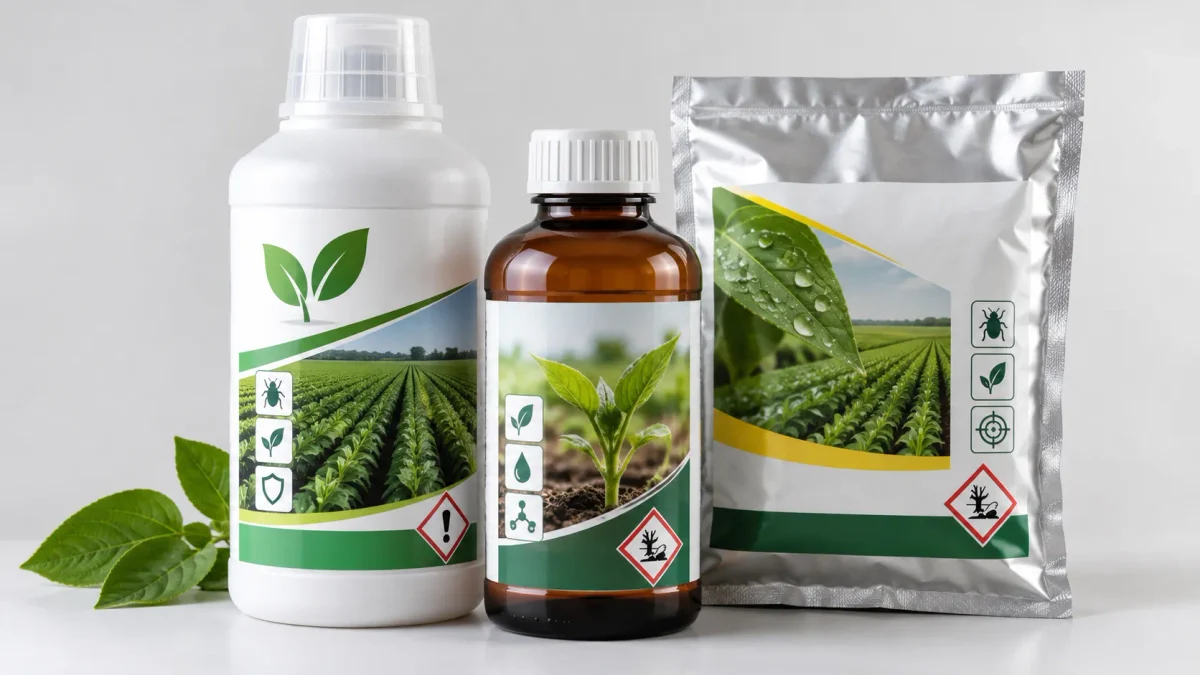
A pesticide product is more than its active ingredient.
Commercial formulations may also contain solvents, dispersants, emulsifiers, wetting agents, stabilizers, carriers, preservatives, antifoaming agents, inorganic materials, and other formulation aids. These components influence whether the active ingredient can be stored, dispersed, diluted, and applied consistently.
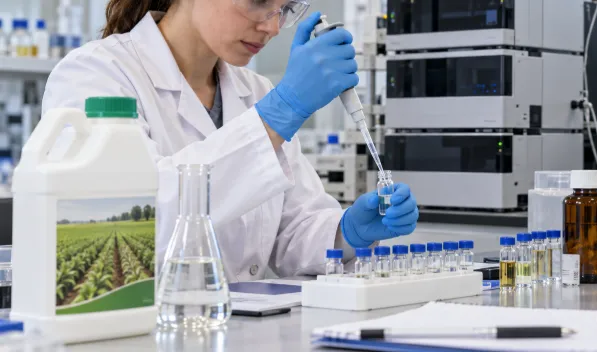
This is why pesticide formulation analysis goes beyond confirming that a pesticide molecule is present. Depending on the analytical objective, a laboratory may need to determine active ingredient concentration, compare formulation additives, investigate impurities, identify unknown components, or explain why one batch performs differently from another.
Xinbodi supports this work through its broader agrochemical and pesticide analysis services for pesticide manufacturers, formulators, suppliers, and R&D teams.
What Is Pesticide Formulation Analysis?
Pesticide formulation analysis is the chemical and physical characterization of a formulated pesticide product.
For a product with a known label claim, one of the most common objectives is to verify whether the stated active ingredient is present at the expected concentration. However, formulation analysis may also investigate:
- formulation aids and carriers;
- known and unknown impurities;
- degradation products;
- differences between batches or suppliers;
- precipitation, separation, or poor dispersibility; and
- formulation changes associated with abnormal performance.
Official pesticide quality-control laboratories commonly separate pesticide testing into chemical analysis of the active ingredient and physical tests appropriate to the formulation type. Government pesticide laboratories, for example, routinely use GC, HPLC, and other methods for active-ingredient determination alongside physical tests such as emulsion stability or sieve testing.
Pesticide Chemical Analysis vs Pesticide Residue Testing
These two types of pesticide analysis are often confused.
| Analysis | Sample being tested | Typical question |
|---|---|---|
| Pesticide formulation analysis | Commercial pesticide product | Does the formulation contain the expected ingredients and concentration? |
| Pesticide chemical analysis | Technical material or formulated product | What chemicals, active ingredients, impurities, or additives are present? |
| Pesticide residue analysis | Food, soil, water, crops, biological or environmental samples | How much pesticide residue remains in the matrix? |
This distinction matters because the analytical concentration range and sample preparation can be completely different.
A commercial suspension concentrate may contain active ingredients at percentage levels, whereas residue testing often measures trace pesticide concentrations in complex environmental or food matrices.
The Iowa Department of Agriculture similarly distinguishes pesticide formulation analysis and trace contamination analysis, while university pesticide laboratories often focus predominantly on residue analysis in crops, soils, or water.
For Xinbodi, the relevant focus is primarily formulated products, technical materials, formulation components, impurities, and comparative product analysis, rather than routine food-residue screening.
What Can Pesticide Analysis Determine?
The analytical scope depends on the pesticide type and the question being investigated.
| Analytical target | Information that may be obtained |
|---|---|
| Active ingredients | Identity and concentration of specified pesticide actives |
| Formulation aids | Surfactants, dispersants, emulsifiers, solvents, carriers and stabilizers |
| Impurities | Process-related impurities, degradation products or unexpected compounds |
| Inorganic components | Mineral carriers, salts, elemental components and selected fillers |
| Formulation comparison | Differences between suppliers, batches, benchmark products or reformulated samples |
| Product instability | Chemical differences associated with precipitation, phase separation, degradation or poor storage stability |
A complete formulation cannot always be reconstructed from one test. Complex pesticide products normally require sample separation followed by complementary analytical methods.
That is similar to other chemical composition analysis projects: the analytical method should be selected according to the chemical class and the information required, rather than applying the same instrument to every sample.
Pesticide Active Ingredient Analysis
Active ingredient determination is one of the strongest and most established applications of pesticide formulation testing.
HPLC is commonly used for non-volatile or thermally sensitive pesticide compounds, while GC may be suitable for volatile or sufficiently thermally stable analytes. The method must use appropriate reference standards, calibration, sample preparation, and quality-control procedures.
A 2025 study published in Microchemical Journal demonstrated an RP-HPLC method for simultaneous determination of seven active ingredients in commercial pesticide formulations, illustrating the continuing role of chromatographic quantification in pesticide quality control. Read the peer-reviewed Microchemical Journal study
For an analytical result to support a meaningful quality decision, identifying the pesticide molecule alone is not enough. The laboratory must also determine whether the quantitative method is appropriate for the formulation matrix.
Pesticide Formulation Testing by Product Type
Different pesticide formulations create different analytical challenges.
| Formulation type | Common analytical considerations |
|---|---|
| Suspension concentrate (SC) | Active ingredient content, particle dispersion, suspensibility, sedimentation and storage stability |
| Emulsifiable concentrate (EC) | Active ingredient, solvent system, emulsifier package and emulsion stability |
| Wettable powder (WP) | Active ingredient, carrier, particle characteristics, wettability and suspension behavior |
| Water-dispersible granule (WG) | Active ingredient, carrier/binder system, dispersibility and particle behavior |
| Soluble liquid (SL) | Active ingredient, solvent/carrier system, solution stability and impurities |
| Mixed formulations | Individual active ingredients, compatibility, relative concentrations and formulation stability |
The physical test should therefore match the formulation type. A suspension concentrate and an emulsifiable concentrate should not be evaluated using the same physical-quality criteria.
This is why pesticide formulation analysis should begin with the product type and project objective before the laboratory selects its testing program.
Pesticide Analysis Methods
No single instrument can characterize every component in an agrochemical formulation.
HPLC and LC-MS can support active-ingredient quantification and investigation of non-volatile compounds. GC-MS can provide information about volatile and semi-volatile substances such as solvents and selected additives. FTIR may help screen formulation materials and functional groups, while ICP-OES, ICP-MS, XRF, or ion chromatography can provide information on elemental or ionic components.
For unknown impurities or formulation differences, higher-resolution mass spectrometry or additional separation may be required.
Quality assurance is especially important when results may support a supplier dispute or regulatory decision. A Journal of AOAC International paper on pesticide product laboratories emphasizes official methods, analytical reference standards, replicate determinations, and confirmatory analysis for samples outside established acceptance criteria. Read the Journal of AOAC International paper on pesticide laboratory quality assurance
The important principle is therefore not “use as many instruments as possible,” but use complementary methods that answer the analytical question with defensible evidence.
Pesticide Quality Testing: A Real Formulation Analysis Case
A useful example involved a commercial suspension concentrate labeled as containing 10% pyraclostrobin and 10% tebuconazole.
An agricultural cooperative reported weaker-than-expected field performance. Routine observations such as appearance and pH did not identify an obvious cause, so a suspect batch was compared with a previously qualified reference product.
HPLC analysis produced the following results:
| Active ingredient | Label claim | Qualified reference | Suspect batch |
|---|---|---|---|
| Pyraclostrobin | 10.0% | 9.8% | 5.1% |
| Tebuconazole | 10.0% | 9.7% | 4.8% |
The analytical finding was clear: both declared active ingredients were present at substantially lower concentrations in the suspect sample than in the qualified reference.
Additional formulation analysis also indicated differences in the supporting additive system.
This case demonstrates why product appearance alone cannot establish pesticide quality. A formulation may appear normal while its chemical composition differs substantially from a qualified batch.
It is important, however, not to overinterpret the analytical result. Lower active ingredient content is a strong and technically plausible contributor to reduced field performance, but pesticide efficacy also depends on application rate, crop and pathogen conditions, spray coverage, environmental factors, and formulation behavior.
The laboratory result therefore establishes a significant formulation difference, not a complete field-efficacy model.
Pesticide Formulation Analysis for Quality Control
Comparative analysis is particularly useful when a manufacturer or buyer already has a qualified reference sample.
Instead of asking only:
Is this pesticide present?
the project can ask:
Is this batch chemically equivalent to the approved product?
Comparison may reveal changes in active ingredient concentration, solvent system, surfactants, impurities, inorganic materials, degradation markers, or formulation stability.
This can support supplier qualification, incoming quality control, batch investigation, formulation troubleshooting, and product development.
Xinbodi’s impurity analysis services can also be used when the key question is not the main active ingredient but an unexpected impurity, degradation product, or process-related by-product.
How to Interpret an Out-of-Specification Pesticide Result
A laboratory result that differs from a label claim or reference product should be interpreted carefully.
The first question is whether the method and reference standard are suitable for that formulation matrix. Sample homogeneity and preparation also matter, particularly for suspensions and heterogeneous formulations.
If a result is substantially outside expectations, confirmation may require replicate measurements, a second preparation, comparison with a reference batch, or an alternative analytical technique.
The classical literature on pesticide formulation quality assurance makes the same point: analytical results become most defensible when appropriate methods, standards, repeat measurements, and confirmatory approaches are used. Read the peer-reviewed Analyst paper on pesticide formulation quality assurance
For this reason, a third-party laboratory should distinguish between:
what has been directly measured,
what has been chemically identified, and
what is being inferred about the cause of the product problem.
That distinction is essential for technically sound pesticide analysis.
When Do You Need a Pesticide Analysis Laboratory?
Pesticide formulation analysis is most useful when the business question concerns the product itself rather than pesticide residues in crops or the environment.
Typical projects include verifying active ingredient concentration, investigating a supplier or batch change, comparing a competitor formulation, identifying formulation aids, studying impurities, investigating storage degradation, and determining why a pesticide formulation precipitates, separates, cakes, or performs differently from a reference product.
For broader formulation investigations, Xinbodi can combine agrochemical and pesticide analysis with targeted active-ingredient quantification, compositional analysis, impurity characterization, and comparative testing according to the project objective.
Conclusion
Pesticide formulation analysis is not simply pesticide identification.
A useful analysis may need to determine:
the identity and concentration of active ingredients, the supporting formulation system, impurities or degradation products, physical stability, and differences between batches or suppliers.
For quality-control investigations, the strongest analytical strategy usually combines targeted quantitative testing with broader formulation characterization and a qualified reference sample where available.
The real case described above illustrates the value of this approach. The suspect pesticide appeared normal during routine inspection, but chemical analysis showed that both declared active ingredients were present at roughly half the nominal concentration.
That is the central value of pesticide chemical and formulation analysis: turning an unexplained product-quality problem into measurable chemical evidence that can support a better technical decision.