
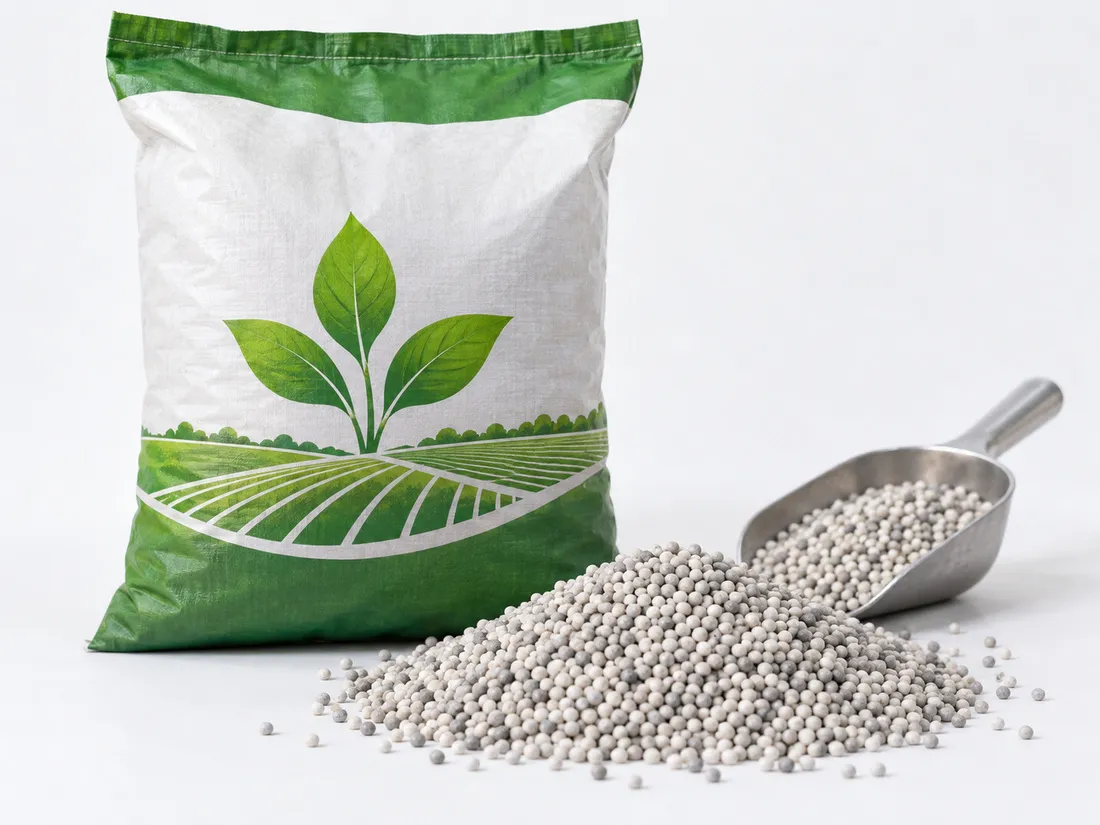
A compound fertilizer can have normal granule size, color, and physical appearance while containing substantially less nutrient than its label claims.
In this case, an agricultural distributor received a batch of potassium-sulfate-type compound fertilizer labeled 15-15-15, corresponding to declared nitrogen, phosphate and potash contents of approximately 15% each.
After field application, users reported weaker crop growth and leaf yellowing compared with previous seasons. These symptoms alone could not establish a fertilizer-quality problem because crop response can also be influenced by soil fertility, weather, water availability, disease, and application practice.
The suspect fertilizer was therefore compared with a previously qualified reference through fertilizer chemical analysis and NPK testing.
What Fertilizer Analysis Can Verify
For commercial compound fertilizers, one of the most important analytical questions is whether the product actually contains the nutrient levels stated on the label.
Typical fertilizer analysis can include:
- total nitrogen;
- available phosphorus expressed as P₂O₅;
- potassium expressed as K₂O;
- total declared nutrient content;
- secondary and trace elements;
- selected inorganic fillers;
- heavy metals or other regulated contaminants; and
- comparison between suppliers or production batches.
Xinbodi includes fertilizers and nutrient products within its broader agrochemical and pesticide analysis services, while projects focused on identifying and quantifying material components can also use chemical composition analysis.
For quality-control work, appearance should therefore be treated as only one part of incoming inspection. It cannot verify nutrient concentration.
NPK Testing Methods for Compound Fertilizer
The suspect and reference fertilizers were evaluated using standardized nutrient-analysis methods.
Total nitrogen was determined according to GB/T 8572-2010, which specifies determination of total nitrogen in compound fertilizers by titration after distillation.
Available phosphorus was evaluated using GB/T 8573-2017, the current national standard for available phosphorus determination in compound fertilizers.
Potassium determination was performed according to the applicable current compound-fertilizer method. GB/T 8574-2024 is the current national standard for potassium determination and has been effective since April 2025.
The overall product assessment was compared with the requirements of GB/T 15063-2020 for compound fertilizer.
XRF and FTIR were used only as supporting characterization tools to investigate inorganic elements and possible filler types. They were not substitutes for the standardized quantitative NPK methods.
Fertilizer Testing Case: 15-15-15 NPK Product
The label declared:
N–P₂O₅–K₂O = 15–15–15
with a nominal total nutrient content of approximately 45%.
The laboratory compared the suspect batch with a qualified reference supplied for the investigation.
| Nutrient | Label claim | Qualified reference | Suspect batch |
|---|---|---|---|
| Nitrogen, N | 15.0% | 14.7% | 9.6% |
| Available phosphate, P₂O₅ | 15.0% | 14.6% | 8.9% |
| Potash, K₂O | 15.0% | 14.8% | 9.2% |
| Total N + P₂O₅ + K₂O | 45.0% | 44.1% | 27.7% |
The qualified reference was close to the declared 15-15-15 formulation.
The suspect product was clearly different.
Its combined NPK content was only 27.7%, approximately 38% below the nominal 45% declared on the package.
More importantly, all three principal nutrients were substantially lower, showing that the problem was not a small analytical deviation affecting only one nutrient.
What the Fertilizer Analysis Revealed
The strongest conclusion from the analytical data was straightforward:
The suspect fertilizer did not have the same nutrient composition as the qualified reference or the declared 15-15-15 formulation.
Nitrogen, phosphorus, and potassium were all significantly reduced.
This type of broad nutrient reduction is consistent with a formulation containing a larger proportion of non-NPK material.
Supporting XRF and FTIR results indicated a high level of calcium- and magnesium-containing carbonate material. The analytical evidence was consistent with a dolomite-rich mineral filler or related carbonate material.
However, chemical analysis alone cannot establish the supplier’s intent.
It is therefore more scientifically accurate to say that:
The suspect product contained substantially more non-NPK mineral material, which diluted the nutrient fraction on a mass basis.
rather than claiming that the supplier deliberately added a cheap filler unless additional manufacturing or commercial evidence supports that conclusion.
Why Normal Appearance Did Not Reveal the Problem
Granulated compound fertilizer is particularly difficult to evaluate visually.
A mineral filler can have particle size, color, and density characteristics that allow it to blend into a fertilizer product without creating an obvious visual defect.
As a result, the suspect batch could still appear normal during routine inspection even though the chemical composition was significantly different.
This is why commercial fertilizer laboratories generally emphasize quantitative NPK analysis when verifying whether a supplied fertilizer matches its guaranteed analysis.
Can Low NPK Explain Poor Crop Performance?

The analytical result provides a technically plausible explanation for the field complaint, but it should not be interpreted too narrowly.
If farmers applied the suspect fertilizer at the same mass rate used for a true 15-15-15 product, they would have supplied substantially less nitrogen, phosphorus, and potassium than expected.
That difference could contribute to:
- reduced nitrogen availability and weaker vegetative growth;
- nutrient-related chlorosis;
- poorer root and reproductive development where phosphorus is limiting; and
- reduced potassium supply associated with stress tolerance and crop performance.
However, field symptoms alone cannot prove fertilizer failure, because crop growth is also affected by soil nutrient status, moisture, weather, pests, disease, application timing, and other agronomic factors.
The laboratory evidence establishes the composition difference. The agronomic consequence should be interpreted together with field conditions.
Fertilizer Analysis for Supplier Quality Control
This case illustrates why fertilizer testing is useful not only for regulatory inspection but also for routine supplier management.
A practical incoming-quality program can compare:
Declared formulation → Qualified reference → Incoming batch
instead of testing a suspect material only after farmers report a problem.
For NPK fertilizers, the most useful controls may include:
- periodic N-P₂O₅-K₂O verification;
- supplier-to-supplier comparison;
- batch-to-batch monitoring;
- secondary and micronutrient testing where relevant;
- screening of unexpected mineral components; and
- targeted contaminant testing when required.
The value of a reference sample is particularly important. It allows the laboratory to determine not simply whether a material contains nitrogen, phosphorus, and potassium, but whether the current batch is chemically consistent with the product previously approved for use.
Conclusion
This fertilizer analysis case demonstrates why visual inspection alone is insufficient for verifying compound-fertilizer quality.
The suspect 15-15-15 product appeared physically normal, but standardized NPK testing found only:
9.6% N, 8.9% P₂O₅, and 9.2% K₂O, giving a total nutrient content of 27.7%.
Supporting chemical characterization also indicated a substantially higher carbonate-mineral fraction than expected.
The key finding was therefore not simply that the fertilizer “looked different.” It was that quantitative chemical analysis demonstrated a major mismatch between the declared formulation and the actual nutrient composition.
For fertilizer manufacturers, distributors, and agricultural buyers, periodic NPK analysis provides an objective way to verify label claims, compare suppliers, and detect quality changes before they become large-scale field problems.