
Water treatment chemicals are rarely single-component products.
An antiscalant, corrosion inhibitor, flocculant, dispersant, membrane treatment chemical, or cooling-water additive may contain several active and supporting components that work together to control scale, deposition, corrosion, particle dispersion, or formulation stability.
For manufacturers and suppliers, the analytical question is therefore often more complex than:
“What is the active ingredient?”
A useful water treatment chemicals analysis may need to determine what components are present, estimate their concentrations, compare two formulations, identify why one product performs differently, or provide a chemical basis for reverse engineering and formulation development.
Xinbodi’s chemical analysis services support these types of product-focused investigations using analytical methods selected according to the formulation and the technical question.
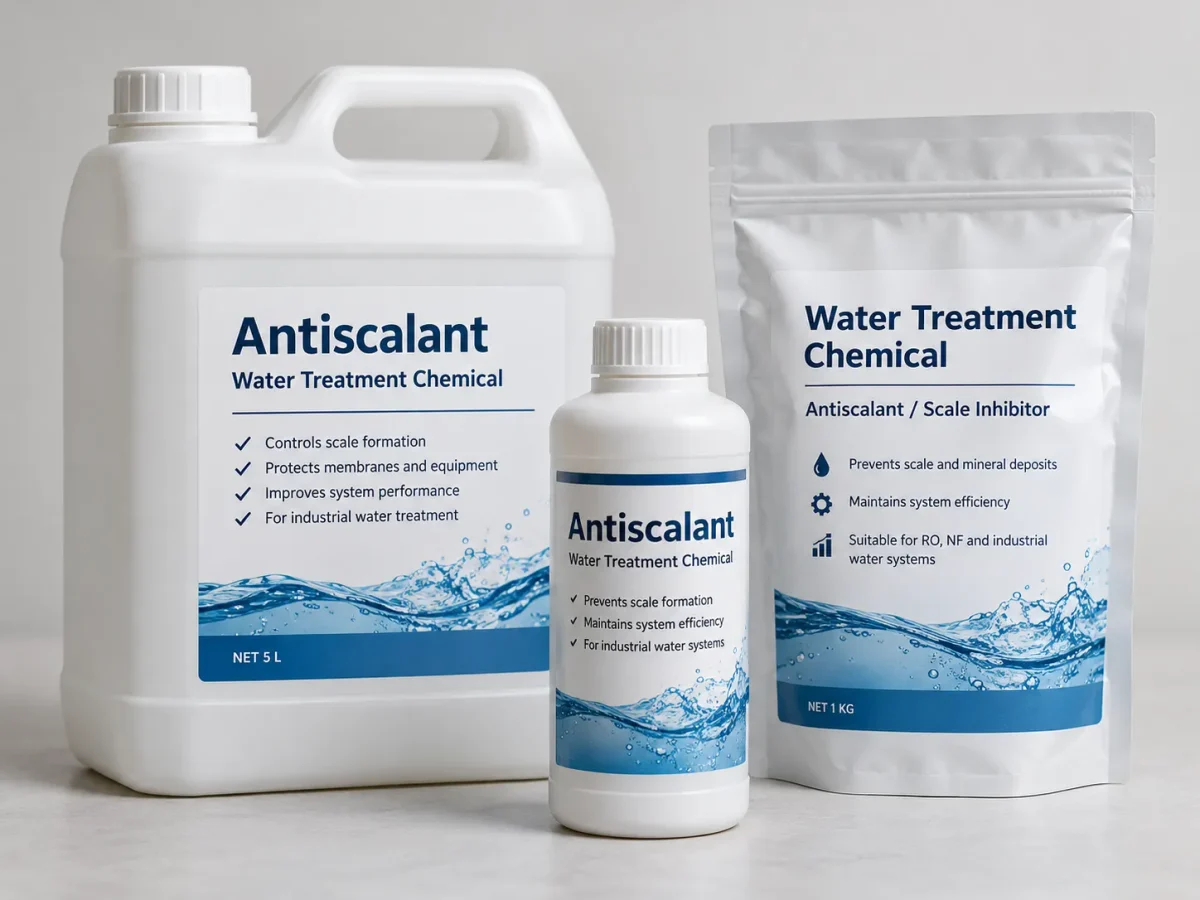
Water Treatment Chemicals Analysis: What Can Be Tested?
It is important to distinguish analysis of water treatment chemicals from conventional water-quality testing.
Water-quality testing asks questions such as:
What metals, ions, organics, or microorganisms are present in this water?
Water treatment chemical analysis instead asks:
What is in this treatment product, how much is present, and why does this formulation behave differently?
Typical projects can include:
| Product / Project | Typical analytical question |
|---|---|
| Antiscalants / scale inhibitors | Which phosphonates, polymers, salts, and supporting additives are present? |
| Corrosion inhibitors | What inhibitor chemistry and supporting components are used? |
| Flocculants and coagulant aids | What polymer or inorganic system is present? |
| Dispersants | What polymer family and formulation system are being used? |
| Membrane treatment chemicals | What active and supporting components differentiate two products? |
| Cooling-water treatment blends | Which inhibitor, dispersant, and inorganic systems are present? |
| Supplier comparison | Has the incoming formulation changed? |
| Competitor benchmarking | What formulation architecture may explain the performance difference? |
Projects focused primarily on ingredient identification and quantitative composition can be handled through chemical composition analysis, while more complete formulation reconstruction can progress into deformulation.
Water Treatment Formulation Analysis
A commercial water treatment product may contain a primary active component together with polymers, chelating agents, inorganic salts, pH-control materials, stabilizers, carriers, and other formulation aids.
That means identifying one major ingredient does not necessarily explain product performance.
For example, two antiscalants may both contain HEDP but still behave differently because of differences in:
- phosphonate concentration;
- polycarboxylate or other polymeric dispersants;
- auxiliary phosphorus-containing components;
- pH and neutralization state;
- inorganic ions;
- polymer molecular characteristics; and
- component ratios.
This is why water treatment formulation analysis normally requires complementary analytical methods rather than a single FTIR spectrum.
Peer-reviewed work in Journal of Chromatography A characterized 24 commercial phosphonate antiscalants and found that technical products could contain substantial amounts of phosphorus-containing impurities and related compounds in addition to the nominal phosphonate. Read the peer-reviewed characterization of commercial phosphonate antiscalants
For businesses comparing a benchmark product with their own formulation, this level of chemical detail can be much more useful than simply confirming the presence of the named active ingredient.
Water Treatment Chemicals Reverse Engineering
Water treatment chemicals reverse engineering goes beyond identifying components.
The objective is to reconstruct enough of the formulation architecture to answer practical development questions such as:
- Which ingredients are likely responsible for performance?
- Why does a benchmark product outperform the internal formulation?
- Has a supplier changed the product?
- Can an imported treatment chemical be replaced?
- Which formulation variables should be tested next?
- Is a performance problem caused by a missing component or an incorrect ratio?
Xinbodi’s deformulation and reverse engineering services use separation, identification, quantification, and comparative interpretation to support these decisions.
A useful reverse-engineering project should not be presented as an automatic “exact recipe copy.” Some trace ingredients, reactive components, proprietary raw-material grades, molecular-weight distributions, or manufacturing conditions may not be fully recoverable from the finished product.
The more defensible goal is to establish a chemically supported formulation profile that reduces trial-and-error during subsequent formulation work.
Scale Inhibitor and Antiscalant Analysis
Scale inhibitors are a particularly good example of why formulation-level analysis matters.
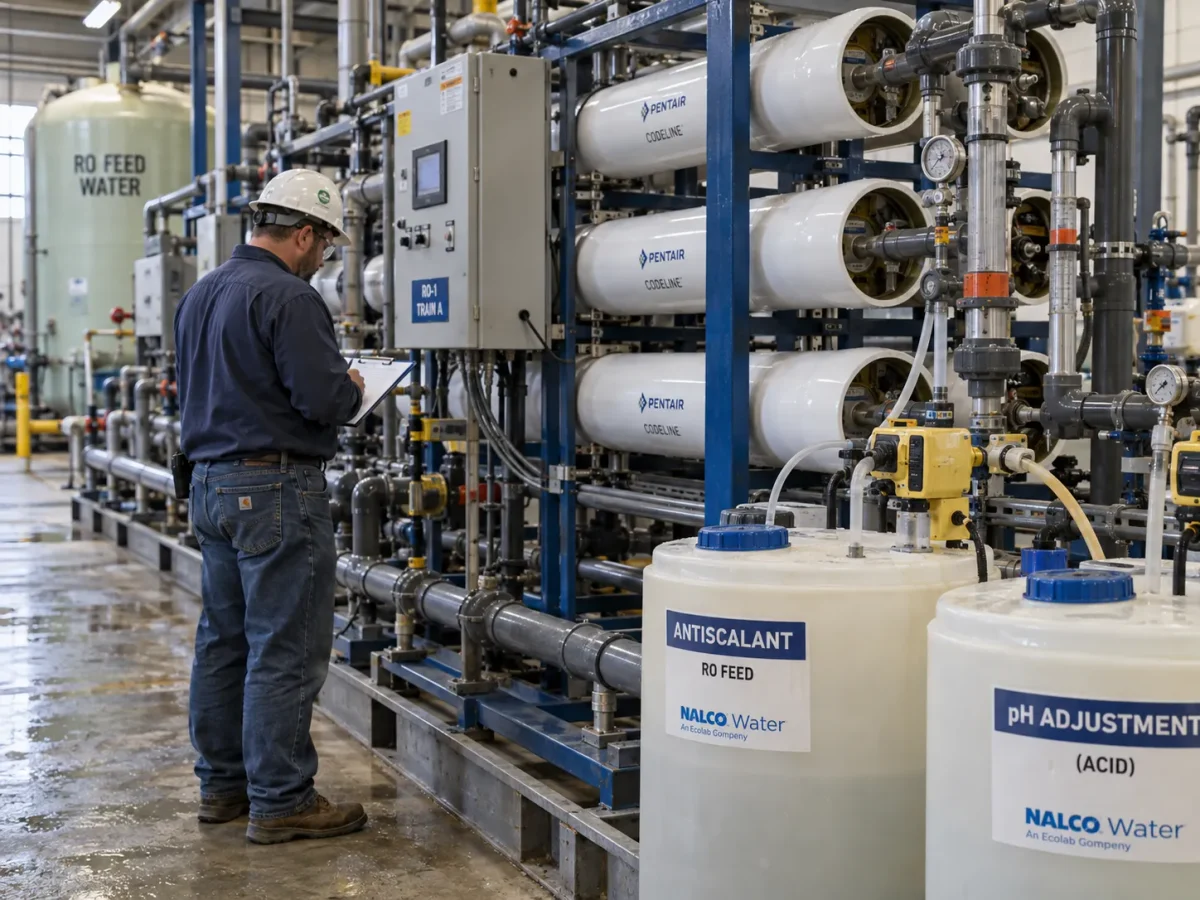
Common antiscalant chemistries include phosphonates and polymeric inhibitors or dispersants. Their performance may involve several mechanisms, including interaction with crystal nucleation and growth, modification of crystal morphology, and stabilization or dispersion of forming particles.
HEDP, for example, is a widely studied phosphonate antiscalant used in reverse-osmosis and other water-treatment applications. Research has also shown that different polycarboxylate structures can produce significantly different calcium-carbonate inhibition behavior, meaning that “polymer present” is not enough information by itself. See the peer-reviewed study on polycarboxylate scale inhibitors
For an antiscalant analysis, useful analytical questions may include:
- Is the expected phosphonate present?
- What is its approximate concentration?
- Is a polymeric dispersant or inhibitor present?
- Are additional phosphorus-containing components present?
- Are inorganic counterions or salts different?
- Has the formulation ratio changed between batches?
- Does the chemical difference correlate with scale-control performance?
This type of analysis is particularly useful when a product still contains the expected “main active” but does not perform like the reference material.
Analytical Methods for Water Treatment Chemicals
There is no universal instrument package for water-treatment formulations.
The analytical strategy should be selected according to the chemistry of the product.
| Analytical need | Possible techniques |
|---|---|
| Organic functional-group screening | FTIR |
| Anions and ionic species | Ion chromatography |
| Phosphorus-containing components | Spectrophotometric or elemental methods, depending on target |
| Organic actives and additives | HPLC, LC-MS, GC-MS where appropriate |
| Metals and inorganic components | ICP-OES, ICP-MS, AAS |
| Polymer / solids / volatile fraction | TGA and complementary characterization |
| Polymer molecular information | GPC where required |
| Comparative performance | Application-specific scale inhibition or compatibility testing |
No single method should be assumed to prove the complete formulation.
For example, total phosphorus can confirm the amount of phosphorus present, but it does not by itself distinguish HEDP from every other phosphorus-containing compound. Conversely, FTIR may support identification of a phosphonate or polymer family but usually cannot provide the entire quantitative recipe.
A reliable interpretation comes from combining orthogonal evidence.
Real Case: Reverse Osmosis Antiscalant Formulation Comparison
A recent project illustrates this point.
A high-purity water company was developing an alternative to a commercial reverse-osmosis antiscalant. The in-house product initially performed acceptably, but after operation the RO system showed increasing differential pressure and visible white mineral deposits on the membrane surface.
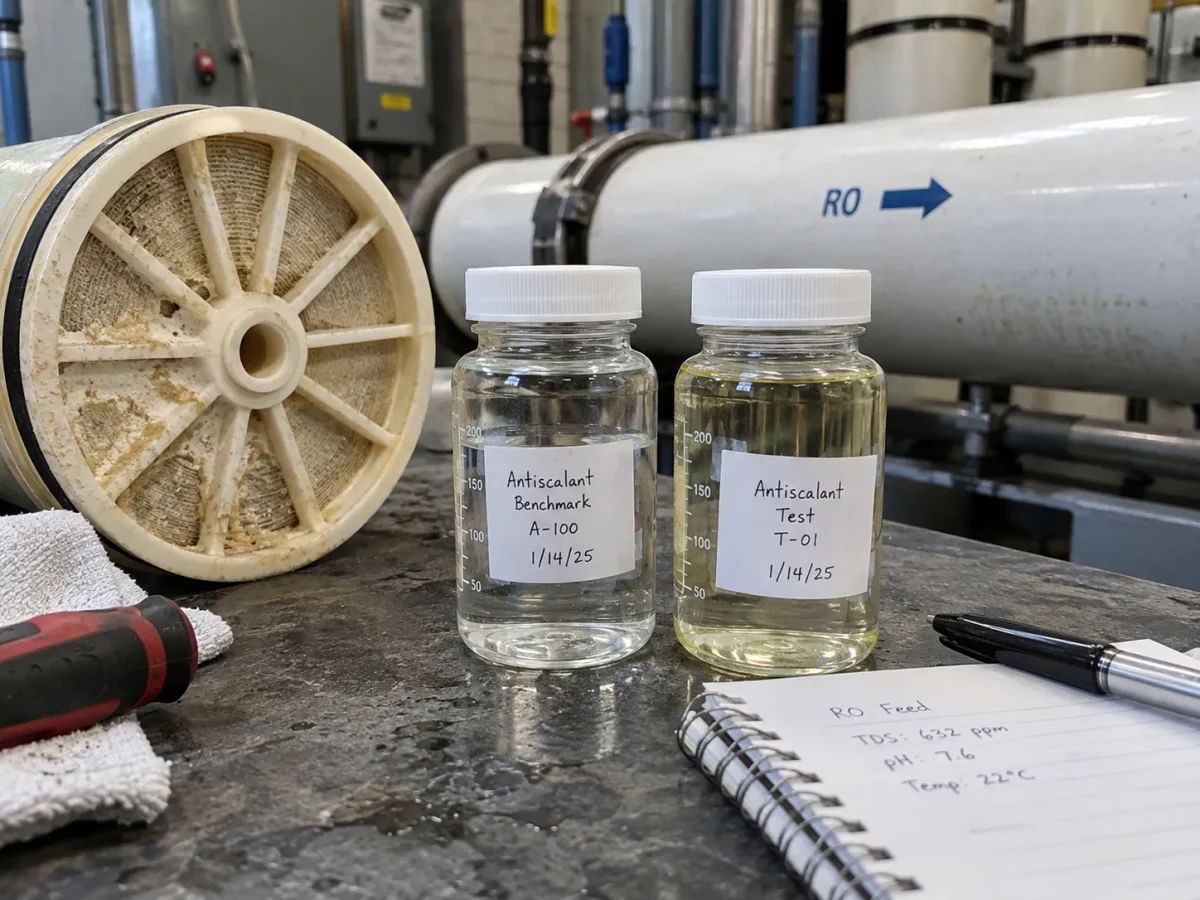
A benchmark product and the development sample were therefore compared through formulation analysis.
The reconstructed profiles were approximately:
| Component system | Benchmark | Development sample |
|---|---|---|
| HEDP | 12.5% | 11.8% |
| Polycarboxylate-type copolymer | 8.2% | 3.5% |
| Additional phosphorus-containing polymeric component | 4.1% | Not detected |
| pH-adjustment component | 2.3% | 2.0% |
| Water | 72.9% | 82.7% |
These values represent an analytically reconstructed formulation profile, rather than a claim that every manufacturing raw material was recovered exactly.
The important finding was not the relatively small difference in HEDP.
The development product contained much less of the polymeric supporting system, and one phosphorus-containing auxiliary component identified in the benchmark was not detected in the development sample.
This provided a stronger explanation for the performance difference than simply asking whether HEDP was present.
After the formulation was adjusted and the supporting inhibitor/dispersant system was rebalanced, subsequent validation showed improved scale-control performance and slower pressure increase in the RO application.
The project illustrates an important principle:
A water treatment chemical may contain the correct major active ingredient and still underperform because the supporting formulation architecture is incomplete or incorrectly balanced.
When to Use Water Treatment Chemical Testing
Water treatment chemical testing is particularly useful when there is a specific commercial or technical decision to make.
Common situations include:
Supplier qualification.
A new batch looks similar but performs differently from the approved product.
Competitor benchmarking.
A market-leading antiscalant, corrosion inhibitor, or treatment blend performs better than the internal product.
Formulation troubleshooting.
The active ingredient is present, but scale control, dispersion, stability, or compatibility is weaker than expected.
Imported product replacement.
A manufacturer wants to understand an imported treatment chemical before developing a local alternative.
Cost reduction.
The goal is to determine which formulation components are essential before evaluating raw-material substitutions.
Quality dispute.
A customer or supplier needs independent chemical evidence showing whether two products are compositionally equivalent.
In each case, the most valuable project usually compares the suspect or development sample directly with a known-good reference.
What a Water Treatment Chemical Analysis Report Should Include
A useful report should do more than list peaks or instrument outputs.
Depending on the project scope, it may include:
- identified major and minor formulation components;
- quantitative or semi-quantitative results where technically feasible;
- comparison between reference and submitted samples;
- supporting spectra, chromatograms, thermal curves, or elemental data;
- interpretation of the likely function of key components;
- clearly stated analytical limitations;
- formulation differences that may be relevant to performance; and
- recommendations for targeted validation or formulation trials.
The report should also distinguish between three levels of evidence:
what was directly measured,
what was chemically identified, and
what is being inferred about formulation function or performance.
That distinction is especially important in reverse engineering, where a chemically plausible mechanism still needs experimental validation before it should be treated as a proven formulation rule.
Conclusion
Water treatment chemical analysis is fundamentally different from routine water-quality testing.
The objective is not simply to measure what is present in treated water. It is to understand the chemical product being added to the system.
For antiscalants, scale inhibitors, dispersants, flocculants, corrosion inhibitors, and other treatment blends, composition analysis can help determine active ingredients, supporting polymers, inorganic components, formulation ratios, and differences between benchmark and development products.
When the business objective extends to product reconstruction, water treatment chemical reverse engineering through Xinbodi’s deformulation service can turn these analytical findings into a clearer formulation-development path.
The RO antiscalant example also shows why this matters: the main active component was already present at a similar level, but the supporting formulation was incomplete. Only by analyzing the treatment chemical as a formulated system could the real development gap be identified.
That is where water treatment chemical analysis provides the greatest value—moving product development and supplier decisions from assumption toward measurable chemical evidence.