
When an injection-molded plastic component suddenly cracks, replacing the resin is often the first reaction. But the raw material is only one possible cause.
Plastic cracking can originate from part geometry, residual molding stress, internal voids, metal inserts, contamination, material degradation, chemical exposure, or several factors acting together. A useful plastic cracking failure analysis therefore needs to answer two questions: where did the crack start, and what created the local weakness or stress that allowed it to propagate?
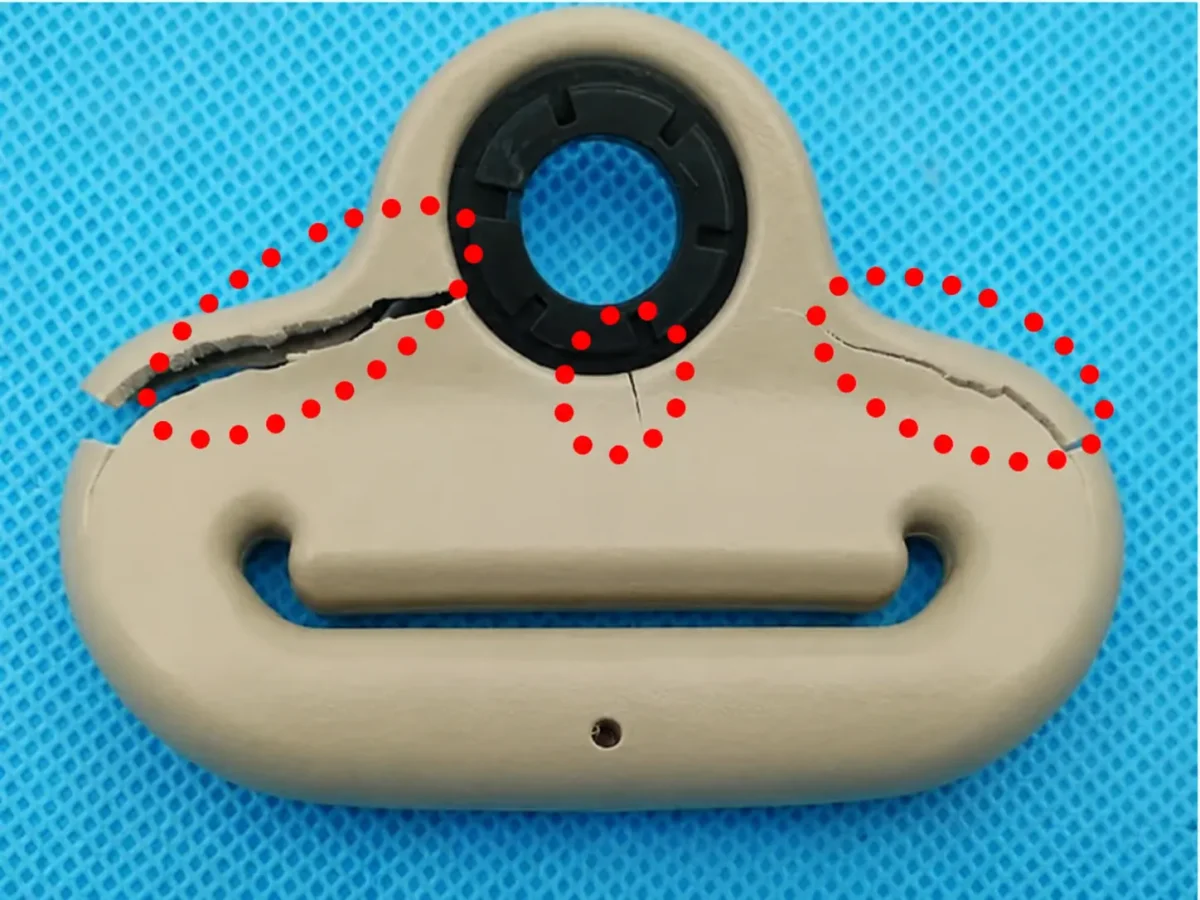
This real laboratory case shows how Xinbodi investigated a cracked injection-molded component using material identification, fracture morphology examination, SEM-EDS, and GC-MS. The analysis indicated that the failure was more consistent with a combination of structural stress, molding defects, and localized foreign material than with a simple raw-material problem.
Why Do Injection-Molded Plastic Parts Crack?
Cracking occurs when the local stress acting on a plastic component exceeds the material’s ability to resist fracture.
The challenge is that the stress may not come only from the external load applied during use. Injection molding itself can introduce residual stress, and component geometry can concentrate that stress around corners, holes, inserts, weld lines, and thickness transitions.
The ASM Handbook on manufacturing-related failures of plastic parts discusses failures associated with material handling, molecular orientation, degradation, molded-in metal inserts, weak weld lines, and voids—illustrating why cracking investigations need to consider the complete molding and product system rather than the polymer alone. ASM Handbook: Manufacturing-Related Failures of Plastic Parts.
A practical investigation therefore considers four areas simultaneously:
| Potential Cause | Typical Questions |
|---|---|
| Material | Is the correct polymer being used? Has it degraded or been contaminated? |
| Processing | Are there voids, poor fusion, excessive residual stress or other molding defects? |
| Product design | Are corners, wall transitions or inserts creating stress concentration? |
| Environment / contamination | Has the component contacted foreign chemicals, lubricants or incompatible materials? |
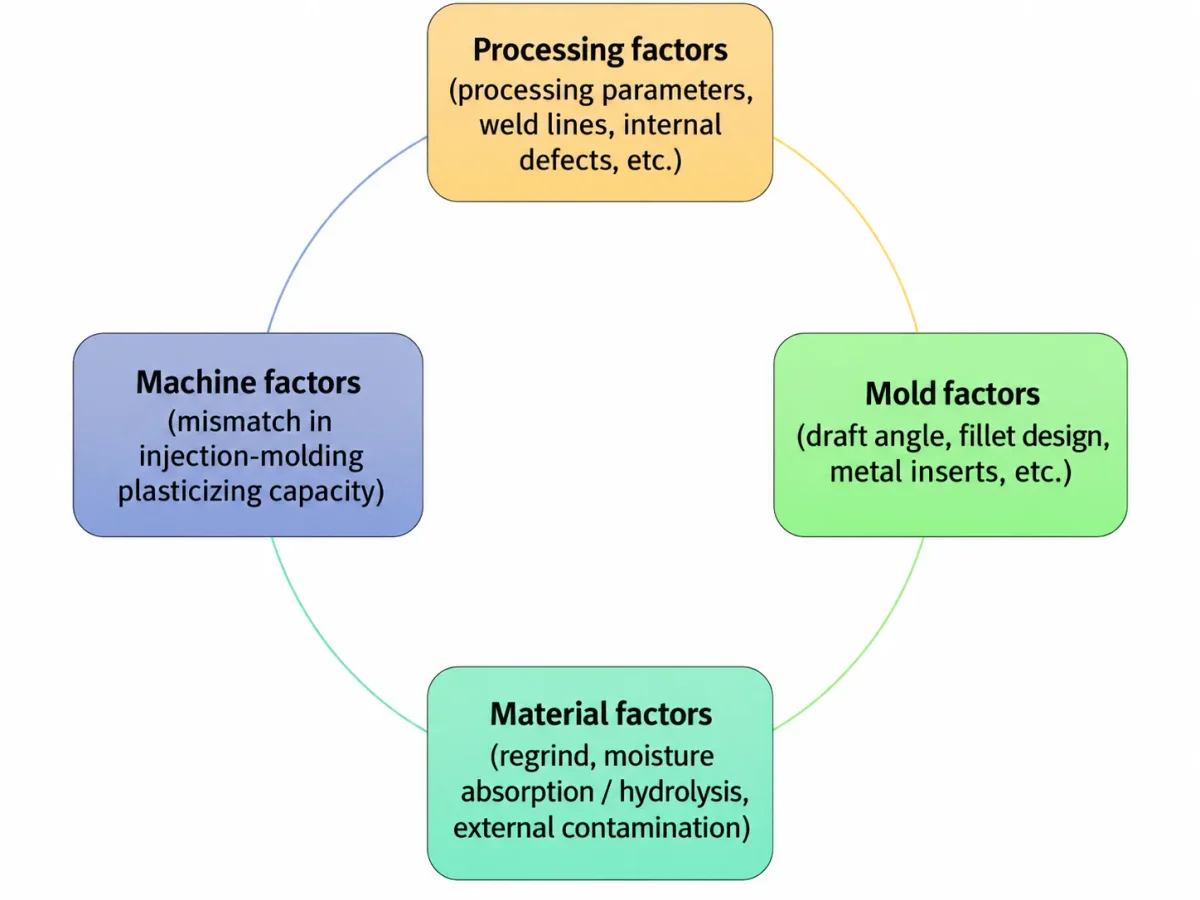
This distinction is important because changing resin will not solve a cracking problem caused primarily by insert design or molding defects.
Case Background: Multiple Cracks in an Injection-Molded Plastic Component
The submitted molded component showed cracking at several locations during use.
The visible damage was concentrated around the upper portion of the component, close to a curved structural region and a molded-in metal insert.
At the beginning of the investigation, several possible causes remained open. The cracking could potentially be related to the molding process, mold or product structure, the polymer material, contamination, or interaction between these factors.
Xinbodi therefore used a three-step failure analysis route:
material identification → fracture morphology analysis → fracture-surface chemical analysis
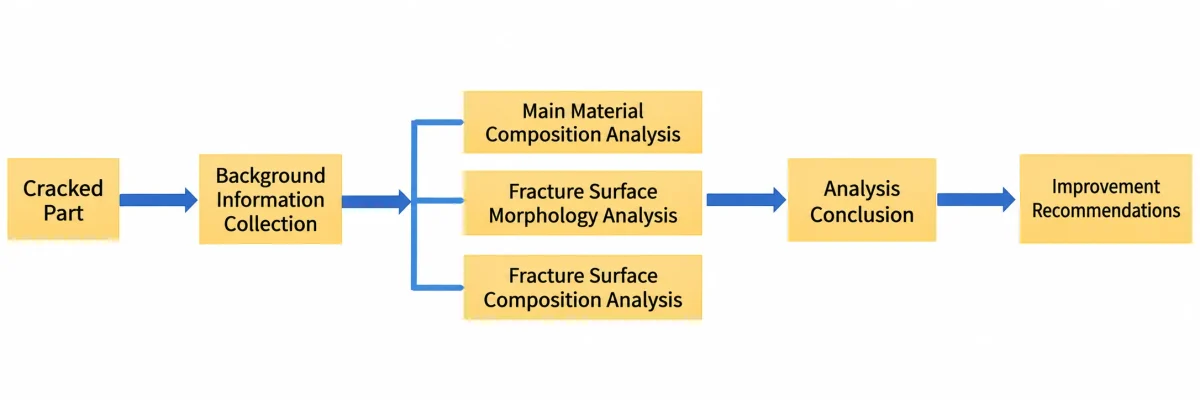
The objective was not simply to identify the plastic. It was to determine why the crack developed at that particular location.
Step 1: Identify the Plastic Before Blaming the Material
The first step in a plastic failure investigation is confirming what material is actually present.
FTIR together with thermal characterization using TGA and DSC showed that the main polymer of the molded component was POM, or polyoxymethylene, commonly known as acetal.
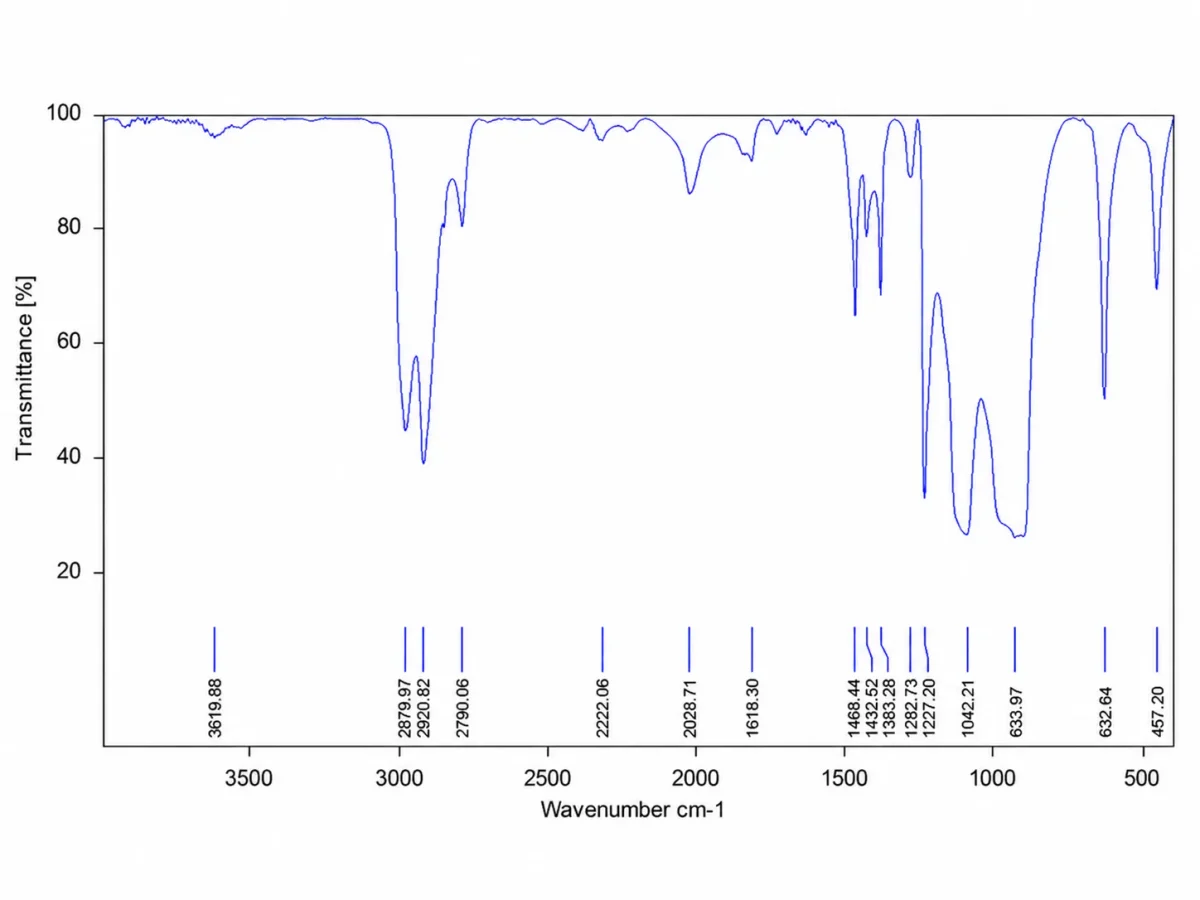
Identifying the base polymer establishes an important baseline, but material identification alone cannot explain a fracture.
POM may crack for many different reasons depending on product design, molding history, local stress, defects, chemical exposure, and service conditions. The next step was therefore to examine the physical evidence around the fracture.
For projects where polymer identity or formulation consistency is uncertain, Xinbodi’s compositional analysis services can be combined with failure analysis to compare the failed material with a reference or approved sample.
Step 2: Locate the Crack Origin and Examine the Fracture Morphology
Optical Microscopy Revealed a High-Risk Structural Area
Optical microscopy showed that the crack was most severe around the curved portion of the component.
The morphology indicated that cracking initiated from the outer region of the part and was associated with a location where stress concentration could reasonably occur.

This region also contained a metal insert.
Metal and thermoplastic materials do not expand and contract in the same way during molding and cooling. When polymer is molded around a rigid metal insert, differential contraction can generate residual stress in the surrounding plastic.
A 2025 peer-reviewed investigation of cracking in injection-molded polymer fittings with metal inserts similarly found that internally accumulated residual stress can contribute to delayed cracking around insert structures. Study on residual stress effects to cracking in injection molding products.
In this case, the crack location and component structure therefore made the metal-insert region an important part of the investigation.
However, location alone was not sufficient to establish the root cause.
SEM Revealed Internal Voids and Abnormal Fracture Features
The fracture surface was then examined at higher magnification using scanning electron microscopy.
SEM observation revealed two important characteristics.

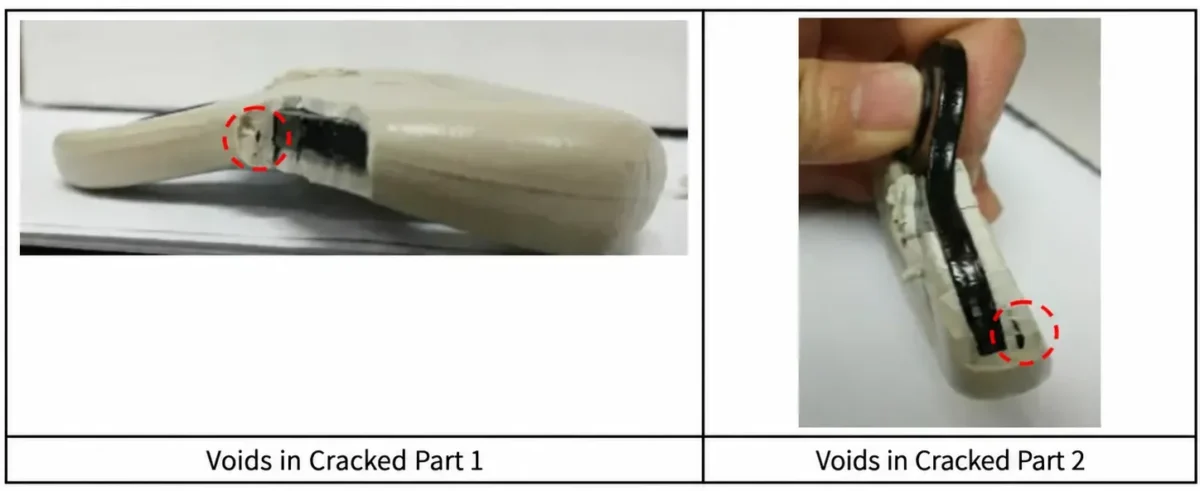
First, the fractured region contained relatively large internal voids, including rounded cavities within the molded structure.
Voids can reduce the effective load-bearing area of a plastic component and create local stress concentration. Research on injection-molded polymer components has similarly noted that void defects can act as stress concentrators and contribute to premature fracture.
Second, the fracture surface contained flake-like foreign features that differed from the surrounding polymer morphology.
This raised another question:
Was an abnormal material present at the crack surface?
Morphology alone could not identify it, so elemental and organic chemical analysis was required.
Step 3: Analyze the Foreign Material on the Fracture Surface
SEM-EDS Found a Different Elemental Profile in the Flake-Like Material
SEM-EDS was used to compare the normal fracture region with the abnormal flake-like area.
The normal region was mainly characterized by carbon and oxygen, consistent with the surrounding polymer matrix.
The flake-like region showed a different elemental profile. In addition to carbon and oxygen, the analysis detected elements including:
Na, Si, Cl, K and Ca.
The result demonstrated that the localized flake-like material was chemically different from the normal POM fracture surface.
This did not by itself establish where the material came from. However, its presence supported the possibility of localized foreign material or contamination at a mechanically sensitive area.
If an incompatible material is present around a crack initiation zone, it may alter local adhesion, structure, or stress distribution. The significance therefore has to be interpreted together with the fracture morphology and production history rather than from EDS alone.

GC-MS Detected a Lubricant-Type Organic Compound
To further investigate the fracture surface, material from the cracked region was extracted and analyzed using GC-MS.
The chromatographic and mass-spectral results indicated the presence of a lubricant-type organic substance. The displayed spectrum was consistent with 9-octadecenamide (Z)-, commonly known as oleamide.
Oleamide can be used as a processing or lubricating-type substance in polymer-related applications, but detecting it at the fracture surface does not automatically prove that it caused the crack.
The important finding in this investigation was that abnormal chemical material was present in the same general failure region where microscopy had already identified structural defects and stress concentration features.
The available evidence did not determine conclusively whether the lubricant-type material originated from the formulation, a processing aid, handling, or external contamination.
For that reason, the chemical result was treated as one part of the root-cause evidence rather than as a stand-alone conclusion.

What Caused This POM Plastic Part to Crack?
The failure could not reasonably be attributed to one isolated laboratory result.
Instead, the evidence pointed to several contributing factors.
| Evidence | Failure Interpretation |
|---|---|
| Cracking concentrated around the curved insert region | Indicates a probable stress-concentration location |
| Molded-in metal component | Differential contraction may contribute to residual stress |
| Internal voids visible by SEM | Molding defects could create local weak points and stress concentration |
| Flake-like foreign matter on fracture surface | Indicates localized material different from normal POM |
| Na, Si, Cl, K and Ca in the abnormal area | Supports the presence of foreign or non-uniform material |
| Lubricant-type organic material detected by GC-MS | Suggests an additional chemical factor requiring production-source review |
| Main resin identified as POM | The available analysis did not show that simply selecting POM was itself the root cause |
Based on the combined evidence, the cracking was considered likely to be associated with metal-insert structural design, injection-molding defects, and localized foreign material or contamination.
Importantly, the case did not support the simplistic conclusion that the raw resin should automatically be replaced.
Corrective Actions: Fix the Failure Mechanism Before Changing Resin
The most useful outcome of plastic failure analysis is not identifying another material to buy. It is determining which process or design variable should be corrected.
For this component, the investigation supported three main corrective directions.
Review the Metal-Insert and Part Geometry
The insert region should be reviewed for unnecessary geometric constraint and local stress concentration.
Where possible, the component structure around the insert can be redesigned to improve stress distribution and reduce the effect of differential shrinkage between the polymer and the embedded metal.
The objective is not necessarily to remove all metal inserts, but to determine whether the insert geometry and surrounding plastic structure are creating excessive residual stress.
Optimize Injection-Molding Conditions and Reduce Internal Defects
The observed voids indicate that molding quality should be reviewed.
Relevant production variables may include filling, packing, cooling, venting, material preparation, and other parameters that influence internal structure.
The specific parameters should be determined from actual process records rather than adjusted blindly.
The goal is to reduce internal cavities and other molding defects that can serve as crack initiation sites.
Investigate the Source of Foreign Material
Because abnormal inorganic-rich flakes and lubricant-type organic material were detected near the fracture surface, contamination control should also be reviewed.
Potential sources should be traced through the actual production process, including raw-material handling, molding equipment, processing aids, cleaning, assembly, storage, and contact materials.
The laboratory evidence establishes that chemically different material was present; process investigation is needed to determine its exact origin.
What Tests Are Useful for Plastic Cracking Failure Analysis?
There is no single instrument that can determine every plastic cracking root cause.
The analytical route should follow the evidence found on the failed component.
| Method | What It Helps Determine |
|---|---|
| FTIR | Polymer identity and major organic material differences |
| DSC | Thermal transitions and differences in thermal behavior |
| TGA | Thermal decomposition and broad composition characteristics |
| Optical microscopy | Crack location, propagation direction and visible structural features |
| SEM | Fracture morphology, voids and localized defects |
| EDS | Elemental differences between normal and abnormal areas |
| GC-MS | Organic contaminants, additives, lubricants and extractable compounds |
Xinbodi’s materials characterization services can combine these techniques according to the actual failure mechanism rather than applying the same test package to every cracked plastic sample.
Why Visual Inspection Alone Is Not Enough
A cracked part may appear to indicate a material-quality problem, but similar visible cracks can result from very different mechanisms.
A crack around a metal insert may originate from residual stress.
A crack beside an internal cavity may be associated with molding defects.
A chemically exposed component may develop environmental stress cracking.
A contaminated surface may contain foreign material that changes local behavior.
These mechanisms require different corrective actions.
That is why a useful plastic fracture analysis should connect the visible failure location with material chemistry, microstructure, manufacturing information, and service history.
What Samples Should Be Submitted for Plastic Failure Analysis?
The failed component is the most important sample, but comparative evidence makes root-cause analysis much stronger.
When available, manufacturers should provide the failed part together with a normal component from the same design, virgin resin or approved raw material, production batch information, molding conditions, metal inserts, and any suspected processing or contact chemicals.
A known-good part is particularly valuable because it allows the laboratory to determine whether a feature is unique to the failed component or simply normal for the product.
The more clearly the laboratory can compare failed vs. normal, the easier it becomes to separate relevant differences from background material characteristics.
How Xinbodi Helps Solve Plastic Cracking Problems
When injection-molded plastic parts crack unexpectedly, Xinbodi can design a targeted failure analysis program based on the actual component, fracture location, production history, and suspected causes.
Depending on the case, the investigation may combine polymer identification, FTIR, DSC/TGA, optical microscopy, SEM-EDS, GC-MS, compositional comparison, and other appropriate materials characterization methods.
The purpose is not simply to report that a component has cracked.
We help manufacturers determine whether the evidence points toward material differences, structural stress, molding defects, contamination, chemical exposure, or a combination of factors, so that corrective actions can be directed at the real problem.
If your plastic component is cracking during molding, assembly, storage, or use, sending both the failed part and a known-good reference can significantly improve the investigation.
Before changing resin, changing suppliers, or modifying the mold, a structured plastic cracking failure analysis can help determine what actually needs to be fixed.