
Asphalt anti-stripping additives are used to improve adhesion between asphalt binder and mineral aggregate and reduce moisture-related stripping. For contractors, additive manufacturers and road-material suppliers, however, product quality depends on more than confirming that an additive contains amines.
The active chemistry, concentration, carrier system and formulation balance all affect performance.
Asphalt anti-stripping additive formulation analysis helps identify active ingredients, quantify selected components, compare benchmark products and evaluate whether a reconstructed formulation provides comparable moisture resistance.
Xinbodi provides chemical analysis and testing services for formulated industrial chemicals, including composition analysis, deformulation and performance-oriented comparative testing.
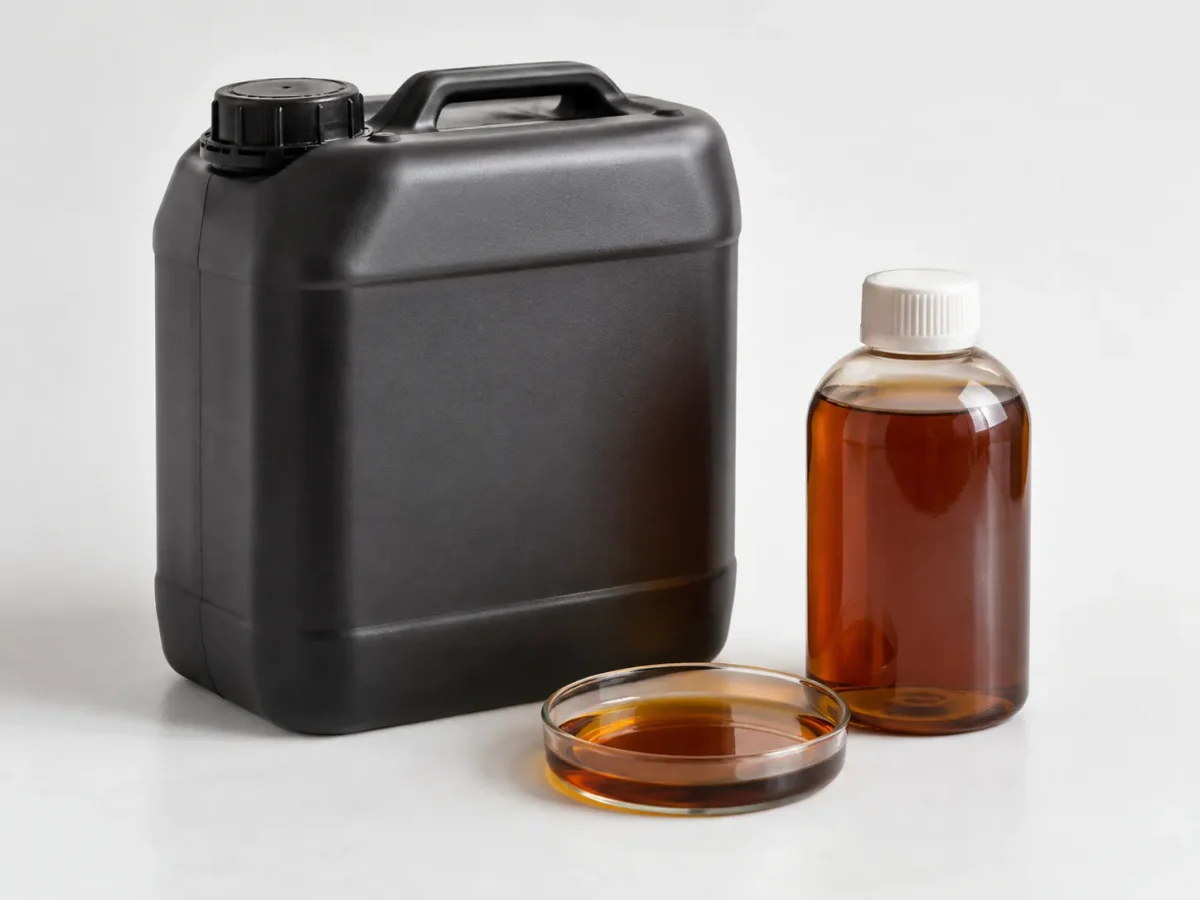
What Is Asphalt Anti-Stripping Additive Formulation Analysis?
Formulation analysis investigates both what is in the additive and how the formulation is structured.
A typical liquid anti-strip investigation may evaluate:
| Formulation Area | What Can Be Analyzed |
|---|---|
| Active adhesion promoter | Amine-, polyamine- or amidoamine-type chemistry |
| Active content | Selected quantitative or semi-quantitative concentration |
| Surfactants | Nonionic or other auxiliary surface-active components |
| Carrier / solvent | Mineral oil, alcohols and other diluents |
| Functional additives | Antioxidants, low-temperature aids and stabilizing components |
| Physical properties | Amine value, thermal behavior and storage stability |
| Performance | Aggregate coating, moisture resistance and mixture-level performance |
The objective is not simply to reproduce an ingredient list. It is to understand which parts of the formulation are essential to asphalt–aggregate adhesion.
Which Active Ingredients Are Used in Asphalt Anti-Stripping Additives?
Many liquid anti-stripping products use nitrogen-containing adhesion promoters such as amines, polyamines and fatty-acid-derived amidoamines.
These molecules can improve the interaction between asphalt binder and mineral aggregate, helping the binder remain attached when moisture is present.
Their effectiveness depends on more than chemical identity. Concentration, aggregate mineralogy, asphalt chemistry and formulation compatibility also matter.
A peer-reviewed study evaluating anti-stripping agents in asphalt mixtures showed that anti-strip additives can significantly improve resistance to moisture-related stripping, while also demonstrating why performance needs to be verified in the actual asphalt–aggregate system rather than predicted from additive chemistry alone.

Are Surfactants and Solvents Also Important?
Yes.
The active amine-based component may represent only part of a commercial liquid additive.
A carrier oil can control viscosity, handling and dispersion in asphalt. Auxiliary surfactants may improve compatibility and distribution, while alcohols or other solvents can influence low-temperature handling and blending.
This is why two anti-stripping additives with similar amine chemistry may still behave differently in production.
How Can a Laboratory Identify an Anti-Stripping Additive Formula?
No single instrument can fully reconstruct a commercial formulation.
How Does FTIR Help Identify the Active Chemistry?
FTIR can provide an initial fingerprint of major functional groups and help distinguish amine/amidoamine chemistry, hydrocarbon carriers and other major formulation components.
It is particularly useful for comparing a benchmark product with an unknown or trial formulation.
What Can GC-MS Identify?
GC-MS can help characterize selected volatile and semi-volatile organic components, including carrier-related compounds, alcohols and selected auxiliary ingredients.
Highly polar or high-molecular-weight amine components may require complementary analytical approaches.
How Is Amine Content Evaluated?
For amine-containing anti-stripping additives, non-aqueous acid-base or potentiometric titration can be used to determine amine value.
Amine value should normally be reported in an appropriate unit such as mg KOH/g, rather than as a simple percentage.
The result can be combined with spectroscopic and chromatographic data to estimate the active adhesion-promoter system.
What Does TGA Add to the Analysis?
TGA can compare broad volatile, organic and residual fractions and provide another check on whether the reconstructed formulation is consistent with the benchmark.
It is best used as cross-validation rather than as a stand-alone method for assigning exact percentages to every ingredient.
Can a Lab Determine the Exact Anti-Stripping Additive Formula?
Selected components can often be quantified accurately, while others are better reported as approximate formulation ranges.
A useful result distinguishes between:
| Result | Meaning |
|---|---|
| Confirmed identification | Chemical identity supported by analytical evidence |
| Quantitative result | Concentration determined with an appropriate method |
| Semi-quantitative estimate | Approximate concentration based on analytical response |
| Formulation estimate | Derived from several complementary methods |
| Performance validation | Confirms whether the reconstructed formulation works in application |
For projects requiring deeper formulation reconstruction, Xinbodi can extend composition testing into deformulation and chemical reverse engineering.
How Is Asphalt Anti-Stripping Performance Tested?
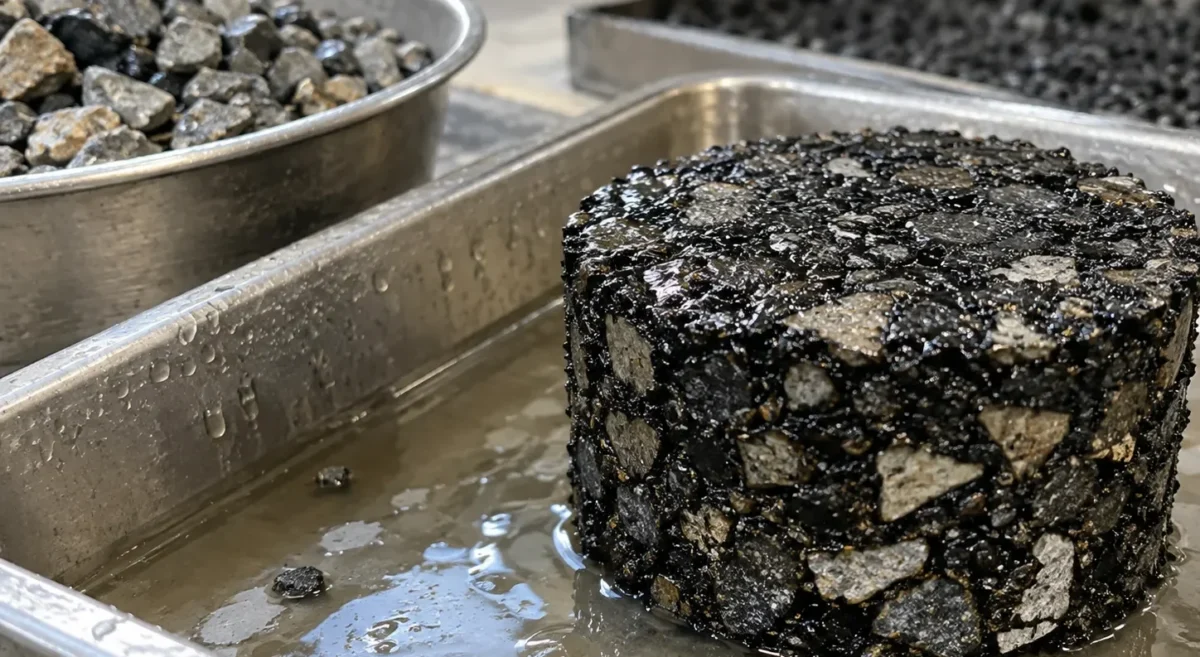
Chemical similarity does not automatically prove performance equivalence.
A benchmark formulation and a reconstructed additive should therefore be tested with asphalt and aggregate.
Is the Boiling-Water Test Enough?
Boiling-water testing can provide a useful visual screening of how well asphalt remains coated on aggregate after water exposure.
It is fast and practical for formulation development, but it should not be treated as the only evidence of long-term moisture resistance.
How Is Moisture Susceptibility Evaluated More Rigorously?
Mixture-level testing provides stronger evidence.
The current ASTM D4867/D4867M standard is specifically intended to evaluate the effect of moisture on asphalt mixtures and can be used to determine whether an anti-stripping additive is effective and to investigate suitable dosage.
Depending on the project specification, tensile-strength or moisture-conditioning approaches may therefore be combined with simpler aggregate-coating tests.
Case Study: Benchmarking an Asphalt Anti-Stripping Additive for In-House Production
A large road-construction company in Southeast Asia regularly purchased a liquid anti-stripping additive for high-grade asphalt paving.
The company had basic chemical blending capability and wanted to evaluate whether it could manufacture an equivalent product internally, reducing dependence on an external supplier.
A proven commercial additive was submitted for formulation analysis.
The objectives were to identify the active chemistry, determine the approximate formulation structure and verify whether a trial formulation could deliver comparable anti-stripping performance.
What Did the Benchmark Formulation Contain?
FTIR, GC-MS, titration and thermal analysis were combined to develop an approximate formulation profile.
| Functional System | Analytical Finding | Approx. wt.% |
|---|---|---|
| Active adhesion promoter | Fatty-acid-derived amidoamine/polyamine-type system | 28.5 |
| Auxiliary surfactant | Nonionic surfactant system | 4.2 |
| Carrier | Light mineral-oil fraction | 62.8 |
| Co-solvent | Isopropanol | 3.5 |
| Minor functional additives | Antioxidant / low-temperature handling additives | 1.0 |
These values were treated as integrated formulation estimates, not as direct results from one instrument.
The measured amine value was approximately 32 mg KOH/g, supporting the presence of a significant amine-based active system.
The benchmark also contained a nonionic surfactant consistent with an alkylphenol-ethoxylate-type material. Because commercial replication must consider the regulatory requirements of the target market, the analytical identification was treated as a benchmark finding rather than an automatic recommendation to use the same raw material.
Could the Benchmark Additive Be Reproduced?
The analytical results indicated that the formulation did not depend on unusually specialized reaction chemistry.
The key challenge was instead reproducing the correct balance between:
amine-based adhesion promoter + surfactant + carrier + co-solvent + minor additives.
The manufacturer used the analytical ranges as a starting point and prepared a trial formulation using commercially available raw materials.
The trial was then compared with the benchmark rather than being accepted based on composition alone.
Did the Trial Additive Match the Benchmark Performance?
In the customer’s project-specific validation:
| Performance Check | Benchmark | Trial Formulation |
|---|---|---|
| Boiling-water aggregate coating | 95% | 93% |
| Immersion Marshall stability ratio | 89.2% | 87.5% |
| Six-month room-temperature storage | Stable | Stable |
Both products remained free of visible phase separation or precipitation during the customer’s storage evaluation.
The trial formulation therefore showed similar performance under the project conditions, allowing the manufacturer to proceed with internal production.
The customer subsequently reported a reduction in supply lead time from approximately three weeks to three days and an overall material-cost reduction of about 31%.
These results are specific to this project and should not be interpreted as universal performance or cost claims.
Why Is Performance Validation Essential After Reverse Engineering?
Two additives can appear chemically similar yet perform differently with a particular asphalt or aggregate.
Performance may change because of:
- amine structure and active concentration;
- aggregate mineralogy;
- asphalt source and chemistry;
- additive dosage;
- mixing temperature;
- moisture-conditioning conditions.
For this reason, reverse engineering should produce a formulation candidate, not an automatic claim of equivalence.
Laboratory and application testing are needed before supplier replacement or full-scale production.
What Samples Should Be Submitted for Anti-Stripping Additive Analysis?
The strongest project normally includes a benchmark additive together with any existing trial formulation.
If performance problems are already occurring, asphalt binder, aggregate information and relevant test results are also useful.
For supplier-comparison projects, an approved reference sample allows the laboratory to identify meaningful differences much more efficiently than analyzing an unknown additive alone.
How Xinbodi Supports Asphalt Anti-Stripping Additive Formulation Analysis
Xinbodi provides formulation analysis for asphalt additives, industrial chemicals and other formulated products.
Depending on the objective, the analytical plan can combine FTIR, GC-MS, amine-value determination, thermal analysis and targeted composition testing.
Xinbodi’s broader composition analysis services can identify major and minor formulation components, while deformulation projects can support benchmark comparison, supplier replacement and in-house formulation development.
The goal is not simply to identify that an additive contains amines. It is to determine which active system is present, how the formulation is balanced, and whether a reconstructed product can deliver comparable anti-stripping performance.