
Materials can have the same chemical composition but very different internal structures. One important difference is whether a material is amorphous or crystalline.
This difference can affect melting behavior, transparency, hardness, flexibility, solubility, thermal stability, processing performance and product reliability.
For manufacturers, understanding amorphous vs crystalline materials is useful in polymer testing, pharmaceutical analysis, battery material testing, coating analysis, adhesive failure investigation and material characterization.
What Are Amorphous and Crystalline Materials?
An amorphous material does not have a long-range, regularly repeating structure. Its atoms, molecules or polymer chains are arranged in a more disordered way.
Common amorphous materials include glass, rubber, some plastics, amorphous silica, some coatings and some pharmaceutical solids.
A crystalline material has a regular repeating structure. Its atoms, ions or molecules are arranged in an ordered pattern.
Common crystalline materials include salts, metals, minerals, ceramics, many pharmaceutical crystals, inorganic fillers and some polymers.
Some materials are not fully amorphous or fully crystalline. Many polymers are semi-crystalline, meaning they contain both amorphous and crystalline regions.
What Is the Difference Between Amorphous and Crystalline?
The main difference is internal structure.
Crystalline materials have ordered, repeating structures. Amorphous materials do not have long-range order.
| Feature | Amorphous Materials | Crystalline Materials |
|---|---|---|
| Internal structure | Disordered | Ordered and repeating |
| XRD pattern | Broad halo | Sharp diffraction peaks |
| Thermal behavior | Glass transition or softening range | Clear melting point |
| Transparency | Often higher | Often lower, depending on material |
| Mechanical behavior | Often more flexible or tough | Often harder or more rigid |
| Examples | Glass, rubber, amorphous polymers | Metals, salts, minerals, crystalline polymers |
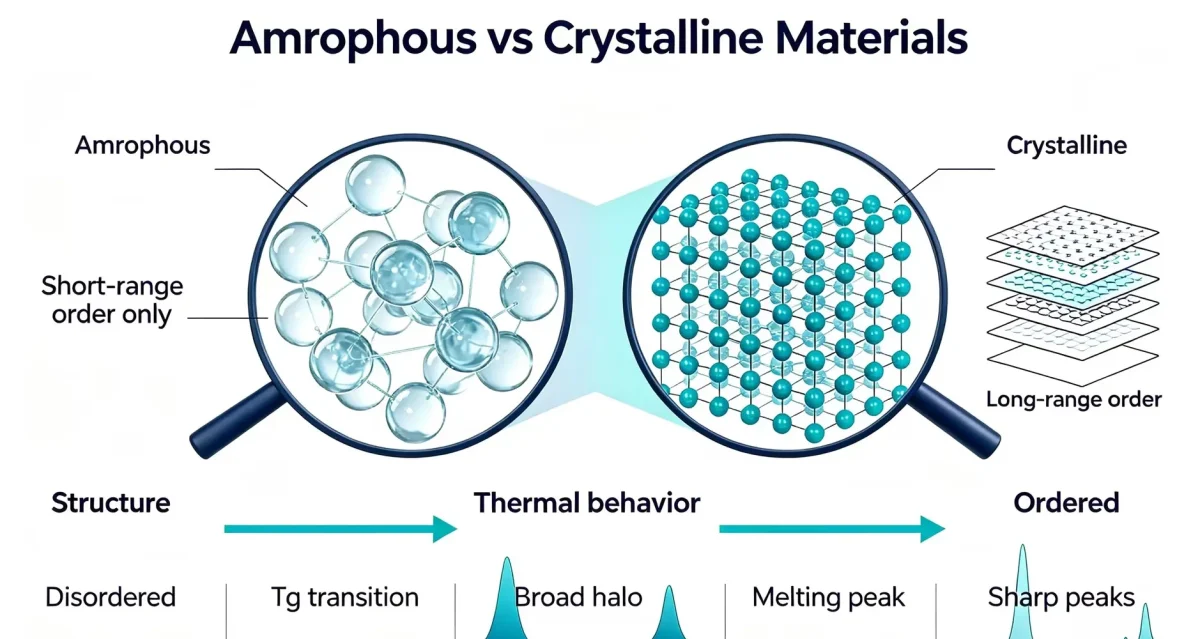
In practical testing, XRD analysis is one of the most direct methods for distinguishing amorphous and crystalline structures. Crystalline materials usually show sharp XRD peaks, while amorphous materials usually show broad diffuse patterns.
Amorphous refers to a material’s structural state, while crystallization refers to a structural change process. A material may start in an amorphous state after rapid cooling or certain processing conditions, but later develop more ordered crystalline regions during slow cooling, heating, stretching, storage, or aging. This change can affect properties such as transparency, shrinkage, hardness, heat resistance, flexibility, and dimensional stability, which is why crystallization behavior is often important in polymer testing and failure analysis.
Which Is Better, Amorphous or Crystalline?
Neither is always better. The better structure depends on the application.
Amorphous materials may be preferred when transparency, flexibility, impact resistance or easy processing is important.
Crystalline or semi-crystalline materials may be preferred when higher strength, heat resistance, chemical resistance or dimensional stability is required.
For example:
- An amorphous plastic may be better for clear optical parts.
- A semi-crystalline polymer may be better for parts requiring heat resistance.
- An amorphous pharmaceutical form may dissolve faster, but a crystalline form may be more stable.
- A coating or adhesive may fail if unwanted crystallization changes flexibility or bonding performance.
So the real question is not whether amorphous or crystalline is better, but whether the material structure matches the product requirement.
How to Determine Amorphous vs Crystalline?
Laboratories usually determine amorphous vs crystalline structure by combining several testing methods.
XRD Analysis
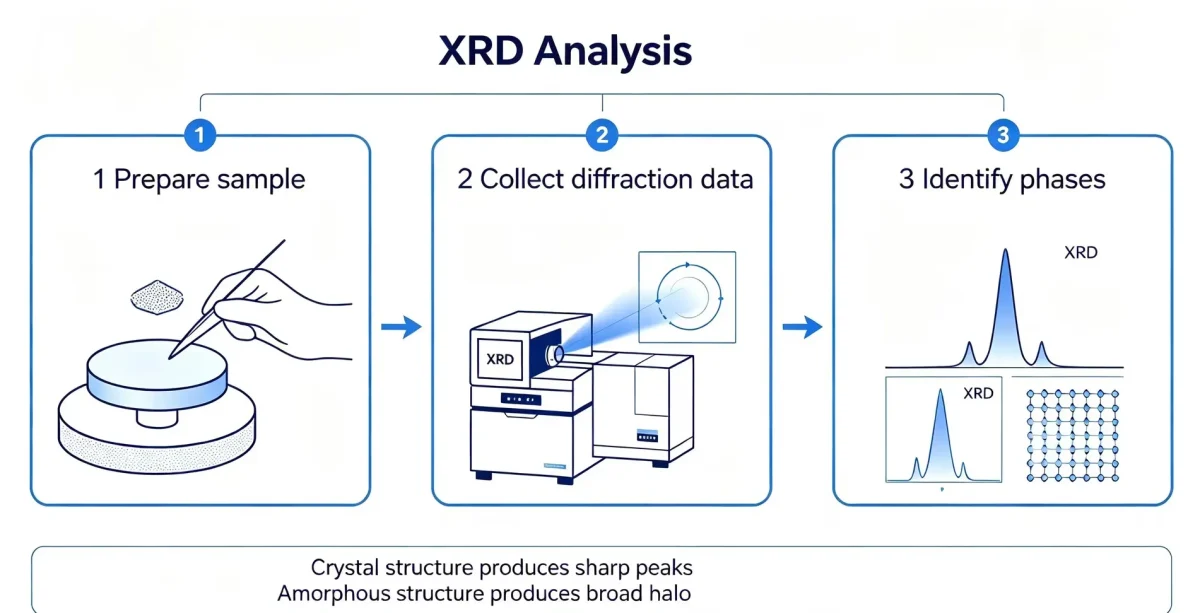
XRD analysis is the most important method for identifying crystalline and amorphous structures.
- Crystalline materials show sharp diffraction peaks.
- Amorphous materials show broad diffuse halos.
- Semi-crystalline materials may show both.
XRD can also help identify crystal phases, inorganic fillers, mineral components and changes between supplier samples.
DSC Analysis
DSC analysis is useful for studying thermal transitions.
It can detect:
- glass transition temperature
- melting temperature
- crystallization temperature
- cold crystallization
- degree of crystallinity in polymers
DSC is especially useful for polymers because many polymer materials contain both amorphous and crystalline regions.
FTIR and Raman Analysis
FTIR and Raman can help identify the material type and chemical structure.
They are often used together with XRD or DSC when the lab needs to understand both composition and structure.
SEM-EDS and XRF Analysis
SEM-EDS helps observe surface morphology, particles, cracks, phase separation and elemental distribution.
XRF helps identify elements in inorganic fillers, pigments, stabilizers or mineral materials.
These methods do not directly replace XRD, but they provide useful supporting information in material characterization and failure analysis.
Why Amorphous vs Crystalline Structure Matters
Amorphous and crystalline structures can affect real product performance.
In polymers, crystallinity can affect strength, flexibility, shrinkage, transparency and heat resistance.
In pharmaceuticals, amorphous and crystalline forms can have different solubility and stability.
In coatings and adhesives, structural changes may influence cracking, bonding strength, aging behavior or surface defects.
In battery materials, crystalline phase structure can affect material performance and consistency.
In supplier comparison, two samples may have similar chemical composition but different crystallinity or crystal phases, leading to different processing or product behavior.
Common Applications
Amorphous vs crystalline analysis is useful for:
- polymer material characterization
- plastic failure analysis
- pharmaceutical solid form analysis
- battery material phase identification
- coating and adhesive failure investigation
- inorganic filler identification
- supplier sample comparison
- material quality control
- product development and troubleshooting
Need Amorphous vs Crystalline Material Analysis?
If you need to determine whether a material is amorphous or crystalline, compare supplier samples, analyze crystallinity, identify crystal phases or investigate product failure, Xinbodi Laboratories can help.
Contact us to discuss your sample type, testing goal and analysis requirements.
FAQ
What is the difference between amorphous and crystalline?
Amorphous materials lack long-range ordered structure, while crystalline materials have regular repeating structures. This difference affects XRD patterns, melting behavior, mechanical properties and material performance.
Which is better, amorphous or crystalline?
Neither is always better. Amorphous materials may offer better transparency or flexibility, while crystalline materials may provide better heat resistance, strength or stability.
Is glass crystalline or amorphous?
Glass is amorphous. It does not have a long-range repeating crystal structure and usually softens over a temperature range rather than melting at one sharp point.
How to determine amorphous vs crystalline?
XRD is the main method used to distinguish amorphous and crystalline materials. DSC, FTIR, Raman, SEM-EDS and XRF can provide supporting information depending on the material and testing goal.