
Rubber products can meet routine hardness, tensile, or dimensional requirements and still fail during heat aging, oil exposure, compression, outdoor use, or long-term storage.
When this happens, conventional performance testing tells manufacturers that a material has failed, but often not why it failed.
Chemical analysis of rubber addresses the composition behind the performance. By separating and characterizing the elastomer, fillers, plasticizers, curing chemicals, antioxidants, processing aids, contaminants, and degradation products, a laboratory can help manufacturers answer questions such as:
- What is this rubber compound made of?
- Why does an imported material perform better?
- Has a supplier changed the formulation?
- Why did a seal crack, harden, swell, or lose adhesion?
- Which part of the formulation should R&D investigate next?
Xinbodi provides chemical composition analysis and rubber material analysis for formulation comparison, supplier verification, failure investigation, and product development.
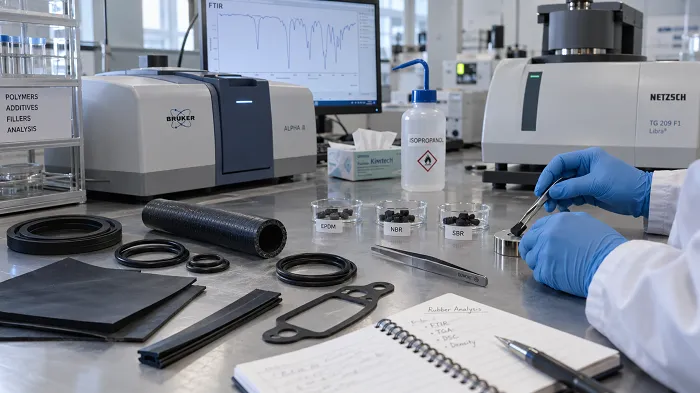
What Is Chemical Analysis of Rubber?
Chemical analysis of rubber is the qualitative and quantitative characterization of a rubber compound or finished rubber product.
Unlike routine mechanical testing, which focuses on properties such as hardness, tensile strength, elongation, compression set, or abrasion resistance, chemical analysis focuses on what is inside the material and how composition may relate to performance.
A commercial rubber compound may contain:
- one or more elastomers;
- sulfur or peroxide curing systems;
- accelerators and activators;
- carbon black or mineral fillers;
- processing oils and plasticizers;
- antioxidants and antiozonants;
- pigments;
- waxes and processing aids;
- coupling agents;
- trace contaminants or degradation products.
ASTM D297 covers qualitative and quantitative chemical analysis of rubber products, including polymer content, extracts, sulfur, fillers, ash, and identification of specific rubber polymers. ASTM D297 – Standard Test Methods for Rubber Products—Chemical Analysis.
For complex industrial compounds, however, a single standard method or instrument is rarely sufficient. Modern rubber analysis commonly combines separation, spectroscopy, chromatography, thermal analysis, elemental analysis, and comparison with reference samples.
What Can Rubber Chemical Analysis Identify?
The analytical depth depends on the rubber type, sample condition, concentration of individual components, and project objective.
Base Elastomer
Chemical analysis can help identify or differentiate rubber systems such as:
- NBR
- EPDM
- NR
- SBR
- CR
- silicone rubber
- FKM
- IIR
- TPU and other elastomeric materials
For some projects, the question goes beyond identifying the polymer family. Differences in copolymer composition or rubber grade can also influence oil resistance, flexibility, aging, and processing behavior.
Curing System
The cure package strongly affects crosslink structure and long-term rubber properties.
Analysis may investigate:
- sulfur;
- peroxide systems;
- accelerators;
- activators such as ZnO and stearic acid;
- selected coagents or curing-related components.
This can be useful when two compounds show different compression set, cure rate, heat resistance, or hardness change even though both are based on the same elastomer.
Fillers and Reinforcement
Common targets include:
- carbon black;
- silica;
- calcium carbonate;
- talc;
- clay;
- barium sulfate;
- titanium dioxide;
- other inorganic fillers.
Filler type and loading can influence hardness, reinforcement, abrasion resistance, processing, density, and cost.
Plasticizers and Processing Oils
Rubber compounds may contain:
- phthalate-type plasticizers;
- process oils;
- ester plasticizers;
- paraffinic or naphthenic oils;
- other low-molecular-weight processing components.
Changes in plasticizer chemistry or dosage can affect hardness, flexibility, migration, oil swelling, extractability, and aging behavior.
Antioxidants and Antiozonants
Aging-protection systems may include combinations of:
- amine-type antidegradants;
- phenolic antioxidants;
- quinoline-type antioxidants;
- waxes;
- UV-related stabilizers.
In many failures, the important issue is not simply whether an antioxidant is present, but whether the protection system is appropriate for the actual heat, oxygen, ozone, or outdoor exposure environment.
Chemical Analysis of Rubber for Deformulation
One major application is understanding the composition of an imported or competitor rubber compound.
A manufacturer may know that a benchmark product has better heat resistance, lower compression set, longer service life, or better oil resistance but have little information about its formulation.
In this case, deformulation and reverse engineering can be used to break the compound into functional systems such as:
elastomer → cure system → reinforcement → plasticizer → aging protection → processing aids
The goal is not merely to produce a list of detected chemicals.
The more useful question is:
Which formulation differences are likely to explain the performance gap?
A recent review of reverse engineering of vulcanized rubber compounds describes the process as a multi-technique analytical challenge involving identification of polymer composition, fillers, additives, curing systems, and degradation products. Reverse engineering of vulcanised rubber compounds: an overview of analytical strategies.
Rubber Chemical Analysis for Supplier and Batch Comparison
Another common use is incoming-material verification.
Two rubber compounds may carry the same supplier grade or meet the same basic specification while differing in:
- elastomer grade;
- filler loading;
- cure system;
- plasticizer;
- antioxidant package;
- processing aids;
- contamination.
A strong comparison normally uses:
approved reference sample vs new supplier or abnormal batch
rather than analyzing one sample in isolation.
This allows the laboratory to build an internal composition fingerprint and identify changes that may not appear in conventional certificates of analysis.
For manufacturers dealing with repeated supplier variation, polymer and rubber materials analysis can support material identification, comparative testing, formulation analysis, and supplier qualification.
Chemical Analysis for Rubber Failure Analysis
Rubber failure is rarely caused by one variable alone.
Common symptoms include:
- cracking;
- hardening;
- excessive compression set;
- swelling;
- discoloration;
- blooming;
- loss of adhesion;
- abnormal odor;
- premature aging;
- surface deposits.
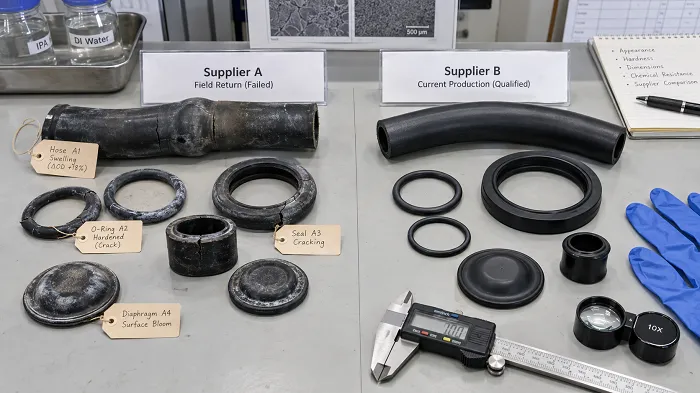
Chemical analysis becomes especially valuable when routine process adjustments fail to eliminate the problem.
Case Example 1: NBR Seal Compound With Poor Heat and Oil Resistance
An automotive rubber manufacturer developed an NBR compound for oil seals.
Routine properties were acceptable, but compared with an imported benchmark, the material showed:
- 120°C × 22 h compression set: 27% vs ≤14%
- 120°C × 70 h hardness change: +11 vs +4 Shore A
- hot-oil volume change: +15.8% vs +8.2%
Repeated changes to sulfur and accelerator dosage did not solve the problem.
Comparative chemical analysis showed several formulation differences:
- lower acrylonitrile content in the customer NBR grade;
- a different sulfur/accelerator strategy;
- incomplete antioxidant protection;
- different carbon black grade;
- a different plasticizer system.
After targeted formulation adjustment, compression set improved to 12%, hardness change decreased to +5 Shore A, and oil-immersion volume change fell to 9.1%.
The key lesson was that the problem was not simply “insufficient sulfur.” It involved the complete compound architecture.
Case Example 2: EPDM Seal With Low-Temperature Cracking
In another project, an EPDM automotive sealing material met room-temperature hardness requirements but cracked at approximately −40°C and developed surface cracking after ozone aging.
Chemical comparison with an imported reference identified differences in:
- EPDM copolymer structure;
- plasticizer system;
- antioxidant/antiozonant protection;
- filler and reinforcing system.
The customer then adjusted the formulation around these functional differences rather than continuing to change only oil content.
These cases illustrate why material failure analysis is often stronger when chemical composition data are evaluated together with the actual failure mode.
Case Example 3: Silicone Seal Failure After Outdoor Aging
A photovoltaic manufacturer reported cracking, yellowing, and sealing failure in silicone rubber strips after about 18 months of outdoor use. New and failed samples were compared by chemical analysis.
The failed material showed stronger siloxane-chain degradation, increased hydroxyl-related degradation products, a low hindered-phenol antioxidant level of 0.12%, and no effective UV absorber.
The evidence indicated that the main problem was an insufficient antioxidant and UV-stabilization system rather than installation. After the supplier improved the aging-protection package, the revised seal passed 1,000 hours of UV aging testing, with expected outdoor service life extended to more than five years.
Analytical Methods Used for Rubber Chemical Analysis
Crosslinked rubber does not behave like a simple liquid formulation. Many ingredients are embedded in an insoluble polymer network, so sample preparation is often as important as the analytical instrument itself.
Solvent Extraction
Selective extraction can separate:
- oils;
- plasticizers;
- antioxidants;
- accelerators;
- other low-molecular-weight components.
Different solvents or sequential extraction may be used depending on the compound.
Py-GC/MS
Py-GC/MS is useful for thermally decomposing polymeric materials and obtaining characteristic products that can support:
- rubber identification;
- polymer comparison;
- additive screening;
- degradation investigation.
It is particularly useful where the crosslinked polymer cannot be analyzed directly by conventional GC-MS.
GC-MS and LC-MS/MS
These methods can help investigate selected organic compounds including:
- plasticizers;
- process oils;
- antioxidants;
- accelerators;
- degradation products;
- other extractable additives.
The technique is selected according to volatility, polarity, molecular weight, and target chemistry.
FTIR
FTIR can provide rapid information about:
- elastomer family;
- major functional groups;
- oxidation-related changes;
- surface deposits;
- extracted components.
FTIR is valuable as a screening technique, but identical FTIR spectra do not prove that two commercial rubber compounds have the same formulation.
TGA
Thermogravimetric analysis helps evaluate compositional fractions such as:
- volatile or extractable material;
- polymer/organic fraction;
- carbon black;
- inorganic residue or ash.
It is particularly useful for comparative compound analysis.
ICP-OES and SEM-EDS
Elemental and microscopic methods can support identification of:
- Zn-containing cure activators;
- inorganic fillers;
- pigments;
- metallic contamination;
- localized foreign particles or surface residues.
A professional investigation normally integrates multiple techniques rather than treating one instrument as a complete formulation-analysis solution.
Why One Test Is Rarely Enough
Suppose two NBR seals both show the same base polymer by FTIR.
They may still differ in:
- acrylonitrile content;
- molecular structure;
- carbon black grade;
- filler loading;
- sulfur level;
- accelerator package;
- process oil;
- antioxidant system.
Those differences may produce very different compression set, heat aging, oil swelling, and service life.
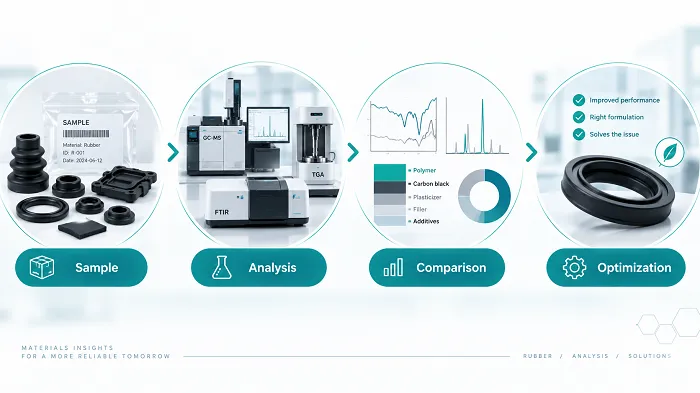
Therefore, chemical analysis of rubber should be designed around the technical question, not around a fixed instrument list.
For example:
| Customer Question | Useful Analytical Approach |
|---|---|
| What rubber is this? | FTIR, Py-GC/MS, DSC |
| Why do two batches perform differently? | Comparative extraction, TGA, GC-MS, elemental analysis |
| What is in the competitor compound? | Multi-technique deformulation |
| Why did the rubber crack or harden? | Failure analysis + chemical comparison |
| Why is oil swelling too high? | Elastomer grade + plasticizer + formulation comparison |
| What is the surface deposit? | FTIR, GC-MS, SEM-EDS |
This problem-oriented approach provides more useful information than ordering multiple unrelated tests.
Rubber Materials Commonly Analyzed
Xinbodi supports analysis of a range of rubber and elastomer systems, depending on the project objective, including:
- NBR and HNBR
- EPDM
- natural rubber
- SBR
- silicone rubber
- CR / neoprene
- FKM
- IIR
- polyurethane and other elastomeric compounds
Typical sample forms include:
- seals and O-rings;
- hoses;
- gaskets;
- molded rubber parts;
- automotive rubber components;
- industrial elastomers;
- uncured compounds;
- failed rubber components;
- supplier and competitor samples.
What Problems Can Xinbodi Lab Help Solve?
Xinbodi Lab provides chemical analysis of rubber for manufacturers, material suppliers, procurement teams, quality departments, and R&D groups that need to understand composition rather than relying only on conventional performance results.
Typical projects include:
Competitor and Imported Material Benchmarking
Analyze the elastomer, filler, cure system, plasticizer, antioxidant package, and other major formulation features to understand why a benchmark compound performs differently.
Supplier and Batch Verification
Compare approved and new material batches to identify meaningful changes in composition and support supplier management.
Rubber Failure Investigation
Combine composition data with failed-vs-good sample comparison to investigate cracking, hardening, swelling, blooming, adhesion loss, or premature aging.
Formulation Development and Material Replacement
Use chemical evidence to narrow the R&D search space and identify which formulation variables should be investigated during product development or localization.
For projects requiring broader mechanical, thermal, and durability evaluation in addition to composition work, see Xinbodi’s rubber testing laboratory services.
Technical Limits of Rubber Chemical Analysis
Rubber formulations can contain dozens of ingredients, and analytical boundaries should be clear.
Trace additives may sometimes only be identified by chemical family rather than quantified precisely. Crosslinked materials may not be fully separable, and some proprietary reaction products can be difficult to assign to one original raw material.
Chemical analysis also does not reproduce every manufacturing variable. Final rubber performance can still depend on:
- mixing sequence;
- dispersion quality;
- cure temperature and time;
- molding conditions;
- raw-material grade;
- storage and service environment.
For this reason, analytical results should be used as technical evidence for formulation development, supplier evaluation, and failure investigation, followed by appropriate performance validation.
Conclusion
Chemical analysis of rubber provides a deeper answer than routine pass/fail testing.
It can help determine what a rubber compound contains, how two formulations differ, whether a supplier has changed the material, and which formulation differences may be contributing to heat-aging, oil-resistance, compression-set, cracking, swelling, or durability problems.
By combining separation, spectroscopy, chromatography, thermal analysis, elemental analysis, and comparative testing, Xinbodi Lab supports rubber manufacturers with composition analysis, deformulation, supplier comparison, failure diagnosis, and formulation-development projects.
The objective is not simply to identify ingredients. It is to turn composition data into a clearer answer to the manufacturer’s real question:
What is different, why does it matter, and what should be investigated next?