
Industrial and commercial cleaning products may look simple, but their performance often depends on a carefully balanced combination of surfactants, builders, alkalinity regulators, chelating agents, solvents, corrosion-control additives, defoamers, preservatives and other functional ingredients.
When two cleaners have similar pH, appearance and even similar main surfactants but behave differently in production, routine specifications rarely explain the difference.
Cleaning composition analysis helps manufacturers determine what is actually present in a cleaning product, quantify selected components where technically feasible, compare formulations and understand which chemical differences may be responsible for cleaning performance, foam, residue, corrosion or stability problems.
When the objective goes beyond identification into competitor benchmarking or formulation reconstruction, the same analytical data can support formula reverse engineering and cleaning product deformulation.
Xinbodi provides chemical composition analysis and deformulation and chemical reverse engineering for industrial cleaners, detergents, degreasers and other formulated chemical products.
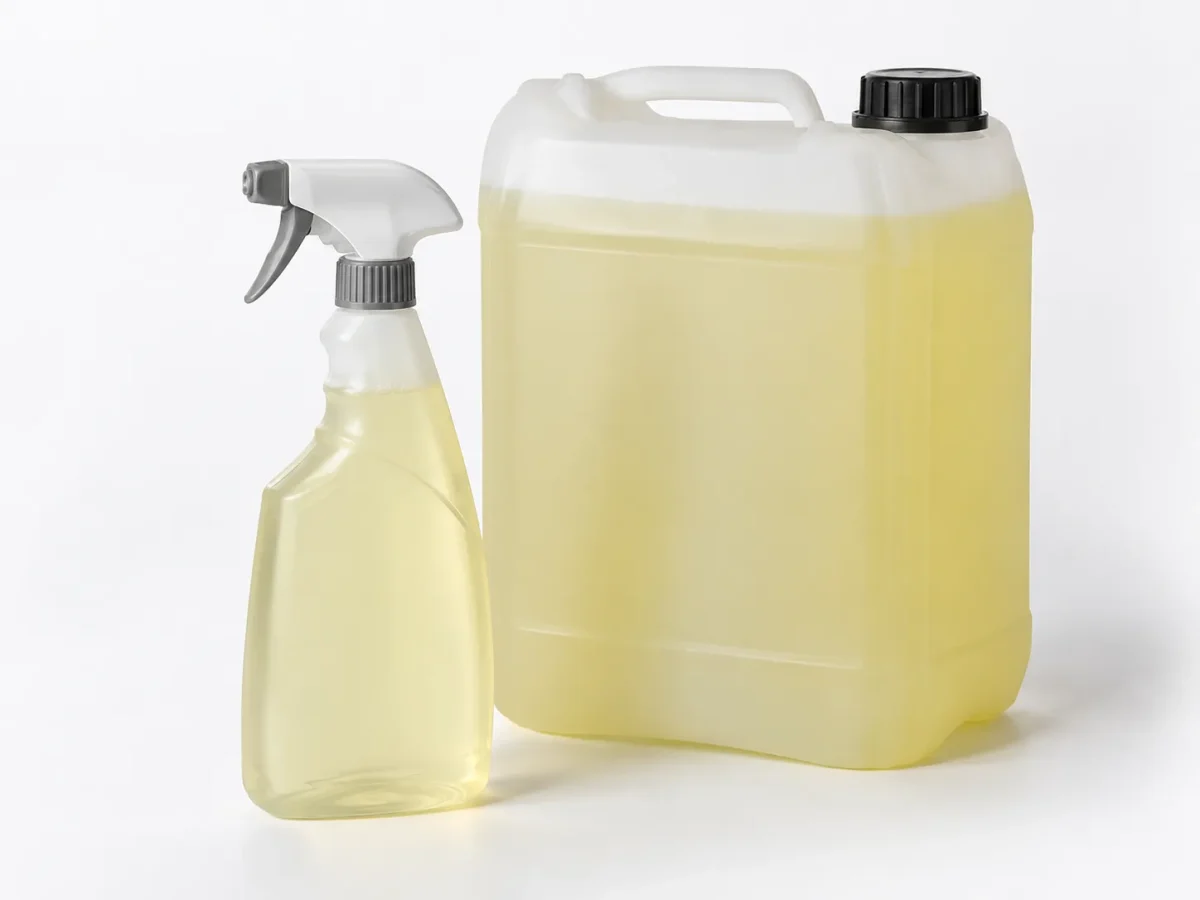
What Is Cleaning Composition Analysis?
Cleaning composition analysis is the systematic characterization of the chemical systems that make up a cleaner or detergent.
Depending on the product, a laboratory may investigate:
| Formulation System | Typical Components | Why It Matters |
|---|---|---|
| Surfactants | Anionic, nonionic, cationic, amphoteric surfactants | Wetting, detergency, emulsification, soil removal |
| Builders / alkalinity | Carbonates, hydroxides, silicates, phosphates | Soil removal, pH control, water conditioning |
| Chelating agents | Gluconates, citrate, EDTA-type systems | Bind Ca/Mg and reduce hard-water interference |
| Solvents | Alcohols, glycol ethers, hydrocarbons | Dissolve oils and organic residues |
| Corrosion-control system | Silicates, selected inhibitors and metal deactivators | Reduce attack on cleaned substrates |
| Foam-control system | Silicone or other defoamers | Control persistent foam |
| Functional additives | Preservatives, hydrotropes, fragrances, dyes | Stability, microbial control, processing or appearance |
This is why identifying only one surfactant rarely provides enough information to reconstruct a cleaner.
Published detergent research similarly describes surfactants and builders as two major formulation systems and emphasizes that cleaning performance depends on multiple surfactant classes and builder chemistries rather than one isolated ingredient.
Cleaning Composition Analysis vs. Formula Reverse Engineering
The two terms are related but not identical.
Cleaning composition analysis primarily answers:
What chemicals or material classes are present, and how much of selected components can be measured?
Formula reverse engineering asks a deeper question:
How are these ingredients combined as a functional formulation, and which ratios or interactions are responsible for the product’s performance?
For example, a composition analysis might identify:
LAS, alcohol ethoxylate, sodium metasilicate, sodium gluconate and silicone defoamer.
Formula reverse engineering goes further by examining whether:
the anionic and nonionic surfactants form a complementary cleaning system, the builder provides sufficient alkalinity without excessive substrate attack, the chelator manages hard water, and the defoamer is appropriately balanced with the surfactant package.
That functional interpretation is often more useful to R&D teams than a simple ingredient list.
Why Manufacturers Request Cleaning Product Composition Analysis
Competitor Benchmarking
A competitor cleaner may remove oil faster, produce less residue or control foam better even though both products have similar pH and appearance.
Composition analysis can compare:
benchmark vs. in-house product, supplier A vs. supplier B, or premium vs. lower-cost formulation.
The objective is to identify which formulation systems actually differ.
Cleaning Product Deformulation
When manufacturers want to develop a local alternative or replace an imported cleaner, deformulation can provide a technical starting point.
Rather than guessing ingredient combinations, laboratory analysis can identify major formulation systems and estimate selected component levels.
The results are best used as an R&D reference rather than interpreted as a guaranteed one-to-one manufacturing recipe.
Product Failure Investigation
Composition analysis is also valuable when the cleaner already exists but performs poorly.
Typical complaints include:
- weak oil removal;
- persistent residue;
- excessive foam;
- corrosion or discoloration;
- instability or precipitation;
- inconsistent performance in hard water;
- differences between production batches.
In these projects, failure analysis can be combined with formulation analysis to determine whether the performance problem is consistent with a measurable change in chemistry.
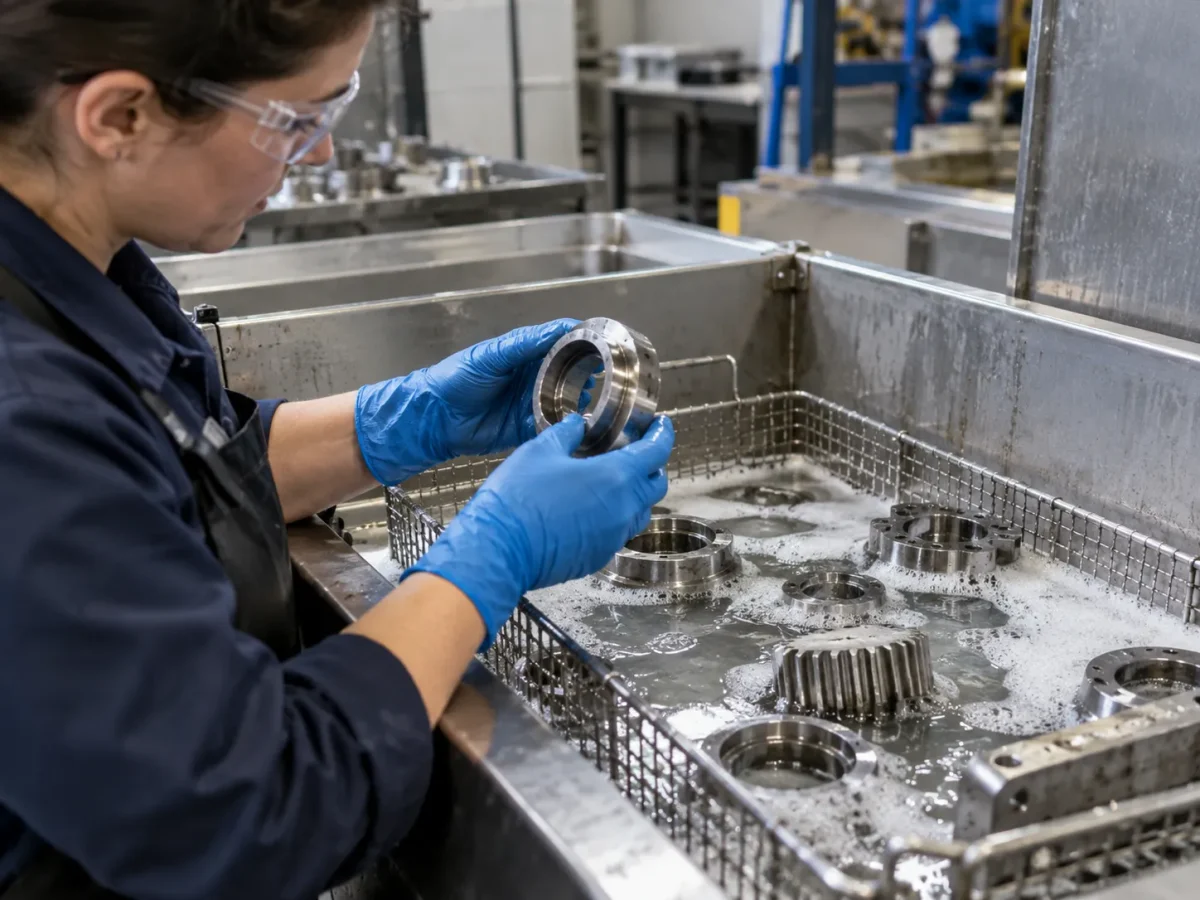
What Analytical Methods Are Used for Cleaning Composition Analysis?
No single instrument can fully characterize a complex cleaner.
A water-based degreaser may contain ionic surfactants, nonionic surfactants, inorganic salts, alkaline builders and low-level organic additives, all of which behave differently during analysis.
FTIR for Initial Chemical Screening
FTIR is useful for recognizing major organic functional groups and comparing overall formulation fingerprints.
It can help screen for:
surfactant families, organic solvents, polymeric additives and other major organic components.
However, similar surfactants can generate overlapping spectra, so FTIR alone generally cannot resolve an entire cleaning formulation.
HPLC and LC-MS for Polar and Non-Volatile Components
HPLC or LC-MS can be useful for selected non-volatile organic components such as nonionic surfactants, chelating agents, preservatives and other polar additives.
Quantification requires an appropriate analytical method and, where necessary, suitable reference standards.
The result should therefore distinguish between confirmed quantitative data and semi-quantitative formulation estimates.
GC-MS for Solvents and Organic Additives
GC-MS is particularly useful for volatile and semi-volatile ingredients.
Typical applications include:
solvent identification, fragrances, selected organic auxiliaries, defoamer-related organic components and extractable formulation ingredients.
Highly ionic surfactants are usually not well suited to direct GC-MS analysis without appropriate sample preparation.
Ion and Elemental Analysis for Inorganic Builders
Ion chromatography can help characterize selected inorganic and ionic species, while ICP-OES, ICP-MS or other elemental techniques can provide supporting information on sodium, silicon, phosphorus and other relevant elements.
For example, a silicate builder should not be identified from one generic anion result alone. Elemental silicon information, alkalinity data and complementary chemistry can provide a more defensible interpretation.
Titration for Active Matter and Alkalinity
Traditional wet-chemistry methods remain useful.
Total alkalinity, acid/base capacity and selected surfactant-active matter can sometimes be quantified more directly by titration than by sophisticated spectroscopy.
For example, ISO 2271 specifies a direct two-phase titration procedure for determining anionic-active matter in applicable detergent systems.
Can a Lab Determine the Exact Cleaning Formula?
Sometimes selected ingredients can be identified and accurately quantified.
In other cases, results are better reported as an approximate concentration or formulation range.
This is because commercial cleaners may contain:
proprietary raw-material blends, homologous surfactant distributions, trace additives, complex reaction products or commercial additives that themselves contain multiple ingredients.
A professional report should therefore distinguish between:
| Result | Interpretation |
|---|---|
| Confirmed identification | Chemical identity supported by suitable analytical evidence |
| Quantified concentration | Determined using a validated or appropriately calibrated method |
| Semi-quantitative estimate | Approximate level based on analytical response |
| Functional formulation estimate | Derived from several complementary methods |
| Suspected / consistent with | Evidence supports the assignment but does not uniquely prove it |
This is more scientifically defensible than promising that every commercial formulation can always be reproduced molecule-for-molecule.
What Matters Most in Cleaning Formula Reverse Engineering?
The most important result is often not the percentage of one surfactant.
It is understanding the formulation architecture.
Surfactant Balance
Anionic surfactants often provide strong detergency but can also contribute to foam and may be more sensitive to hard-water ions depending on the formulation.
Nonionic surfactants can improve oil removal, wetting and performance under different water conditions.
A mixed system may therefore perform differently from a formulation based primarily on a single surfactant.
Builder and Alkalinity System
Increasing alkalinity does not automatically increase cleaning efficiency.
Strong alkalinity may improve removal of some soils but can also increase substrate compatibility problems or corrosion risk.
The important issue is how alkalinity, builders and surfactants are balanced.
Chelation and Water Hardness
Calcium and magnesium can interfere with cleaning chemistry and contribute to deposits or reduced surfactant efficiency.
Chelating agents can improve formulation robustness when tap water or hard water is used.
Foam Control
More foam does not necessarily mean better cleaning.
For industrial tanks, spray systems and circulating cleaning equipment, persistent foam can cause overflow, unstable process control and additional defoamer consumption.
A separate foam-control strategy may therefore be required even when cleaning performance is acceptable.
Case Study: Industrial Water-Based Degreaser Composition Analysis
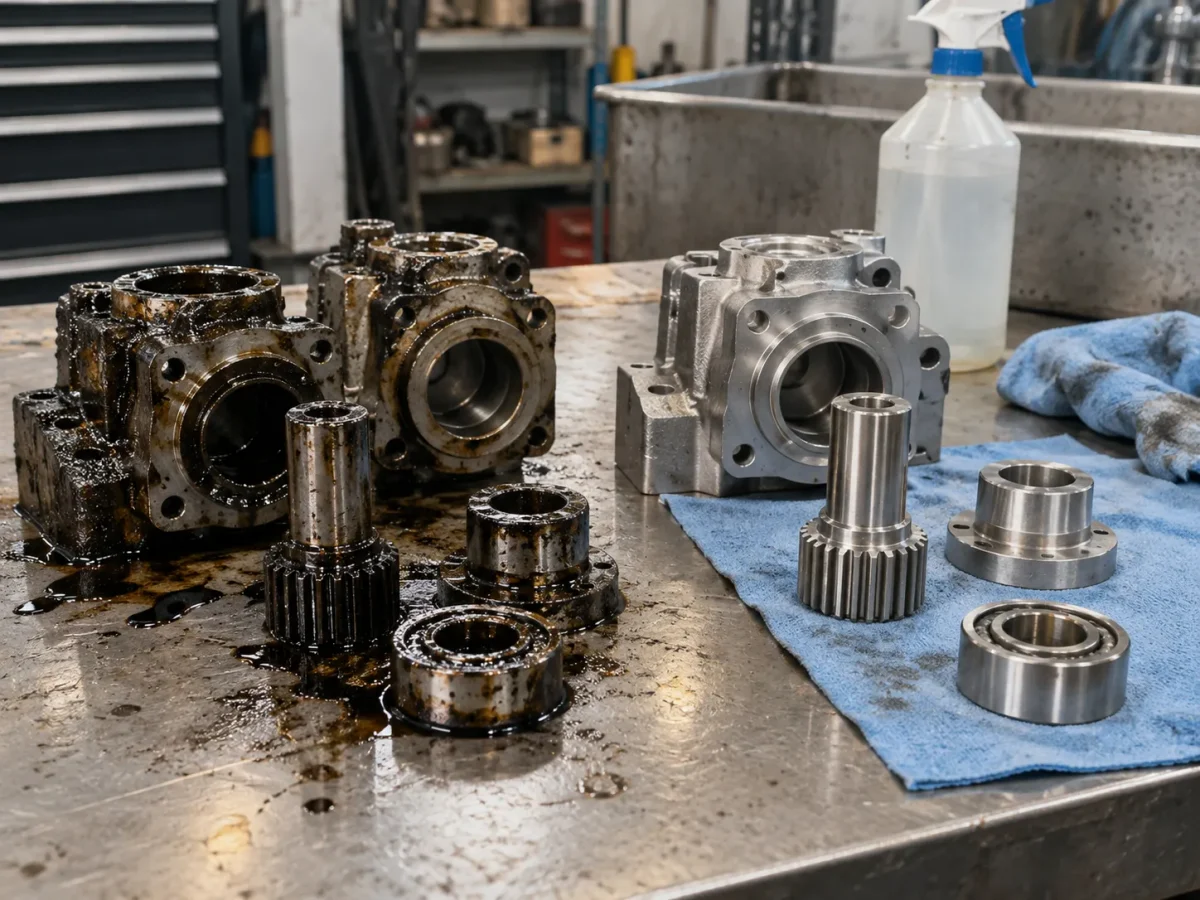
An automotive-parts manufacturer was developing a water-based industrial degreaser for removing stamping oils.
The in-house product met internal requirements for appearance and pH, but production trials revealed three recurring problems.
Heavy-oil removal was incomplete and oily residue remained on some components. Foam accumulated in the cleaning tank and required repeated defoamer additions. Steel parts also showed visible yellow rust after extended post-cleaning storage.
Increasing the surfactant dosage and alkalinity did not solve the cleaning problem and increased concern about metal compatibility.
The company therefore submitted an imported benchmark cleaner and its own formulation for comparative cleaning composition analysis and formula reverse engineering.
How the Benchmark Cleaner Was Analyzed
The project used complementary methods rather than treating one instrument result as the complete formula.
FTIR provided initial chemical-class screening.
Chromatographic methods were used to investigate nonionic surfactants and selected organic additives.
GC-MS supported identification of extractable and semi-volatile organic components.
Ion, elemental and wet-chemistry analysis supported characterization of inorganic builders, alkalinity and selected surfactant-active matter.
Laboratory performance comparisons were then used to determine whether the chemical differences were consistent with the observed differences in oil removal, foam behavior and corrosion.
Approximate Composition of the Benchmark Cleaner
The benchmark formulation was reconstructed as an analytical estimate based on the combined data rather than as a direct one-instrument measurement.
| Functional System | Component Identified / Consistent With | Approx. wt.% |
|---|---|---|
| Carrier | Deionized water | 65.7 |
| Anionic surfactant | Linear alkylbenzene sulfonate (LAS) | 8.2 |
| Nonionic surfactant | Fatty alcohol ethoxylate, AEO-9-type | 6.1 |
| Foam / surfactant auxiliary | Cocamide DEA-type material | 3.3 |
| Alkaline builder | Sodium metasilicate | 10.5 |
| Chelating system | Sodium gluconate | 4.2 |
| Metal-control additive | Triazole-type component | ~0.3 |
| Foam control | Silicone-type defoamer emulsion | ~0.2 |
| Other minor additives | Preservative / pH adjustment components | ~1.5 |
One important scientific qualification was made during interpretation.
The trace triazole-type component should not be treated as the principal steel-corrosion inhibitor simply because it was detected. Benzotriazole-type chemistry is more strongly associated with protection of copper and copper alloys.
For the steel-cleaning application, the controlled alkaline/silicate environment and overall formulation balance were more relevant to corrosion behavior.
What Was Different in the In-House Cleaner?
The customer formulation showed a substantially simpler chemical architecture.
Selected analytical findings included:
| Formulation Area | In-House Cleaner |
|---|---|
| Water phase | Tap-water based |
| Main surfactant | LAS-type anionic surfactant, ~7.8% |
| Alkalinity | Sodium carbonate + sodium hydroxide, selected quantified fraction ~11.2% |
| Nonionic surfactant | No comparable benchmark-level nonionic system identified |
| Chelating system | No comparable gluconate-type chelator identified |
| Dedicated foam-control system | No comparable silicone defoamer identified |
| Corrosion-control architecture | Simpler than benchmark |
The original internal formulation table did not produce a defensible complete 100% analytical mass balance, so these results should be understood as selected quantified components and comparative findings, not as a reconstructed complete recipe.
That distinction is important in formula reverse engineering.
Why the Cleaner Was Failing
The Surfactant System Was Too Simple
The benchmark combined an anionic LAS-type surfactant with a nonionic alcohol ethoxylate.
The in-house cleaner relied primarily on the anionic system.
The analytical evidence suggested that the customer was not simply using “too little surfactant.” The formulation lacked the same complementary surfactant architecture found in the benchmark.
This helped explain why repeatedly increasing LAS did not produce a proportional improvement in heavy-oil removal.
Hard-Water Control Was Weak
The benchmark contained sodium gluconate, while the in-house cleaner used tap water and did not show a comparable chelation system.
This difference was technically important.
Calcium and magnesium ions can interfere with cleaning formulations and reduce formulation robustness. The chelator in the benchmark helped manage these ions rather than relying only on higher alkalinity.
Alkalinity Was Not Properly Balanced
The in-house product depended heavily on sodium carbonate and sodium hydroxide.
Increasing these components raised alkalinity but did not rebuild the missing surfactant or chelation systems.
The benchmark instead used a broader builder system that included sodium metasilicate together with surfactant and chelation chemistry.
The lesson was not that metasilicate is universally “better” than NaOH.
The problem was that the customer’s formulation depended too strongly on alkalinity as the solution to a multi-factor cleaning problem.
Foam Control Was Missing
The customer formulation did not contain a comparable dedicated foam-control system.
At the same time, it relied strongly on a high-foaming anionic surfactant.
This was consistent with the production problem of persistent tank foam.
Increasing surfactant loading therefore risked worsening one of the problems the R&D team was trying to solve.
Formula Reverse Engineering Guided the Optimization
The analytical results changed the R&D approach.
Instead of continuing to increase surfactant concentration and alkalinity, the formulation was adjusted around four functional systems.
The LAS-type surfactant was combined with an AEO-9-type nonionic surfactant.
The strong-alkali balance was reduced and the builder system was adjusted to provide more controlled alkalinity.
Sodium gluconate was introduced to improve hard-water management.
A silicone-type defoamer was introduced at an application-appropriate level.
The purpose was not to copy every benchmark ingredient exactly.
It was to reproduce the functional logic behind the benchmark cleaner.
Performance Verification After Reformulation
In the customer’s project-specific validation, the optimized formulation achieved an oil-removal result of approximately 94.7%, compared with approximately 96.2% for the imported benchmark under the same internal comparison conditions.
Foam height was reduced by approximately 70% relative to the original in-house formulation.
After the customer’s steel-coupon exposure test, no obvious rust was observed after 24 hours under the specified project conditions.
These results should be interpreted as case-specific development data, not universal performance claims for all cleaning products.
The important outcome was that the analytical results identified why adding more surfactant or more caustic alkalinity had failed to solve the original problem.
Cleaning Composition Analysis for Supplier and Batch Comparison
Formula reverse engineering is not only used to analyze competitors.
It can also help when an existing supplier changes.
A manufacturer may notice:
different foam, stronger odor, poorer oil removal, new residue, color change or corrosion after receiving a new batch.
Comparative analysis can determine whether measurable differences exist in:
surfactant type, surfactant level, builders, solvents, chelating agents, inorganic salts, additives or contamination.
A retained qualified sample is particularly valuable because it gives the laboratory a direct reference.
Cleaning Composition Analysis for Product Development
For R&D teams, the purpose of analytical benchmarking should not be blind copying.
The stronger approach is:
identify the functional systems → determine the performance-critical differences → rebuild the formulation using suitable raw materials → validate performance.
This can support:
industrial degreasers, metal cleaners, household cleaners, detergent products, descaling cleaners, maintenance chemicals and other formulated cleaning products.
What Samples Should Be Sent for Formula Reverse Engineering?
The most informative project normally includes both the target cleaner and a suitable reference.
For example:
competitor product vs. your formulation, approved batch vs. abnormal batch, or high-performing cleaner vs. poorly performing cleaner.
Information about substrate, soil type, dilution ratio, cleaning temperature, water hardness, foam problem, corrosion issue and current formulation knowledge can significantly improve the analytical plan.
Without this application information, the laboratory may identify ingredients but still lack the context needed to explain why they matter.
How Xinbodi Supports Cleaning Composition Analysis
Xinbodi provides cleaning composition analysis, cleaning product deformulation and formula reverse engineering for industrial and commercial formulations.
Depending on the product, the analytical workflow can combine spectroscopy, chromatography, elemental and ionic analysis, titration and targeted performance comparisons.
The objective is not simply to generate an ingredient list.
Xinbodi helps manufacturers understand:
what is in the cleaner, how the formulation is structured, what differs from a reference product, and which differences may explain performance.
For projects focused primarily on ingredient identification and selected quantification, Xinbodi’s composition analysis services can be used to characterize the product.
For competitor benchmarking, formulation reconstruction or product redevelopment, deformulation and chemical reverse engineering provides the deeper analytical framework needed to connect composition with formulation design.
Whether the problem is poor oil removal, excessive foam, residue, corrosion, supplier variation or the need to develop an alternative to an imported cleaner, a structured cleaning composition analysis project can reduce trial-and-error and provide a clearer technical direction for formulation development.