
A makeup setting spray can contain only a few recognizable ingredients on its label while still being difficult to reproduce successfully.
Two formulas may list glycerin, PVP, Zinc PCA, sodium hyaluronate and botanical extracts, yet differ significantly in oil-control duration, film flexibility, hydration, spray feel and makeup wear. The reason is that product performance depends not only on which ingredients are present, but also on their concentrations, raw-material grades, molecular-weight distributions, polymer combinations and formulation balance.
Cosmetic formulation analysis uses complementary analytical techniques to identify and quantify selected ingredients, characterize polymers and functional systems, compare a benchmark with an in-house formula, and support cosmetic formula reverse engineering.
For cosmetic brands, OEM manufacturers and product-development teams, this approach can reduce trial-and-error when an INCI list alone does not provide enough information to rebuild a benchmark product.
Xinbodi provides cosmetics testing and formulation analysis together with deformulation and chemical reverse engineering for skincare, makeup, haircare and other formulated cosmetic products.
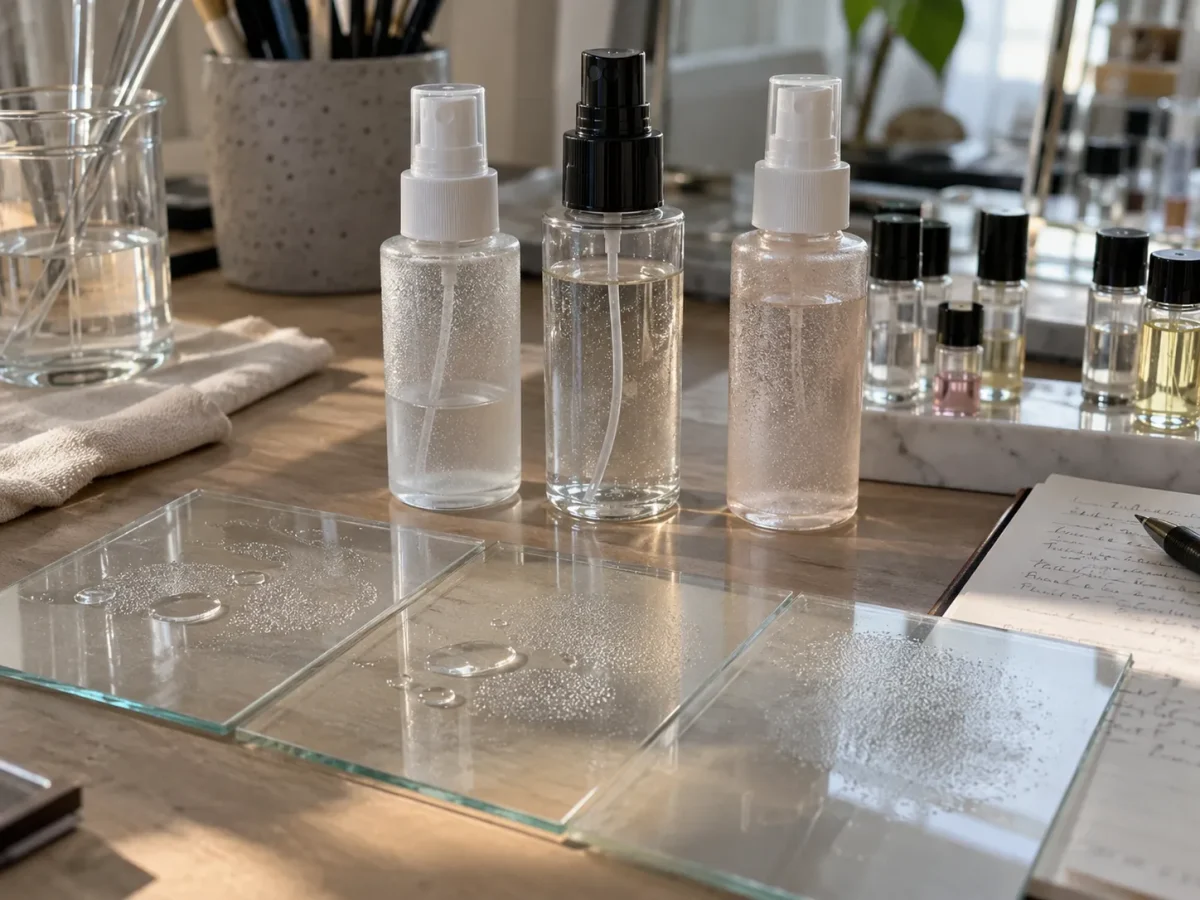
What Does Cosmetic Formulation Analysis Reveal?
Cosmetic formulation analysis is more than identifying an ingredient list.
A useful analysis attempts to determine how the formulation is constructed and which ingredient systems are responsible for product performance.
For a makeup setting spray, the investigation may include:
| Formulation Area | What the Analysis May Determine | Why It Matters |
|---|---|---|
| Film-forming polymers | Polymer identity, molecular characteristics and approximate ratios | Makeup setting, flexibility, tack and wear |
| Humectants | Glycerin, glycols, hyaluronate and selected concentrations | Hydration and skin feel |
| Oil-control ingredients | Zinc PCA and other functional ingredients | Sebum-control positioning |
| Soothing ingredients | Selected botanical or defined active ingredients | Product positioning and skin feel |
| Volatile ingredients | Solvents, fragrance components and volatile silicones | Drying and sensory characteristics |
| Buffer / chelation system | Selected salts, chelators and pH-control components | Formulation stability |
| Particulate systems | Particle-size populations and inorganic carrier materials | Dispersion and delivery behavior |
The goal is not simply to generate a longer ingredient list.
The commercially useful question is:
How is the formula built, and why does the benchmark perform differently from the product we are developing?
Why Is the INCI List Not Enough to Reverse Engineer a Cosmetic Formula?
An INCI list is extremely useful, but it is not a manufacturing formula.
Under the EU Cosmetics Regulation, ingredients are generally listed in descending order of weight at the time they are added, while ingredients below 1% may be listed in any order after ingredients present above 1%. This means the label does not disclose exact concentrations for most ingredients.
An ingredient list also normally does not reveal:
the molecular weight of a polymer, the ratio between two film formers, the grade of a commercial raw material, the molecular-weight distribution of hyaluronic acid, the concentration of a fragrance mixture, or the way multiple functional ingredients are combined.
This is why two setting sprays with apparently similar INCI lists can behave differently.
For example, listing PVP tells an R&D team that a film-forming polymer is present. It does not tell them its molecular characteristics, concentration or whether it is being combined with another polymer to improve flexibility and makeup wear.
Cosmetic formulation analysis fills this information gap.
What Ingredients Matter Most in Makeup Setting Spray Formulations?
A setting spray typically needs to balance several functions that can work against one another.
How Do Film Formers Affect Setting Performance?
Film-forming polymers create a thin layer after the spray is applied and the volatile phase evaporates.
This layer can improve makeup adhesion and wear, but an overly rigid or concentrated film-forming system may produce tightness, tack, flaking or poor sensory properties.
Research on film-forming formulations shows that performance depends strongly on the relationship between polymer selection, solvents, plasticization and the properties of the resulting film.
This is why reverse engineering should characterize the polymer system, rather than merely confirm that PVP or an acrylates polymer is present.
Why Does the Humectant System Matter?
Setting sprays often need to produce a lightweight film without leaving the skin feeling excessively dry.
Humectants such as glycerin, propylene glycol and sodium hyaluronate can influence water retention, spray feel and the sensory balance of the dried film.
Determining the concentration and, where relevant, molecular characteristics of these materials can therefore help explain why two products with similar ingredient lists feel different after application.
Can Oil-Control Ingredients Be Quantified?
Selected cosmetic actives can often be quantified when a suitable analytical method and reference standard are available.
For example, Zinc PCA may require complementary determination of the organic PCA component and zinc rather than assuming that one generic chromatographic peak represents the complete ingredient.
Niacinamide and dipotassium glycyrrhizate can be investigated using appropriately developed chromatographic methods.
The appropriate method depends on the matrix, concentration and required accuracy.
How Do Laboratories Reverse Engineer a Makeup Setting Spray?
No single instrument can reconstruct an entire cosmetic formulation.
A setting spray can contain small polar molecules, volatile materials, polymers, salts, trace additives and particulate components in the same sample.
A multi-method strategy is therefore normally required.
Which Analytical Methods Are Used for Cosmetic Formulation Analysis?
HPLC and LC Methods for Selected Cosmetic Actives
Targeted liquid chromatography can be used to quantify selected non-volatile active ingredients and functional components where suitable standards and methods are available.
Examples may include niacinamide, dipotassium glycyrrhizate and other defined cosmetic ingredients.
Quantitative results should be distinguished from semi-quantitative estimates, particularly when authentic standards are unavailable.
GC-MS for Volatile and Semi-Volatile Ingredients
GC-MS can support identification of:
fragrance components, selected solvents, volatile silicones, emollient-related compounds and other extractable organic ingredients.
It is particularly useful when a product’s sensory characteristics or volatile profile differ from a benchmark.
GPC/SEC for Polymer Molecular-Weight Distribution
Polymer identity alone may not explain film performance.
GPC or SEC can help characterize molecular-weight distributions in polymeric ingredients and distinguish differences between benchmark and in-house polymer systems.
For sodium hyaluronate, molecular-weight distribution can also be relevant because products may use more than one molecular-weight fraction rather than a single uniform grade.
FTIR for Polymer and Raw-Material Identification
FTIR provides supporting information for film-forming polymers, silicones and other major organic materials.
However, overlapping signals mean that FTIR generally should not be used alone to reconstruct a complex cosmetic formula.
Ion and Elemental Analysis
Ion chromatography and elemental analysis can support investigation of ionic ingredients, salts and metal-containing actives.
This can be particularly useful when interpreting buffering systems, chelating systems or zinc-containing ingredients.
Particle Analysis for Dispersed Systems
Some cosmetic formulations contain dispersed particles or carrier systems.
Particle-size measurement can determine whether a distinct particle population exists and characterize its approximate size distribution.
However, particle-size data alone cannot prove that a particular active ingredient is physically encapsulated inside a specific carrier. Confirming an encapsulation structure may require additional separation, microscopy or localized chemical analysis.
Can Cosmetic Reverse Engineering Determine Exact Ingredient Percentages?
Not every ingredient can always be assigned an exact percentage.
A realistic formulation-analysis project produces different levels of certainty depending on the component.
| Result Type | What It Means |
|---|---|
| Quantified component | Concentration measured using an appropriate quantitative method |
| Semi-quantitative component | Approximate concentration estimated from analytical response |
| Polymer characterization | Identity, molecular distribution or comparative polymer information |
| Functional-system estimate | Composition inferred by integrating several analytical results |
| Identified trace component | Presence supported, but concentration may not be reliably quantified |
Major actives and selected formulation components can often be measured more accurately than trace fragrance materials, botanical extracts or proprietary raw-material blends.
A professional reverse-engineering report should clearly separate measured results from formulation interpretation.
Case Study: Reverse Engineering a Benchmark Makeup Setting Spray
A European cosmetics OEM manufacturer had an established formulation and production team but did not operate an independent analytical laboratory.
The company planned to develop a setting spray based on a successful benchmark product positioned around oil control, hydration and makeup setting.
Its formulation team had already reviewed the public ingredient list and produced initial prototypes.
However, several important questions remained unresolved.
The ingredient list did not reveal accurate concentrations for the key functional ingredients. The development team also did not know the characteristics of the film-forming polymer system, the molecular-weight profile of the sodium hyaluronate system, or whether low-level formulation components had been omitted from its prototype.
Repeated formulation trials therefore involved substantial guesswork.
The company submitted the benchmark setting spray and its own development sample for comparative cosmetic formulation analysis and reverse engineering.
What Did the Setting Spray Analysis Need to Answer?
The project focused on four practical R&D questions.
First, were the estimated concentrations of the known functional ingredients correct?
Second, was the benchmark using a more complex film-forming system than the development formula?
Third, were additional low-level functional components present that were important to formulation stability or performance?
Finally, how did the overall formulation architecture differ between the benchmark and prototype?
The analytical plan was designed around those questions rather than applying a standard cosmetic testing package.
What Did Quantitative Analysis Reveal?
The customer had already estimated concentrations based on its interpretation of the ingredient list.
Targeted laboratory analysis showed that several estimates were inaccurate.
| Functional Category | Component | Customer Estimate | Analytical Result |
|---|---|---|---|
| Humectant | Glycerin | 3–5% | ~2.1% |
| Humectant | Propylene glycol | 2–4% | ~3.5% |
| Oil-control active | Zinc PCA | 0.5–1.0% | ~0.3% |
| Supporting active | Niacinamide | 1–2% | ~0.8% |
| Humectant | Sodium hyaluronate | 0.05–0.10% | ~0.08% |
| Soothing active | Dipotassium glycyrrhizate | 0.10–0.30% | ~0.15% |
Several values were below the concentrations initially assumed by the development team.
This was an important finding because it showed that simply adding more of a recognizable active ingredient would not necessarily reproduce the benchmark’s performance.
The formulation structure mattered more than maximizing individual actives.
Why Was Sodium Hyaluronate More Complex Than the INCI List Suggested?
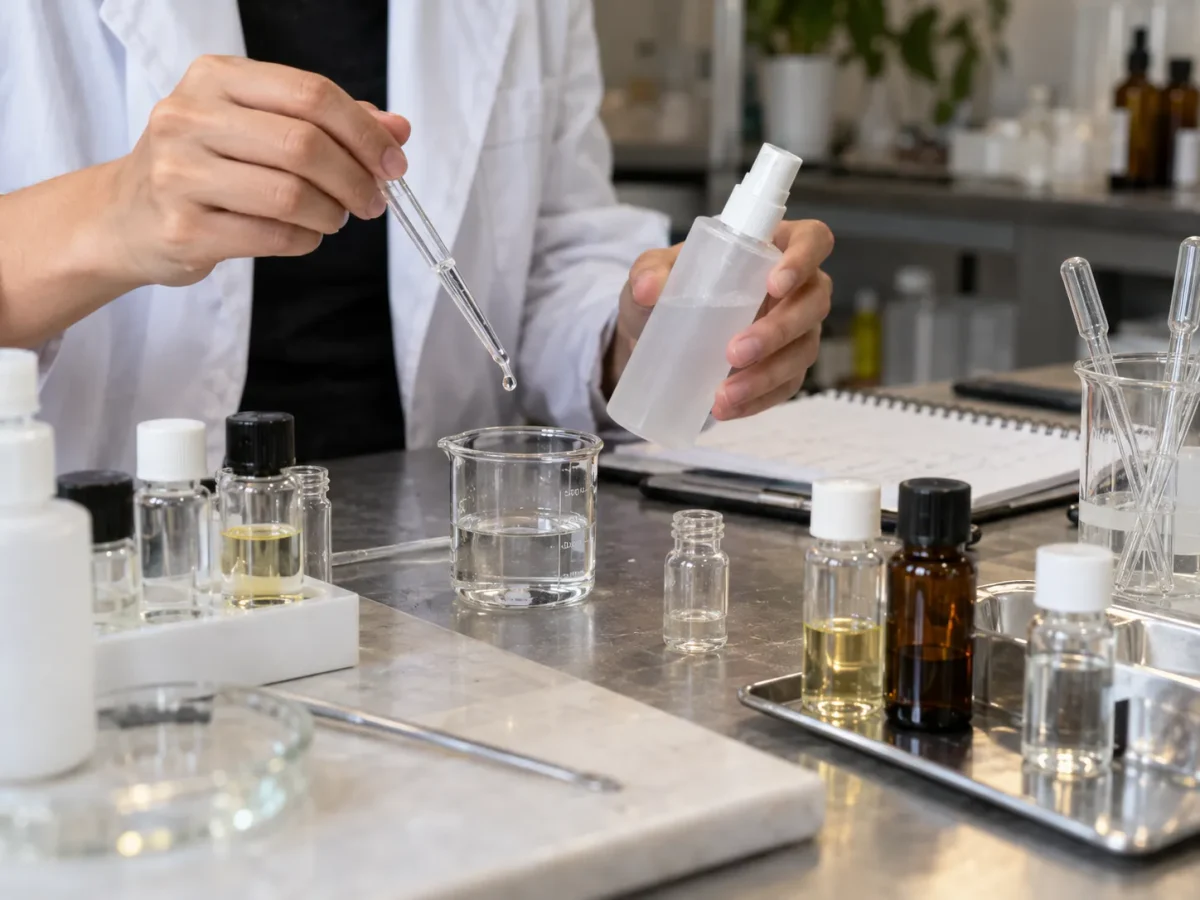
The ingredient declaration showed sodium hyaluronate, but polymer characterization indicated that the benchmark was not behaving like a single narrow molecular-weight fraction.
The analysis was consistent with a bimodal sodium hyaluronate distribution, with higher- and lower-molecular-weight fractions present at an approximate ratio close to 2:3.
This finding changed the customer’s approach.
Instead of treating sodium hyaluronate as one interchangeable raw material, the development team considered molecular-weight distribution as part of the formulation design.
The analytical result should not be interpreted as proof that one fraction penetrates to a particular skin depth. Rather, it showed that the benchmark used a more deliberately structured polymer distribution than the prototype.
What Hidden Film-Forming System Was Found?
The customer’s prototype relied largely on a single PVP-type film former.
The benchmark showed a more complex polymer profile.
Integrated FTIR and polymer-characterization results were consistent with a combination of:
PVP K30-type material + Acrylates/Octylacrylamide Copolymer, at an approximate polymer ratio near 3:1.
This provided a plausible explanation for why the benchmark could achieve stronger setting performance without relying on a single high loading of PVP.
Using two film-forming polymers can allow the formulation developer to balance properties such as film strength, flexibility, adhesion and sensory feel.
The analysis therefore redirected the development team from asking:
“How much more PVP should we add?”
to:
“What polymer architecture is needed to reproduce the benchmark film?”
That is one of the key differences between ingredient identification and true cosmetic formula reverse engineering.
Were Additional Low-Level Functional Ingredients Identified?
The analysis also indicated additional formulation features that had not been incorporated into the original prototype.
A particulate carrier system was observed in the benchmark, with a particle population around the submicron range. Chemical evidence was consistent with a silica-containing carrier associated with zinc-containing and botanical components.
The evidence supported a structured particulate system, although particle-size measurement alone was not treated as proof of the exact encapsulation architecture.
The benchmark also contained a low-level buffering and chelation system.
Approximately 0.05% disodium hydrogen phosphate was consistent with a buffering role, while approximately 0.03% disodium EDTA was associated with trace-metal chelation and formulation stability.
Importantly, EDTA was not interpreted as a pH buffer itself.
These were low-concentration ingredients, but they demonstrated why looking only at the headline actives would not fully explain the formulation.
What Was the Benchmark Setting Spray’s Formulation Logic?
The most useful result of the project was not a single percentage.
It was understanding how several systems worked together.
The benchmark could be interpreted as three interconnected functional systems rather than a literal physical three-layer structure.
Film-Forming System
A combined polymer system provided the primary setting film.
Instead of depending entirely on PVP, the benchmark balanced PVP-type chemistry with an acrylates-based film former.
Humectant System
Glycerin, propylene glycol and more than one sodium-hyaluronate molecular-weight fraction supported the hydration side of the formula.
This helped the development team understand why increasing only glycerin had not reproduced the benchmark feel.
Oil-Control and Stability System
Zinc PCA and supporting functional ingredients were combined with a particulate/carrier component, while buffer and chelation chemistry helped maintain formulation consistency.
The key insight was that setting, hydration and oil control were being designed as one formulation system, rather than as unrelated ingredient claims.
How Did the Analysis Support Formula Development?
Based on the analytical findings, the European OEM adjusted its development formula.
The team reduced its dependence on estimated INCI concentrations and recalibrated selected actives around the measured benchmark levels.
It introduced a mixed molecular-weight sodium hyaluronate strategy, revised the film-forming system toward a multi-polymer design, incorporated the missing stability components and further evaluated the particulate oil-control system identified in the benchmark.
After three formulation iterations, the customer reported that its selected internal performance indicators reached more than 90% of the benchmark target and the revised sample passed its internal product-acceptance process.
These results are specific to this project and should not be interpreted as universal performance claims for setting sprays.
The commercial value was that the development team could focus its formulation trials on measured differences rather than continuing broad trial-and-error adjustments.
Can Cosmetic Formulation Analysis Reproduce a Benchmark Product Exactly?
Not always.
Even a detailed chemical analysis cannot automatically recreate:
the original manufacturing order, mixing energy, raw-material supplier, polymer microstructure, fragrance formula, botanical extract composition or every trace additive.
Reverse engineering should therefore be treated as a technical reconstruction process, not a promise of a perfect molecular copy.
The most useful outcome is usually a defensible formulation profile that tells the R&D team:
what is present, approximately how much is present, which raw-material characteristics matter and how the functional systems appear to work together.
Prototype formulation and performance validation are still required.
When Should a Cosmetics OEM Use External Formulation Analysis?
External analysis is particularly useful when an internal development team has strong formulation capability but lacks specialized analytical resources.
Typical situations include competitor benchmarking, imported-product replacement, repeated prototype failure, uncertainty about polymer or active concentrations, supplier substitution and projects where an INCI list does not provide enough information to guide development.
In these projects, analytical work complements the customer’s formulator rather than replacing them.
The laboratory provides chemical evidence; the formulation team uses that evidence to design and validate the final product.
What Samples Should Be Submitted for Cosmetic Formula Reverse Engineering?
For benchmark projects, the strongest comparison normally includes both the target commercial product and the customer’s current prototype.
The laboratory should also receive the available INCI list, the intended product claims, known raw materials and the specific performance gaps the development team is trying to solve.
This makes it possible to design the analytical workflow around decisions that actually matter.
For example, a project focused on poor makeup wear requires a different emphasis from one focused primarily on fragrance matching or preservative identification.
What Should a Cosmetic Formulation Analysis Report Include?
A useful report should clearly separate analytical facts from formulation interpretation.
It may include confirmed ingredient identities, quantitative results for selected targets, polymer molecular-weight information, chromatograms and spectra, comparative formulation findings and an explanation of which differences may be technically important.
It should also state the limitations of the analysis.
This is especially important for fragrance mixtures, botanical extracts, proprietary blends and ingredients present at very low levels.
How Xinbodi Supports Cosmetic Formulation Analysis and Reverse Engineering
Xinbodi provides cosmetic formulation analysis for brands, OEM/ODM manufacturers and product-development teams that need to understand how an existing cosmetic product is formulated.
Depending on the product and project objective, chemical composition analysis can be used to identify and quantify selected ingredients, while deformulation and reverse engineering can extend the investigation into formulation architecture, competitor benchmarking and formulation reconstruction.
Projects can include makeup setting sprays, creams, lotions, serums, haircare products, cleansers, color cosmetics, nail products and other complex formulations.
The objective is not simply to copy an INCI list.
It is to determine which ingredients are present, how much of the important components are present, what raw-material characteristics matter, and how the formulation systems work together.
For a cosmetics manufacturer that already knows how to formulate but needs better analytical evidence, cosmetic formulation analysis can shorten the path from benchmark product to technically informed prototype development.