
A cosmetic ingredient list can tell you what ingredients may be present, but it rarely explains how the product was actually formulated.
It does not disclose exact concentrations, commercial raw material grades, trace additives or the relationships between emulsifiers, surfactants, polymers, oils and active ingredients. It also cannot reveal the original manufacturing sequence or processing conditions.
Cosmetic formulation reverse engineering combines sample separation, chemical analysis and formulation interpretation to provide a clearer understanding of how an existing skincare, haircare or color cosmetic product is constructed.
For cosmetic brands and R&D teams, the results can support competitor benchmarking, formulation reconstruction, imported ingredient replacement, supplier evaluation and cost optimization.
What Is Reverse Engineering a Product?
Reverse engineering a product means analyzing an existing product to understand its composition, structure and formulation logic.
In cosmetics, the process is often divided into two related stages:
Cosmetic deformulation focuses on separating, identifying and, where technically feasible, quantifying the ingredients in a finished product.
Cosmetic formulation reverse engineering goes further. It interprets the analytical findings to understand how ingredient systems work together and how the results can support reconstruction or redevelopment.
A reverse engineering project may investigate:
- Oils, esters, waxes and emollients
- Surfactants and emulsifiers
- Silicones and film-forming materials
- Thickeners and polymers
- Preservatives and antioxidants
- Functional active ingredients
- Fragrances and volatile compounds
- Pigments and mineral ingredients
- Low-level additives, impurities or contaminants
The objective is not simply to produce another ingredient list. A useful project should explain the product’s formulation architecture, such as its oil phase, emulsifier system, thickening mechanism, preservative system or surfactant combination.
This information can then provide a technical foundation for prototype development and raw material selection.
What Are Examples of Reverse Engineering?
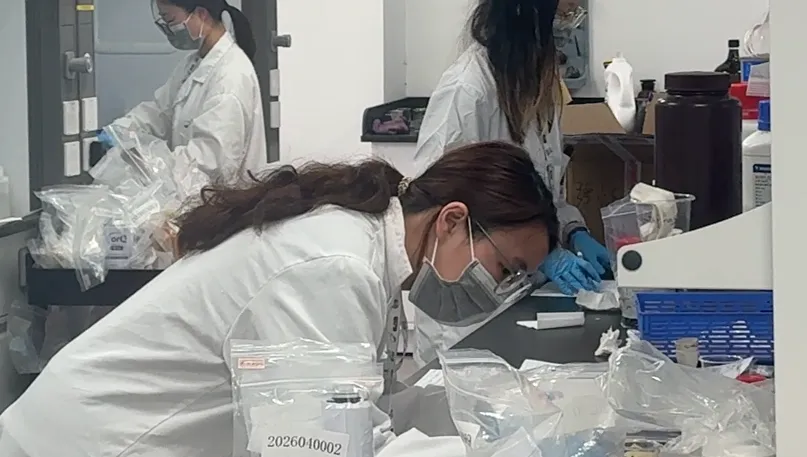
The following Xinbodi Lab cases show how cosmetic formulation reverse engineering can support different product-development objectives.
Imported Anti-Aging Serum Localization
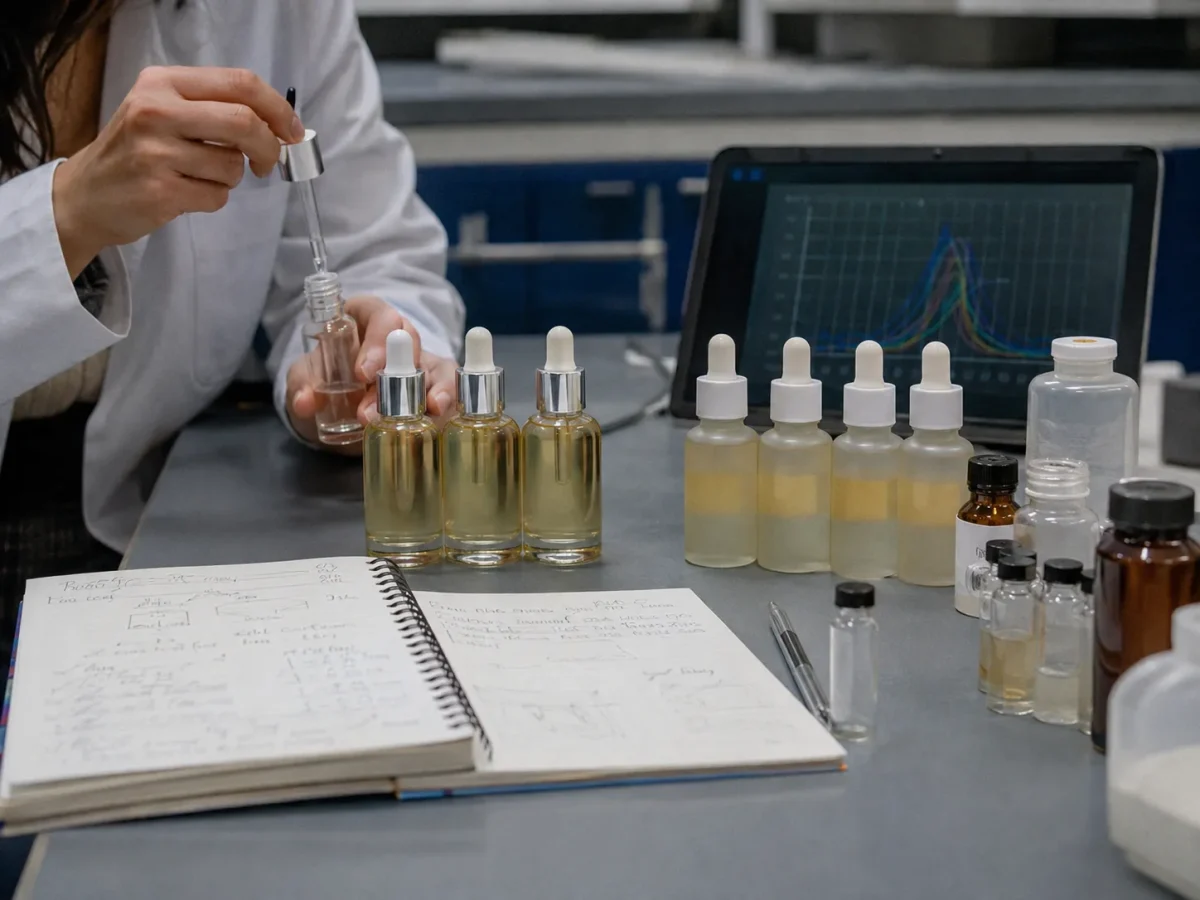
A cosmetic brand wanted to develop a locally sourced alternative to a popular imported anti-aging serum.
The project required more than identifying the INCI ingredients. The reconstructed formulation needed to retain the reference product’s overall formulation characteristics while reducing dependence on imported raw materials.
GC-MS, LC-MS and NMR were used to investigate the water phase, oil phase, active ingredients and preservative system. The analysis detected low-level functional additives and skin-feel modifiers present at below 0.2%.
Reference-spectrum matching helped characterize the main active ingredients and clarify the combined thickener and emulsifier system. The analytical results were then used to guide local raw material selection and laboratory formulation trials.
Project-reported outcome: analytical formulation similarity exceeded 90%, and the use of compatible domestic raw materials reduced total raw material costs by approximately 28%. Skin feel and product performance were verified during subsequent formulation trials.
Premium Shampoo Competitor Benchmarking
A haircare brand wanted to benchmark a premium shampoo and adapt the formulation to its domestic supply chain.
The analysis focused on the surfactant combination, cationic conditioning ingredients, anti-dandruff component, minor conditioning additives and fragrance-delivery materials.
The identified ingredient system provided a basis for adjusting surfactant ratios and selecting alternative domestic raw materials.
Project-reported outcome: formulation similarity exceeded 92%, while raw material costs were reduced by approximately 24%. Client-side product testing also reported improved fragrance retention after formulation optimization.
This project illustrates that reverse engineering can support both competitor analysis and supply-chain adaptation.
Matte Lip Glaze Formulation Reconstruction
A color cosmetics brand wanted to benchmark a popular matte lip glaze while improving excessive dryness and weak color retention in its own product.
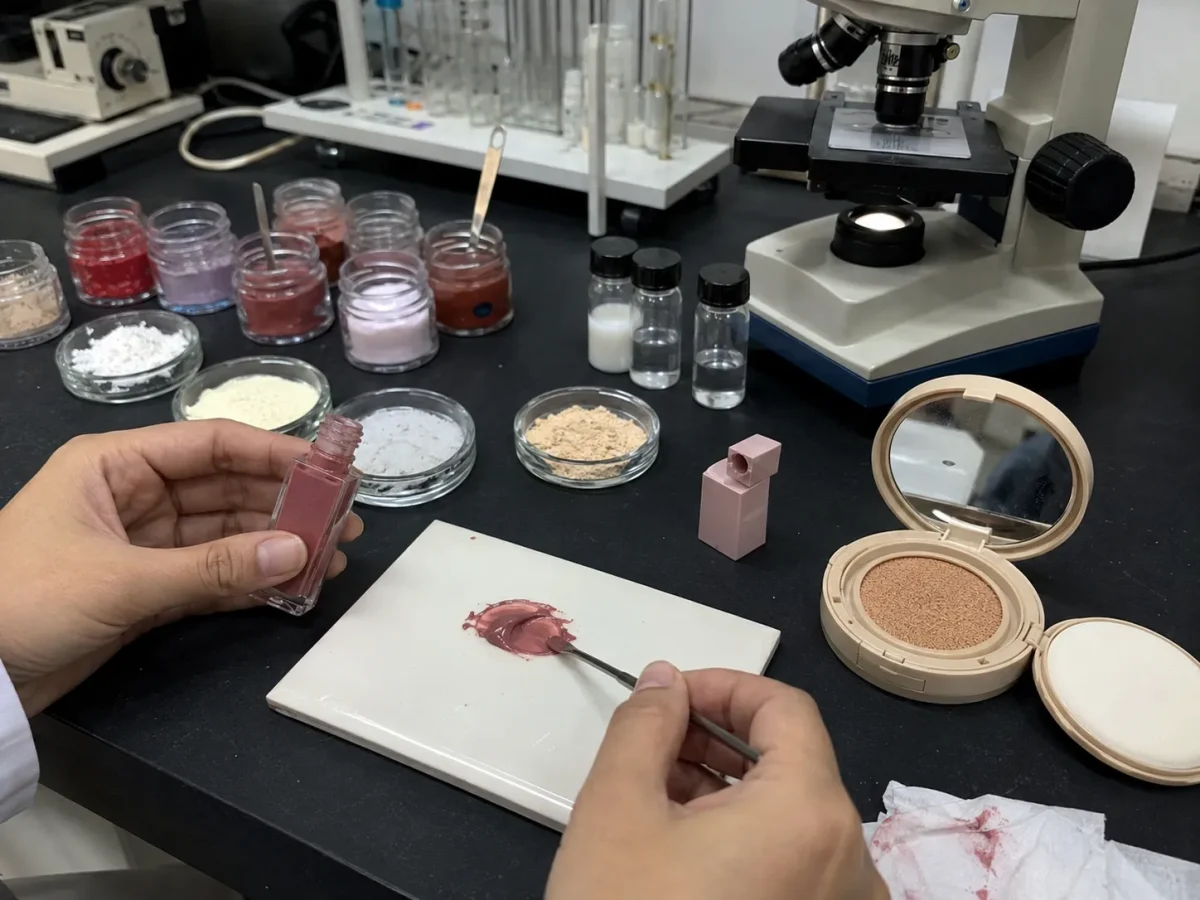
The analytical workflow investigated film-forming agents, silicone oils, pigments, dispersants and low-level film-forming additives.
Microscopic characterization also showed that uneven pigment dispersion was an important difference between the brand’s existing product and the reference sample.
The results were used to guide adjustments to the dispersing process, film-forming system and moisturizing components.
Project-reported outcome: the reconstructed product achieved a finish similar to the reference sample. Subsequent application testing reported a 45% increase in wear time and a production yield of 98%.
Cushion Foundation and Sunscreen System Analysis
A cosmetics brand planned to develop a cushion foundation based on a benchmark product while meeting domestic sunscreen-registration requirements.
The analysis examined the powder system, UV filters, emulsifiers, humectants and surface-treated mineral ingredients. It also evaluated the concentration and coating characteristics of the principal inorganic UV-filter materials.
The analytical findings were used to adjust the UV-filter combination and improve the powder-treatment process.
Project-reported outcome: analytical formulation similarity exceeded 90%. The reformulated product subsequently passed the required sunscreen testing and showed improvements in darkening and uneven powder application.
SPF and PA performance were confirmed through qualified regulatory testing rather than chemical composition analysis alone.
How to Reverse Engineer a Skincare Product?
To reverse engineer a skincare product, the analytical workflow should be designed around the product type and development objective.
A facial serum, cream, cleansing oil and sunscreen product cannot all be analyzed using the same fixed test package.
1. Define the project objective
The laboratory first needs to understand what the client wants to achieve.
Typical objectives include:
- Reconstructing a competitor product
- Replacing imported ingredients
- Comparing two suppliers
- Identifying a claimed active ingredient
- Reducing raw material costs
- Investigating sediment, discoloration or abnormal odor
2. Review the available product information
Useful information may include the INCI list, product claims, known raw materials, application, storage history and reference samples.
The INCI list is valuable, but it does not provide exact concentrations or identify supplier-specific raw material grades. Some commercial cosmetic ingredients are themselves complex blends, while botanical extracts and fragrances can contain many individual substances.
3. Separate the cosmetic formulation
Complex products may contain water-soluble, oil-soluble, volatile, polymeric and inorganic components in the same matrix.
Depending on the sample, the formulation may be separated into:
- Water-phase components
- Oil-phase ingredients
- Volatile compounds
- Polymeric materials
- Pigments and mineral particles
- Insoluble residues or sediment
4. Use complementary analytical methods
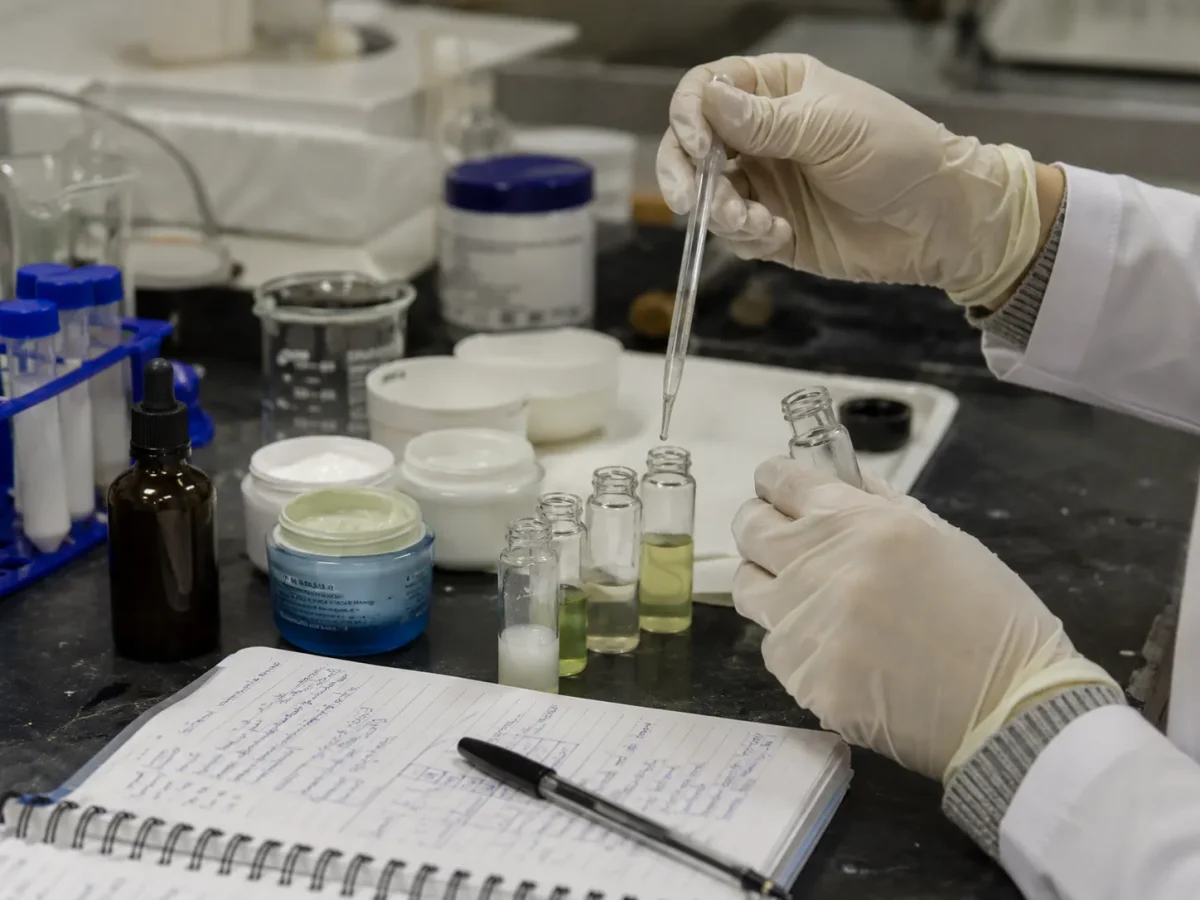
A single instrument is rarely sufficient for complete cosmetic formulation analysis.
The laboratory may combine:
- GC-MS for fragrances, solvents and volatile ingredients
- LC-MS or HPLC for preservatives, UV filters, antioxidants and selected active ingredients
- FTIR for oils, silicones, waxes, surfactants and polymers
- NMR for molecular structure confirmation
- Py-GC-MS and GPC for polymeric ingredients
- ICP, XRF or XRD for pigments, minerals and inorganic materials
- SEM-EDS or Raman for particles, precipitates and localized residues
5. Interpret the formulation as a system
Instrumental results should not be treated as isolated outputs.
The laboratory should evaluate how the identified ingredients may function together, including:
- Emulsifier combinations
- Thickener and polymer systems
- Oil-phase composition
- Surfactant combinations
- Preservative systems
- Fragrance profiles
- Pigment and dispersant systems
6. Support formulation reconstruction
The analytical findings can guide raw material selection, concentration adjustment and laboratory formulation trials.
However, chemical analysis alone does not confirm skin feel, cleansing performance, wear time, SPF or other application properties. These should be verified through formulation trials and appropriate performance or regulatory testing.
What Can Cosmetic Formulation Reverse Engineering Reveal?
The achievable result depends on the product complexity, ingredient concentration, sample separation and availability of reference materials.
A project may provide:
- Identification of major ingredients
- Identification of ingredient classes
- Quantitative or semi-quantitative results
- Approximate formulation ratios
- Oil-phase and water-phase composition
- Surfactant or emulsifier-system information
- Preservative and fragrance profiles
- Competitor or supplier comparison
- Identification of sediment or contaminants
- Technical recommendations for formulation reconstruction
Why Is the INCI List Not Enough for Reconstruction?
Even a complete INCI list does not normally disclose:
- Exact ingredient concentrations
- Supplier-specific raw material grades
- Molecular weight of polymeric ingredients
- Composition of proprietary blends
- Fragrance composition
- Phase-addition sequence
- Processing temperature
- Homogenization conditions
Two products can use similar INCI ingredients and still behave very differently because of concentration, raw material grade or manufacturing process.
Reverse engineering therefore uses the INCI list as supporting information rather than treating it as a complete formula.
What Can Reverse Engineering Not Guarantee?
Cosmetic reverse engineering does not always produce an exact copy of a commercial formulation.
Complex fragrances, botanical extracts, proprietary blends, polymers and very low-level additives can be difficult to identify completely. The original production process may also strongly influence the final product.
A realistic objective is to obtain a technically supported formulation profile that can guide:
- Product reconstruction
- Competitor benchmarking
- Ingredient substitution
- Cost optimization
- Supplier selection
- Prototype development
The reconstructed formula must still undergo appropriate stability, safety, performance and regulatory validation.
Choosing a Cosmetic Reverse Engineering Laboratory
A suitable laboratory should be able to customize the analytical workflow according to the product and project objective.
Important capabilities include sample separation, organic and inorganic analysis, targeted quantification, multi-method verification and formulation-level interpretation.
The laboratory should also explain clearly which conclusions come directly from chemical analysis and which require formulation trials or third-party performance testing.
Need Cosmetic Formulation Reverse Engineering?
Xinbodi Laboratories provides cosmetic formulation analysis, deformulation, ingredient identification, competitor comparison and formulation reconstruction support.
Send us your product sample, available INCI list and development objective. Our technical team will evaluate the formulation and recommend an analytical workflow for reverse engineering, domestic material substitution or product improvement.