
Why Nail Polish Composition Analysis Was Needed
A cosmetics ODM manufacturer was developing a fast-drying, long-wear glossy nail polish to benchmark a premium imported product.
The in-house formula had several persistent problems:
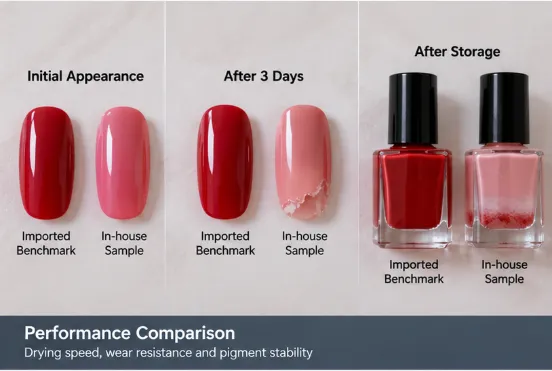
- surface drying took about 2 minutes 40 seconds
- the coating peeled after approximately one day
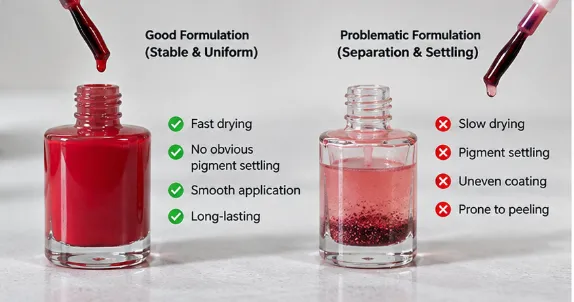
- pigments gradually settled during storage
- the bottle showed visible separation after about one month
- repeated adjustments to solvent and plasticizer levels did not solve the problem
The customer therefore requested nail polish composition analysis and cosmetics formula reverse engineering to understand how the benchmark balanced drying speed, film strength, flexibility, pigment suspension and storage stability.
How the Nail Polish Formula Was Analyzed
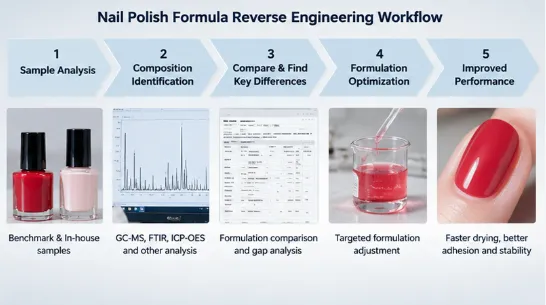
Nail polish is a multi-component lacquer system. Typical formulations combine volatile solvents, film-forming polymers, resins, plasticizers, pigments and suspension agents, so one analytical method is rarely sufficient.
The benchmark and in-house samples were analyzed using a combination of:
- headspace GC-MS for volatile solvent composition
- solvent extraction + GC-MS for plasticizers and organic additives
- FTIR for nitrocellulose, resin and functional-group identification
- centrifugal separation and spectroscopy for pigment characterization
- ICP-OES for selected inorganic elements
- microscopic examination and coating tests for pigment dispersion and film behavior
Analytical studies have demonstrated that GC-MS/MS can be used to identify and quantify selected ingredients in commercial nail products. See this FDA study on cosmetic ingredients in nail products.
This approach helped connect the chemical composition with the observed application problems.
What the Benchmark Nail Polish Composition Revealed
The imported benchmark used a more balanced formulation architecture than the customer’s product.
Solvent System
The benchmark contained a four-solvent system with different evaporation rates, including:
- ethyl acetate
- butyl acetate
- isopropanol
- n-butanol
The combination of fast, medium and slower-evaporating solvents helped provide rapid surface drying without causing excessive shrinkage, bubbling or poor leveling.
This matches the general formulation principle described in nail-polish literature: solvent blends with different boiling points are used to control drying rate and film formation.
Film-Forming System
The benchmark used nitrocellulose as the primary film former, together with an additional resin component.
This combination provided a better balance between:
- hardness
- adhesion
- gloss
- flexibility
- resistance to peeling
The customer’s formula relied on a simpler film-forming system, which contributed to weaker adhesion and shorter wear time.
Plasticizer and Flexibility Differences
The imported product used a blended plasticizer system, while the customer’s formula relied mainly on a single plasticizer.
The benchmark formulation produced a more flexible film without making the coating excessively soft.
The comparison also indicated that the customer’s plasticizer selection created both a performance gap and a potential formulation-compliance concern, making replacement and reformulation necessary.
Why Pigment Settling Occurred
One of the clearest differences was the suspension system.
The imported benchmark contained an organoclay-based suspending component, while the customer’s formulation lacked an equivalent suspension structure.
Without sufficient rheological control:
- pigments settled more easily
- the product separated during storage
- application became less uniform
- color consistency deteriorated
Root Cause of the Nail Polish Performance Gap
The poor performance was not caused by one incorrect ingredient.
The main differences were found in four interconnected areas:
solvent balance + film-forming resin system + plasticizer system + pigment suspension system
The customer’s formulation had:
- an unbalanced solvent profile, causing slower drying and poorer film formation
- a simpler resin system, reducing adhesion and durability
- an unsuitable plasticizer strategy
- insufficient suspension control, leading to pigment settling and separation
This explains why repeatedly increasing only the solvent or plasticizer level did not solve the problem.
Results After Formula Optimization
The customer adjusted the formulation according to the analytical findings rather than copying the benchmark formula directly.
After optimization:
- surface drying time improved from about 2 minutes 40 seconds to approximately 65 seconds
- coating wear improved from about one day to more than three days
- pigment separation was no longer obvious after prolonged room-temperature storage
- the coating became smoother and more uniform
- raw-material cost was reduced by approximately 27% after replacing part of the imported material system
The development cycle was also significantly shortened because the customer could focus on the formulation gaps identified by analysis instead of continuing broad trial-and-error testing.
What This Nail Polish Composition Analysis Shows
A nail polish formula cannot be optimized by looking at solvent content or resin type alone.
Drying speed, gloss, adhesion, flexibility and storage stability depend on how the entire formulation works together.
Nail polish composition analysis and cosmetics formula reverse engineering can help manufacturers understand:
- why a competitor product performs better
- which formulation system is causing slow drying
- why pigments settle or separate
- why the coating chips or peels too quickly
- which raw materials may be suitable for replacement
- where formulation optimization should begin
Nail Polish Formula Reverse Engineering at Xinbodi
Xinbodi provides nail polish composition analysis, cosmetic formulation analysis and formula reverse engineering for cosmetic brands, ODM/OEM manufacturers and product-development teams.
Depending on the formulation and project objective, analysis may cover:
- solvent systems
- film-forming resins
- plasticizers
- pigments
- suspending agents
- UV stabilizers
- preservatives and selected functional additives
If you have a benchmark product and your own formulation, submitting both samples usually provides the most useful comparison for identifying formulation differences and guiding further development.
For broader cosmetic formulation projects, see our cosmetic formulation reverse engineering service.