
Plastic modification is used to improve the properties of existing polymer materials through formulation design, blending, reinforcement and the selection of functional additives.
For manufacturers, the objective is rarely to improve one property in isolation. A plastic component may need higher impact resistance without losing too much stiffness, better heat resistance without becoming difficult to process, or a lower-cost formulation that still meets the required performance specification.
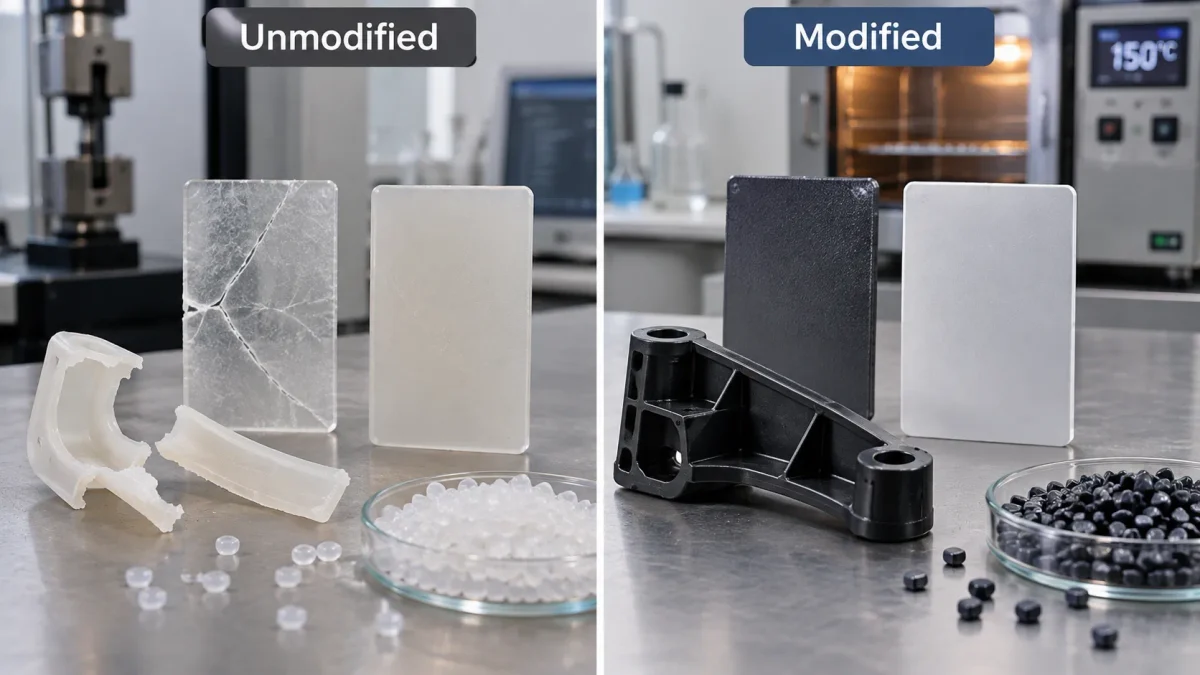
These challenges require more than selecting a resin or adding a modifier. The base polymer, additive system, compatibility, processing behavior and final properties must be considered together.
Xinbodi Laboratories provides plastic modification and formulation development support, including material and formulation analysis, modification strategy development, laboratory prototyping and performance verification.
This article explains the main plastic modification approaches and how they can be applied to industrial material development.
What Is Plastic Modification?
Plastic modification refers to changing a polymer material’s composition or structure to obtain properties better suited to a particular application.
Physical modification commonly involves blending existing polymers, introducing reinforcing materials or incorporating additives without intentionally creating an entirely new polymer backbone. Chemical modification, by contrast, involves chemical reactions such as grafting, functionalization or crosslinking.
In practical compounding projects, these approaches may overlap. For example, a polymer blend may be prepared through physical mixing while a reactive compatibilizer promotes chemical reactions at the interface.
The appropriate strategy depends on the base material, target properties, processing conditions and cost requirements.
| Modification Objective | Common Technical Approach |
|---|---|
| Improve toughness | Elastomer toughening and impact modifiers |
| Increase stiffness and strength | Glass fiber or mineral reinforcement |
| Improve polymer compatibility | Blending and compatibilization |
| Adjust processing behavior | Resin selection, lubricants and processing aids |
| Improve heat resistance | Resin modification, blending and reinforcement |
| Modify appearance or transparency | Resin compatibility, particle selection and morphology control |
| Introduce functional properties | Flame retardants, stabilizers and specialty additives |
For a successful plastic modification project, the first step is to define the required performance—not simply choose an additive.
Plastic Toughening and Impact Modification
Plastic toughening aims to improve resistance to cracking or fracture under impact and deformation.
It is relevant when a product shows brittle fracture, poor low-temperature impact performance or insufficient durability during assembly and use.
Elastomer Toughening
Elastomers can be introduced into certain thermoplastics to improve impact resistance.
Potential modifying materials include selected ethylene-based elastomers, EPDM, SEBS and other impact-modifier systems, depending on the polymer and application.
A dispersed elastomer phase can influence how the material responds to stress. However, the result depends on factors such as particle size, dispersion, interfacial adhesion and modifier concentration.
Adding more elastomer does not necessarily produce a better formulation.
Excessive modification may reduce stiffness, hardness or heat resistance, creating new problems for structural components.
Balancing Toughness and Stiffness
A practical formulation must balance the target impact performance against other requirements.
For example, a modified polypropylene component may require improved impact behavior while retaining sufficient flexural stiffness and dimensional stability.
The development task is therefore to select a suitable modifier system, prepare candidate formulations and compare their properties under relevant conditions.
Xinbodi supports this process through formulation development and laboratory sample preparation, with impact and mechanical testing used to evaluate the resulting material.
Plastic Reinforcement and Stiffness Improvement
Reinforcement is used when a plastic needs higher stiffness, strength or dimensional stability.
Common approaches include glass-fiber reinforcement, mineral filling and the use of other functional reinforcing materials.
Glass-Fiber Reinforcement
Glass fibers can improve the load-bearing behavior of suitable thermoplastics.
Relevant formulation variables include fiber content, fiber length, interfacial adhesion and the compatibility of the reinforcement with the polymer matrix.
A reinforcement system that improves stiffness may also affect flow behavior, surface appearance, impact properties and dimensional changes after molding.
For this reason, fiber selection cannot be separated from processing and end-use requirements.
Mineral Filling
Mineral fillers such as calcium carbonate, talc and other inorganic materials may be used to modify stiffness, dimensional behavior, appearance or formulation cost.
Their effects depend on particle size, morphology, loading, surface treatment and dispersion.
A higher filler content is not automatically advantageous. Poor dispersion or inadequate interfacial adhesion may weaken the material or reduce impact performance.
The development objective is to achieve the required mechanical behavior with a suitable resin–filler–additive combination.
Depending on the project, Xinbodi can combine composition analysis with formulation development and materials testing to investigate the relationship between a modified material’s composition and its performance.
Polymer Blending and Compatibilization
Polymer blending combines two or more polymer materials to obtain a set of properties that may be difficult to achieve with a single resin.
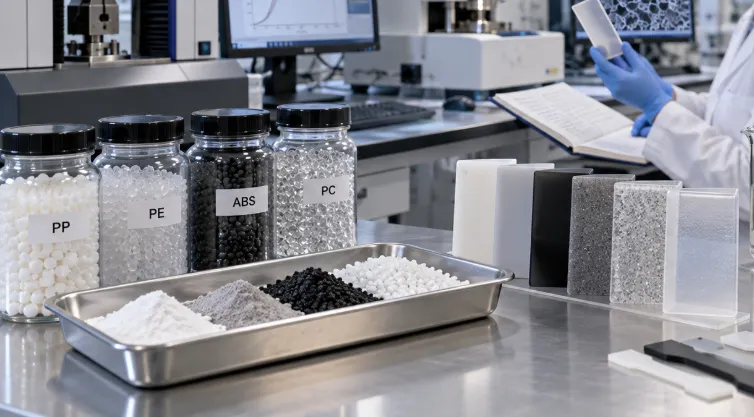
Examples include selected PP/PE, PC/ABS and other engineering-polymer blend systems.
However, two polymers do not necessarily form a compatible blend simply because they can be mixed.
Why Compatibility Matters
In an incompatible blend, the polymer phases may separate into a morphology with weak interfaces.
This can limit mechanical performance even when the individual polymers have desirable properties.
A compatibilizer may improve interactions between the phases, influence dispersed-phase size or strengthen the interface.
Research published in Chemical Reviews, Advances in Nonreactive Polymer Compatibilizers for Commodity Polyolefin Blends, discusses compatibilizer design, blend testing and the relationship between polyolefin-blend structure and mechanical behavior. <Cite refs={[“turn568692search6”]}/>
How Compatibilization Supports Formulation Development
The development process may involve adjusting:
- Base-polymer selection and blend ratio
- Compatibilizer chemistry and concentration
- Modifier and filler systems
- Mixing and processing conditions
- Target mechanical and thermal properties
The effectiveness of a compatibilizer depends on the specific polymer pair and formulation.
A review in Advanced Industrial and Engineering Polymer Research, Compatibilization Phenomenon in Polymer Science and Technology: Chemical Aspects, describes different approaches to polymer-blend compatibilization and emphasizes that the method must be selected according to the intended performance objective. <Cite refs={[“turn568692search7”]}/>
For Xinbodi, blending projects can combine material selection, formulation adjustment, laboratory prototyping and comparative performance testing to identify a suitable development direction.
Improving Plastic Processability and Flow Behavior
A formulation may meet its mechanical targets but still be difficult to manufacture.
Common processing problems include unstable flow, excessive viscosity, poor filler dispersion and inconsistent product appearance.
Plastic modification can address these issues through resin selection, adjustment of the formulation and appropriate processing aids.
Resin and Additive Selection
The base resin’s flow characteristics influence how the material behaves during processing.
A change in resin grade or the introduction of a modifier can affect the formulation’s rheological behavior.
Lubricants and processing aids may also influence friction, flow and material handling, but their selection must remain compatible with the required mechanical and surface properties.
Why Melt Flow Alone Is Not Enough
Melt flow measurements can provide useful comparative information, but they do not describe every aspect of processing behavior.
For more demanding projects, rheological characterization and practical sample evaluation may be needed to understand how formulation changes affect material handling and processing.
The objective is to develop a formulation that can be processed consistently while meeting the required product properties.
Heat Resistance and Functional Plastic Modification
Heat resistance is another common reason for plastic modification.
A component may soften, deform or lose mechanical properties when exposed to its operating environment.
Potential development approaches include selecting a more suitable resin, introducing reinforcement, developing a polymer blend or adjusting the additive system.
However, different thermal measurements answer different questions.
| Property | What It Helps Evaluate |
|---|---|
| DSC transitions | Melting, crystallization and selected glass-transition behavior |
| TGA | Thermal mass-loss and decomposition behavior |
| Heat deflection temperature | Deformation under a specified load and temperature |
| Vicat softening temperature | Softening behavior under specified conditions |
| Mechanical testing after exposure | Property retention following thermal conditioning |
A higher decomposition temperature does not necessarily mean a plastic component will retain its shape under load at a higher service temperature.
The relevant test must be selected according to how the finished product will actually be used.
Functional modification may also involve flame-retardant systems, wear-related properties, stabilization or other application-specific requirements. Each project requires its own formulation and verification plan.
How Xinbodi Approaches Plastic Modification Projects
Plastic modification is an iterative R&D process.
At Xinbodi, projects can connect formulation analysis, modification strategy development, laboratory prototyping and performance verification around a defined material target.
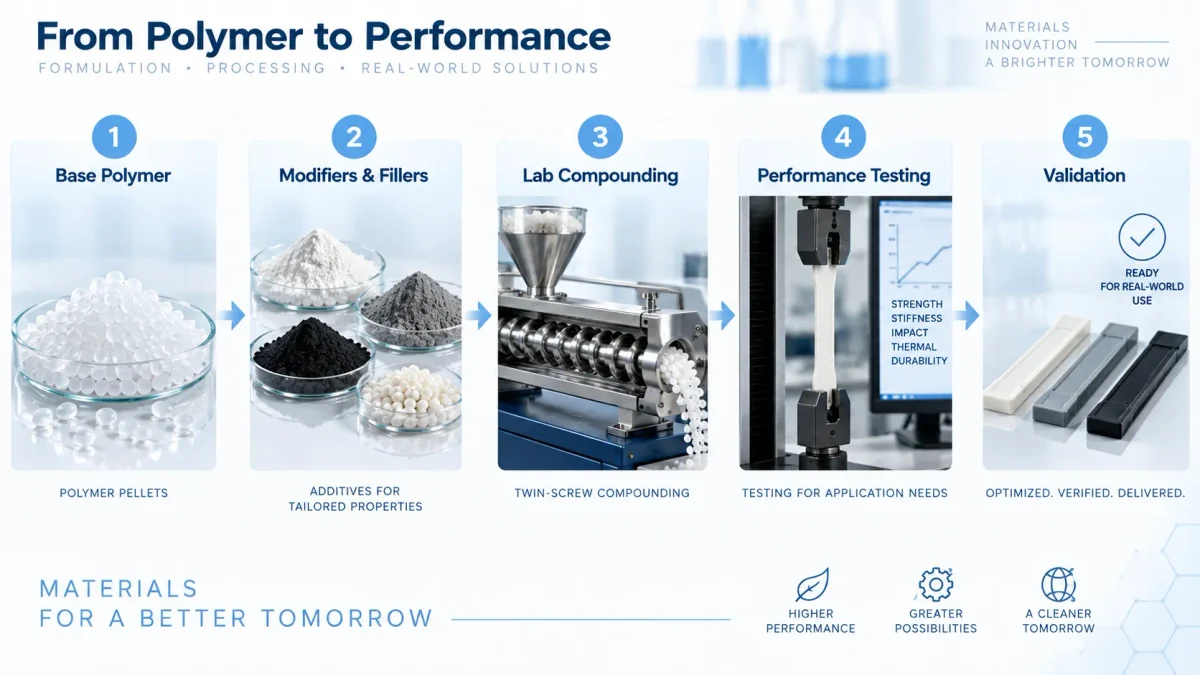
Step 1: Define the Material and Performance Requirements
The project begins with the current material and its application.
Useful information includes the base resin, component geometry, processing method, operating environment, existing performance data and target specification.
A request to “improve toughness,” for example, should be translated into measurable requirements. The formulation may also need to retain acceptable stiffness, appearance, flow and cost.
Step 2: Understand the Existing Formulation
Where an existing product or benchmark is available, chemical composition analysis can help investigate its resin system, fillers, modifiers and selected additives.
If the customer is attempting to reproduce or improve a benchmark material, deformulation and reverse engineering can provide a starting point for identifying meaningful formulation differences.
This information helps narrow the development direction rather than selecting modification ingredients without reference to the original material.
Step 3: Develop the Modification Strategy
The modification plan is selected according to the performance objective.
For example, improving impact resistance may involve an elastomer modifier, while increasing stiffness may call for reinforcement or a different polymer blend.
Candidate formulations should also consider compatibility, processing conditions and possible trade-offs.
Step 4: Laboratory Prototyping
Xinbodi undertakes laboratory sample preparation and formulation trials to evaluate selected modification approaches.
The purpose is to turn the proposed material system into testable samples and compare candidate formulations.
Development work may require more than one formulation iteration, particularly when improving one property changes another.
Step 5: Performance Verification and Formulation Refinement
Modified samples are evaluated against the original material, a benchmark or the customer’s specification.
The results guide further formulation adjustments.
A project is not complete simply because an additive has been introduced. The relevant properties must be measured and interpreted against the intended application.
How to Verify Whether Plastic Modification Worked
Performance verification should cover both the target improvement and important properties that must be retained.
| Development Goal | Relevant Verification |
|---|---|
| Toughness improvement | Impact resistance, tensile behavior and elongation |
| Stiffness improvement | Flexural and tensile properties |
| Heat-resistance improvement | Thermal characterization and application-relevant temperature testing |
| Flow modification | Melt flow and rheological behavior |
| Reinforcement or filling | Composition, filler content and morphology |
| Blend development | Mechanical properties, thermal behavior and phase morphology |
| Appearance modification | Color, surface condition and relevant optical properties |
For complex materials, testing alone may not explain why two candidate formulations perform differently.
A combination of thermal analysis, spectroscopy, microscopy and mechanical testing can help connect observed properties with the material’s composition and structure.
Xinbodi’s materials testing services support this verification stage across relevant physical, mechanical and thermal properties.
Common Trade-Offs in Plastic Modification
A formulation change may solve one problem while creating another.
Understanding these trade-offs is essential to successful development.
| Modification Approach | Intended Benefit | Potential Trade-Off |
|---|---|---|
| Elastomer toughening | Higher impact resistance | Lower stiffness or heat resistance |
| Glass-fiber reinforcement | Higher stiffness and strength | Processing, appearance or impact-related changes |
| Mineral filling | Stiffness, dimensional or cost adjustment | Lower toughness or poorer dispersion |
| Polymer blending | Combined property profile | Phase separation or weak interfaces |
| Processing aids | Improved processability | Possible effects on surface or mechanical behavior |
| Functional additives | Targeted property improvement | Compatibility or processing changes |
The appropriate balance depends on the product.
An automotive housing, a packaging component and an industrial structural part may require very different combinations of toughness, stiffness, heat resistance and appearance.
This is why plastic modification should be treated as application-specific formulation development rather than a universal additive recipe.
Plastic Materials and Applications for Modification Development
Plastic modification approaches can be considered for a range of thermoplastic and engineering-polymer systems.
| Material System | Typical Development Objectives |
|---|---|
| Polypropylene (PP) | Toughness, stiffness, filling and processing behavior |
| Polyethylene (PE) | Flexibility, reinforcement, blending and processing |
| Polyamide (PA) | Impact modification, reinforcement and dimensional performance |
| Polycarbonate/ABS (PC/ABS) | Balance of impact behavior, heat resistance and processing |
| ABS | Impact, stiffness, appearance and selected functional properties |
| Other engineering plastics | Application-specific mechanical, thermal and processing requirements |
The final approach must account for the polymer grade, product design and intended manufacturing process.
For broader material identification, formulation comparison and characterization, explore Xinbodi’s Polymer Analysis and Testing Services.
Plastic Modification and Formulation Development at Xinbodi Lab
Xinbodi Laboratories supports manufacturers seeking to improve existing plastic materials or develop modified formulations for new applications.
Our work connects four activities: understanding the current material, selecting a modification approach, preparing laboratory samples and verifying whether the resulting material meets the project objective.
We can support projects involving plastic toughening, reinforcement, polymer blending, compatibilization, processing-property adjustment and other formulation challenges within the agreed development scope.
The focus is not simply to identify what a plastic contains. It is to use material knowledge and experimental feedback to develop a formulation suited to the customer’s requirements.
Need to improve a plastic material or develop a modified formulation?
Send Xinbodi your existing material, target properties, application requirements and any available reference samples. Our team can review the project and discuss an appropriate formulation development and performance verification plan.