
Identifying polyethylene in a plastic film is only the first step. A multilayer PE film may contain different polyethylene grades, a surface adhesive system, inorganic fillers, and low-level additives that are difficult to distinguish using a single analytical method.
For manufacturers evaluating an unfamiliar film, the more useful questions are: How many layers does it contain? What materials are present in each layer? Which additives can be identified, and which conclusions remain uncertain?
This case shows how Xinbodi’s polymer film composition analysis lab investigated a submitted PE film using microscopy, spectroscopy, chromatography, and thermal analysis. The available report documents the analytical findings but does not establish the customer’s original project objective or any subsequent production outcome.
What Did the Multilayer PE Film Analysis Reveal?
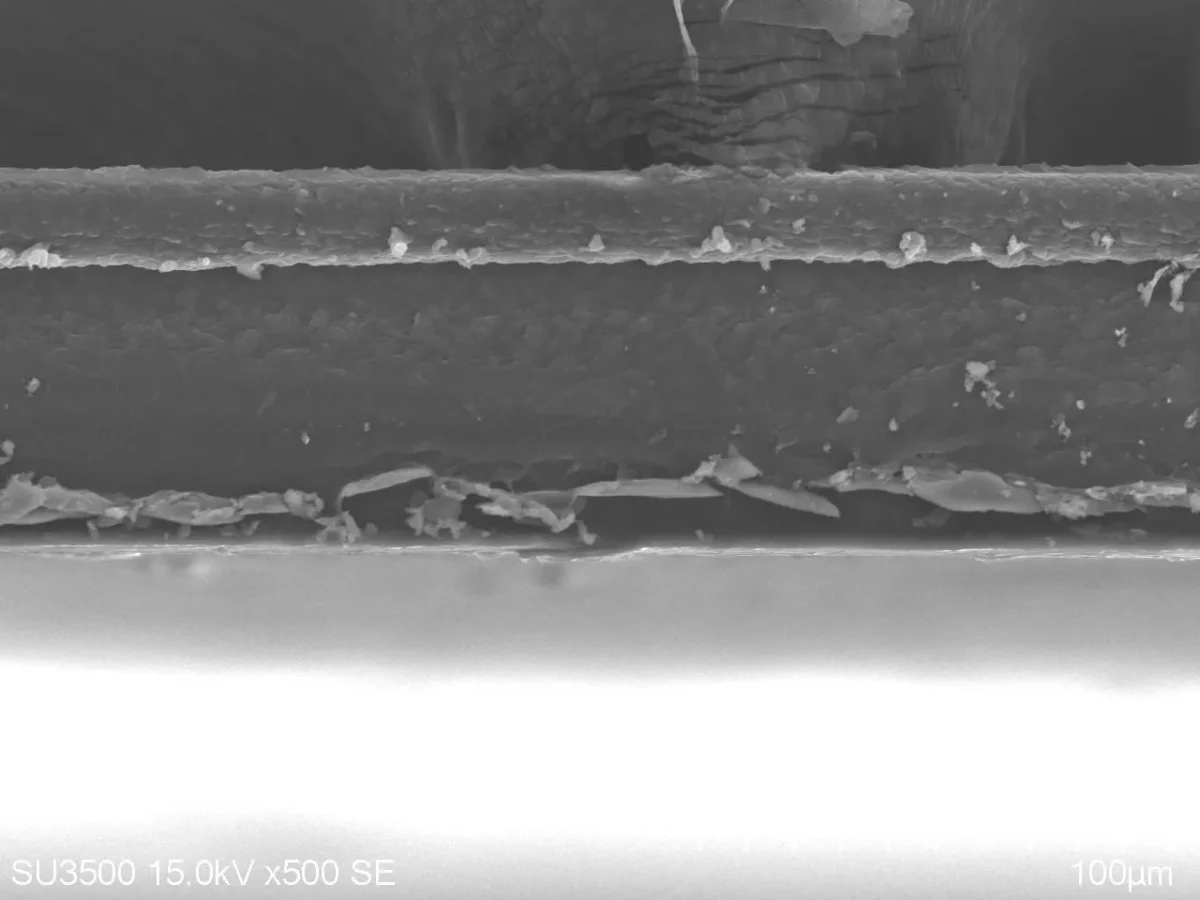
The laboratory interpreted the sample as a three-layer film with an approximate total thickness of 80 μm. The cross-sectional SEM image supported the layered structure, although the soft adhesive-related layer could not be separated and measured precisely.
| Film region | Approximate thickness | Composition indicated by the analysis |
|---|---|---|
| Adhesive-related surface layer | 10 μm | Polyisobutylene (PIB)-related or butyl-rubber-related material |
| Intermediate layer | 40 μm | Linear low-density polyethylene (LLDPE) |
| Third layer | 30 μm | LLDPE, with a possible LDPE contribution |
The reported thicknesses are approximate structural estimates, not precise measurements of independently isolated layers. The material assignments were obtained by interpreting multiple analytical results together.
Why FTIR Alone Was Not Enough to Identify the Film
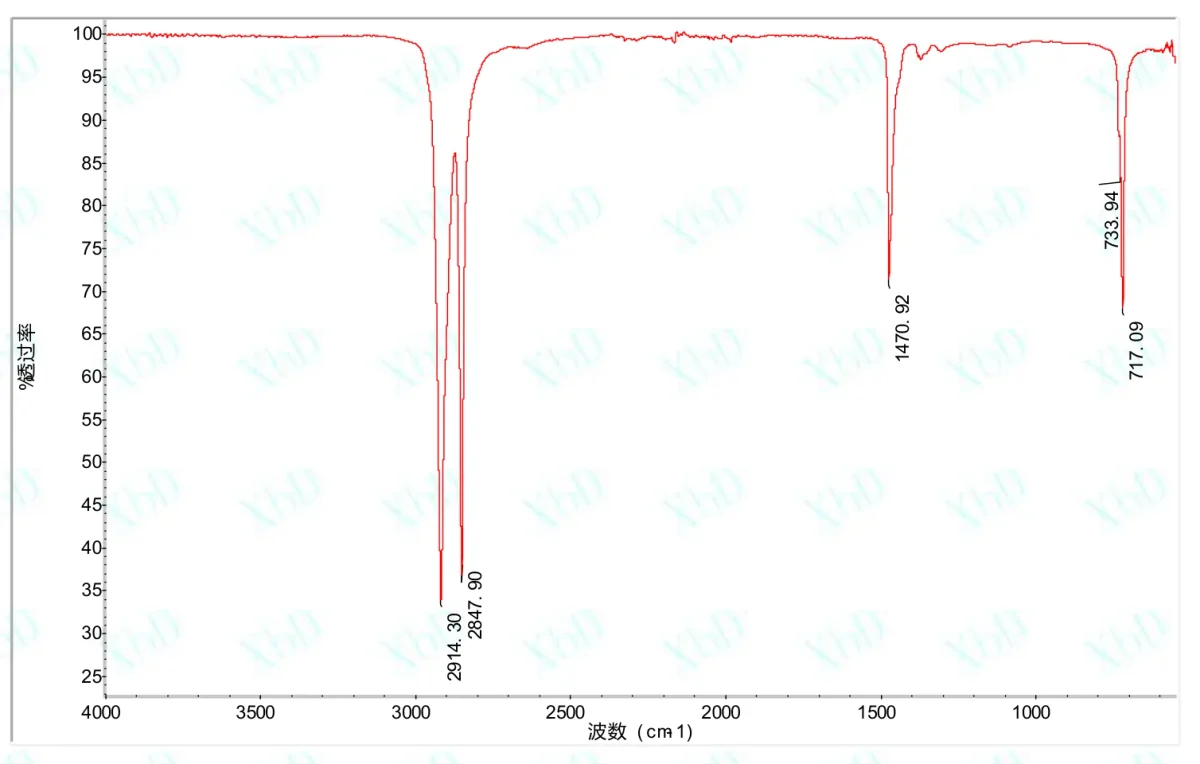
FTIR measurements of the two film surfaces provided different information. The non-adhesive surface mainly showed polyethylene characteristics, while the adhesive-related surface indicated PE together with a PIB- or butyl-rubber-related component.
This distinction illustrates an important limitation of surface analysis: identifying PE on one surface does not establish the complete composition of a multilayer film. A surface spectrum can be influenced by the exposed layer and, depending on its thickness and the sampling method, material beneath it.
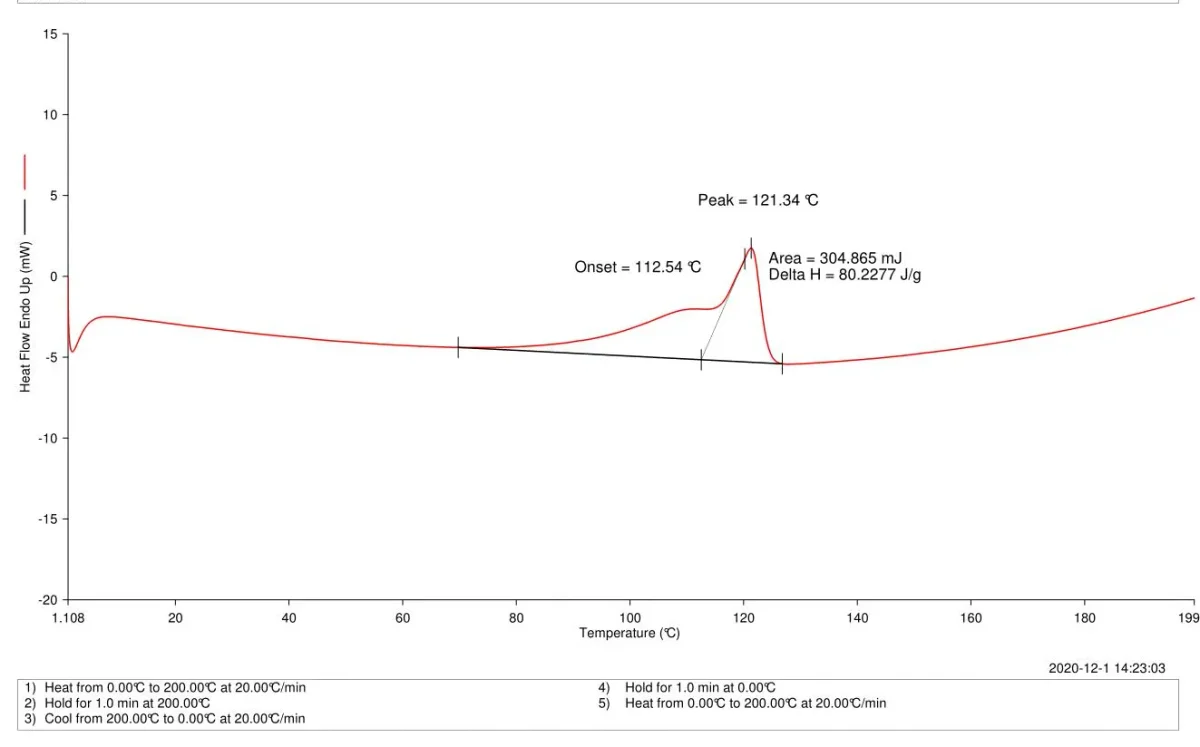
The report also used differential scanning calorimetry (DSC) to investigate the polyethylene system. A melting feature around 121°C was interpreted as consistent with LLDPE, while a feature in the 100–110°C range suggested that LDPE might also be present. These temperatures support a material interpretation; they do not independently establish an exact resin grade or blend ratio.
The value of combining FTIR and DSC for multilayer polymer identification is also discussed in the peer-reviewed study Identification of Multilayer Packaging Materials by Selective Dissolution and Precipitation With Minimal Concentration of Solvents, FTIR, and DSC for Mechanical Recycling , published in the Journal of Applied Polymer Science. That study concerns separate samples and is cited here to explain the complementary methods, not to validate Xinbodi’s specific findings.
What Additives Were Found in the PE Film?
The investigation did not stop after identifying the principal polymer system. Analysis of the film and its extractable fraction provided evidence of several lower-level components.
| Component or category | Reported interpretation | Why it matters |
|---|---|---|
| Amide wax | Lubricant-related additive | Provides a lead for investigating processing and surface-additive systems |
| Stearic acid | Tentative identification from instrumental fragment information | Possible dispersing or lubricant-related component |
| Calcium carbonate | Inorganic filler | Helps describe the non-polymer fraction of the formulation |
| Antioxidants 168, 1010, and 1076 | Antioxidant components reported in the analysis | Identifies part of the stabilization system |
| Pigment | Pigment reported; specific identity not established in the summary | Indicates that color-related formulation components may also be relevant |
The report’s GC-MS analysis of the methanol-soluble fraction provided information about antioxidants and fatty-acid- or ester-related substances. XRF supplied evidence of calcium, while the TGA curve showed a high-temperature mass-loss event attributed in the report to calcium carbonate decomposition.
These findings were interpreted together rather than treating an elemental signal or an individual chromatographic peak as a complete formulation answer.
Research published in the Journal of Chromatography A similarly demonstrates why multilayer-film investigations may need to examine chemicals associated with different layers, including antioxidants, slip agents, and adhesive-related substances. See Identification of Chemicals in a Polyvinyl Chloride/Polyethylene Multilayer Film by Ultra-High-Performance Liquid Chromatography/Quadrupole Time-of-Flight Mass Spectrometry . The published study used a different film and analytical method; it provides methodological context rather than evidence about this PE sample.
How the Polymer Film Composition Analysis Lab Combined the Evidence
Different analytical techniques answered different parts of the same materials question.
| Analytical method | Contribution to this case |
|---|---|
| SEM | Examined the cross-section and supported the three-layer structural interpretation |
| FTIR | Screened the two surfaces and the soluble fraction for polymer and organic-component information |
| GC-MS | Examined extractable organic additives |
| Py-GC-MS | Provided pyrolysis-fragment evidence relating to PE and PIB/butyl-rubber-like material |
| DSC | Investigated thermal transitions associated with the polyethylene system |
| TGA | Supported interpretation of thermal decomposition and the inorganic fraction |
| XRF | Supplied elemental evidence relevant to the inorganic filler |
The key information gain came from cross-checking the findings. SEM helped reveal the physical structure, but not the full chemistry. FTIR identified polymer-related signals, but did not by itself resolve every polyethylene grade. Chromatographic and thermal methods supplied additional evidence about minor components and material behavior.
What the Results Can—and Cannot—Tell a Manufacturer
For an unfamiliar multilayer film, this analysis provides a starting point for material comparison and formulation research: an estimated layer structure, a principal PE resin system, evidence of a surface adhesive-related material, and identified additive categories.
There are also important limits. The report could not conclusively distinguish PIB from butyl rubber, and it noted that the adhesive-related material might have been introduced through a PE/PIB masterbatch. LDPE and stearic acid were also reported as inferred rather than unambiguous identifications. The results do not establish an exact commercial resin grade, a complete layer-specific recipe, or proven adhesion, aging, or mechanical performance.
Those distinctions matter when analysis is used for product benchmarking or development. A compositional result can guide the next experiment, but it should not be presented as proof that a replacement film has already been manufactured or performance-validated.
From Film Identification to Further Formulation Work
A useful polymer film analysis report does more than identify the word “polyethylene.” It helps the manufacturer narrow down which material systems, layer arrangements, and additive categories deserve further investigation.
Xinbodi supports this type of work through its chemical composition analysis services and broader polymer testing and plastics analysis capabilities. If the project later requires formulation reconstruction rather than identification alone, that is a separate stage of deformulation and reverse engineering , with its own material-selection and validation requirements.