
A pressure-sensitive adhesive can feel sticky and still fail in the actual product.
A tape may grab the surface immediately but peel off too easily. A protective film may show high peel strength but poor quick stick. Another PSA may perform well at room temperature yet creep, leave residue, or debond when exposed to heat.
This is why pressure-sensitive adhesive testing should not rely on a single “adhesion” value.
A useful PSA evaluation normally considers three different properties:
- Tack: how quickly the adhesive forms contact under light pressure
- Peel adhesion: how strongly the bonded PSA resists removal
- Shear holding power: how well the adhesive resists creep or cohesive deformation under sustained load
Xinbodi’s adhesives and sealants testing and analysis supports manufacturers investigating tape, label, protective-film and adhesive performance problems through comparative testing, material characterization and failure analysis.
What Does a Pressure-Sensitive Adhesive Testing Lab Measure?
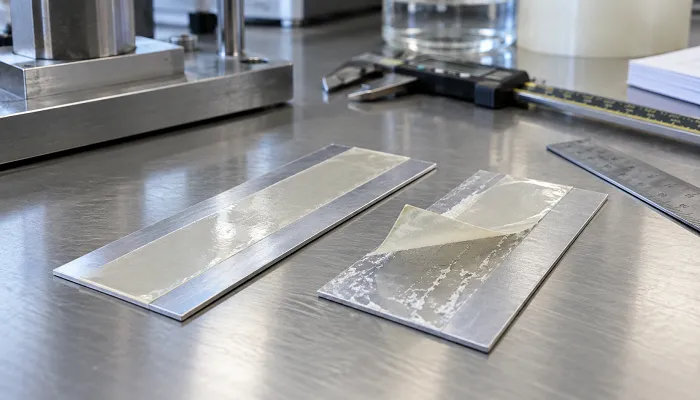
Pressure-sensitive adhesives are viscoelastic materials. Their performance depends on a balance between the ability to flow and wet a substrate during bonding and the ability to resist deformation during service.
A peer-reviewed review in the International Journal of Adhesion and Adhesives identifies tack, peel strength and shear resistance as the principal mechanical performance measures for PSAs and links them strongly to bulk viscoelastic behavior, surface roughness, tackifier compatibility and crosslinking. review of the mechanical properties of pressure-sensitive adhesives
| Test | What It Measures | Typical Customer Problem |
|---|---|---|
| Tack | Initial or rapid adhesion after short contact | Label will not grab quickly; film lifts immediately |
| Peel adhesion | Resistance to removal after bonding | Tape peels too easily or edge lifting occurs |
| Shear holding | Resistance to creep under sustained load | Tape slides, creeps or leaves adhesive residue |
| Heat / aging comparison | Retention of performance after exposure | Product works at room temperature but fails at higher temperature |
| Failure analysis | Where and why separation occurred | Interfacial debonding, cohesive failure, residue or inconsistent batches |
These tests should be interpreted together.
A PSA with excellent tack can still have poor shear resistance, while a product with high peel strength may still fail because its cohesive integrity is inadequate.
Peel Adhesion Testing: How Strongly Does the PSA Stay Bonded?
Peel testing measures the force required to remove a pressure-sensitive tape or film from a defined substrate under controlled geometry and speed.
ASTM D3330/D3330M for peel adhesion of pressure-sensitive tape includes 180° and 90° configurations for different tape constructions and substrates. ASTM also notes that the measured peel response is affected by backing stiffness, adhesive rheology and test configuration, so results need to be compared under consistent conditions.
For industrial customers, peel testing is useful when investigating:
- weak tape adhesion
- edge lifting
- protective-film removal behavior
- supplier-to-supplier differences
- batch consistency
- coating or formulation changes
A low peel value shows that the bonded system has insufficient resistance to removal, but the test alone does not identify whether the cause is the adhesive formulation, the substrate surface, the backing, coating weight or processing.
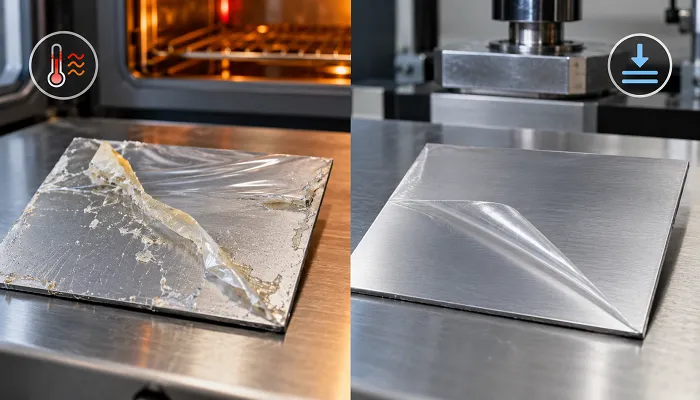
That is where failure analysis becomes important.
Tack Testing: Will the PSA Grab the Surface Quickly?
Tack describes the ability of a PSA to develop measurable adhesion after short contact and low applied pressure.
ASTM D6195 loop tack testing provides a quantitative method for evaluating this rapid bonding behavior and explicitly notes that backing stiffness can influence the result.
Low tack can become a practical problem in:
- high-speed labeling
- protective-film application
- rough or difficult-to-wet substrates
- cold application conditions
- tapes that need immediate positioning stability
Tack should not be confused with peel strength.
A PSA can have adequate long-term peel resistance but still fail to make sufficient contact during the first few seconds of application.
Shear Holding Power: Will the PSA Creep or Fail Under Load?
Shear testing evaluates whether a pressure-sensitive adhesive can remain bonded while a sustained force acts parallel to the adhesive/substrate interface.
ASTM D3654/D3654M shear adhesion testing includes methods for pressure-sensitive tapes under constant load, including an elevated-temperature procedure. ASTM also notes that backing and adhesive variations affect the result and that the test itself cannot identify the specific cause of nonuniformity.
Typical shear-related problems include:
- tape sliding on a vertical surface
- adhesive creep
- edge movement
- residue after removal
- failure under elevated temperature
- cohesive splitting inside the adhesive layer
For PSA development, shear is particularly important because improving quick tack by making an adhesive softer can reduce cohesive resistance if the formulation becomes too flowable.
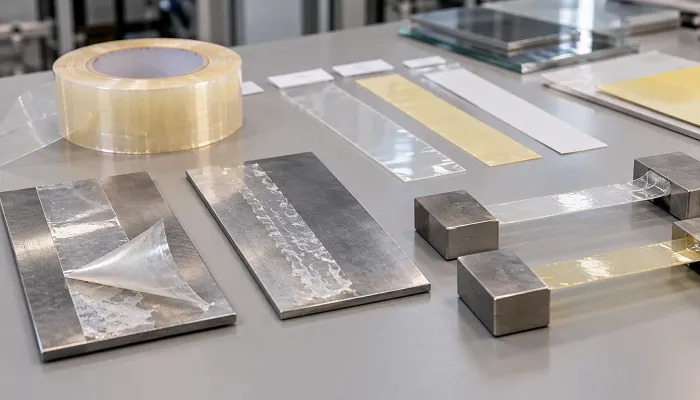
This is why a good pressure-sensitive adhesive requires an appropriate adhesion–cohesion balance, not simply maximum stickiness. Research on acrylic PSAs likewise describes tack and peel as adhesion-related properties, while shear resistance primarily reflects cohesion.
Why Peel, Tack and Shear Must Be Evaluated Together
Different combinations of test results point toward different troubleshooting directions.
| Test Pattern | Possible Direction to Investigate |
|---|---|
| Good tack + low peel | Contact forms quickly but interfacial bonding or peel resistance is insufficient |
| Good tack + poor shear | PSA may be too soft, insufficiently cohesive or poorly crosslinked |
| Low tack + good peel | Initial wetting may be limited even though bonded strength develops later |
| Good room-temperature results + hot shear failure | Temperature-dependent viscoelastic balance or interface durability may be inadequate |
| High peel + heavy residue | Cohesive integrity of the adhesive layer should be investigated |
| Good standard-steel result + poor real-substrate result | Surface energy, contamination or substrate compatibility may be important |
These patterns are diagnostic clues, not proof of one specific root cause.
The backing material, adhesive coat weight, dwell time, application pressure, test surface, temperature and formulation all influence PSA performance.
Case 1: Solvent-Based Acrylic PSA With Low Peel Strength and High-Temperature Interfacial Failure
One Xinbodi project involved a PET-backed solvent-based general-purpose acrylic pressure-sensitive tape.
The customer reported that the tape felt sufficiently tacky during normal handling, but edge lifting occurred after application to stainless steel, and the product debonded readily under elevated-temperature conditions.
Test Results
The laboratory evaluated initial tack, 180° peel strength and elevated-temperature shear behavior.
| Test | Result |
|---|---|
| Rolling-ball tack | #8; met the customer’s initial-tack requirement |
| 180° peel strength | 2.1 N/25 mm; below the project target |
| 60°C shear holding | Rapid interfacial debonding |
| Failure surface | Little or no visible adhesive residue on the panel |
The results showed a clear mismatch:
initial tack was acceptable, but peel adhesion and high-temperature bond durability were insufficient.
Failure Interpretation
Formulation evaluation indicated that the solvent-based acrylic copolymer contained a relatively high contribution from harder monomer units, resulting in a comparatively high glass-transition region for the intended application.
At room temperature, the adhesive still provided measurable surface tack. However, its ability to deform and establish sufficiently intimate contact with the substrate was limited.
The clean failure surface also supported a primarily interfacial adhesive failure, rather than cohesive rupture inside the PSA layer.
One point is important here: elevated temperature does not normally make an acrylic PSA simply “stiffer.” In most PSA systems, increasing temperature reduces modulus and increases molecular mobility.
At elevated temperature, this softening changes the adhesion–cohesion balance. If interfacial bonding is already weak, sustained shear loading can promote rapid debonding or creep rather than improving adhesion.
Recommended Optimization Direction
The development direction therefore focused on improving interfacial wetting without sacrificing excessive cohesive strength:
- moderately reduce the hard-monomer contribution where formulation design allows;
- adjust the soft/hard segment balance to improve contact at application temperature;
- evaluate suitable tackifying or wetting components;
- improve adhesive–substrate contact;
- revalidate peel and shear performance at the actual service temperature.
The purpose was not simply to make the adhesive softer.
The goal was to obtain a better balance between wetting, peel resistance and temperature-dependent shear stability.
Case 2: Water-Based Acrylic PSA With Poor Initial Tack and Heavy Residue After Shear
A second project involved a PE-backed protective film coated with a water-based acrylic pressure-sensitive adhesive.
The customer reported that the product remained strongly attached after application but was difficult to apply quickly and left significant adhesive residue after long-term loading.
Test Results
| Test | Result |
|---|---|
| 180° peel strength | 4.8 N/25 mm; above the project requirement |
| Rolling-ball tack | #2; insufficient quick-stick performance |
| Room-temperature shear | Cohesive failure with substantial adhesive residue |
This combination was very different from Case 1.
The product had high peel strength, but initial tack was poor and the adhesive layer failed internally during sustained shear loading.
Why This Combination Requires Careful Interpretation
The initial formulation review indicated relatively high crosslinker addition.
High crosslink density can reduce chain mobility and therefore reduce tack because the PSA cannot deform and wet the substrate quickly enough.
However, excessive crosslinking alone cannot fully explain the observed result.
A uniformly over-crosslinked adhesive would generally be expected to show stronger cohesive resistance, whereas this product produced cohesive failure and substantial residue during shear testing.
That means the failure pattern was more consistent with a broader formulation or network imbalance.
Possible areas requiring investigation include:
- uneven or inefficient crosslinking;
- imbalance between polymer molecular weight and crosslink density;
- incomplete film formation;
- drying or residual-water effects;
- tackifier / crosslinker balance;
- low-molecular-weight components;
- coating uniformity.
The low tack and cohesive residue therefore should not be attributed to “too much crosslinker” without additional evidence.
Recommended Optimization Direction
The appropriate development strategy was to rebalance both surface adhesion and bulk cohesion.
The recommended direction included:
- optimize rather than simply maximize crosslinker level;
- evaluate curing and film-formation uniformity;
- adjust tackifier or compatible soft-component content where appropriate;
- review drying conditions and residual moisture;
- confirm adhesive coat weight;
- compare tack, peel and shear after each formulation adjustment.
The target was a more balanced PSA that provided:
adequate quick stick + required peel adhesion + sufficient shear cohesion + clean removal.
What These Two PSA Failure Cases Show
These projects illustrate why one pressure-sensitive adhesive test cannot describe the whole product.
Case 1 showed:
acceptable tack + low peel + high-temperature interfacial failure.
Case 2 showed:
low tack + high peel + cohesive shear failure with residue.
Both products could easily have been described simply as having “adhesion problems,” but their actual failure mechanisms and development directions were very different.
That is why PSA troubleshooting should combine mechanical performance testing with observation of the failure surface and, when needed, material characterization.
Xinbodi’s materials testing services include adhesion and peel evaluation for adhesives, sealants, tapes and laminates, together with thermal, mechanical and environmental testing approaches.
When the problem cannot be explained by routine performance testing, a broader material failure analysis investigation can compare failed and normal samples and connect mechanical behavior with material, surface and environmental evidence.
When Should PSA Testing Be Combined With Failure Analysis?
Routine peel, tack and shear testing is appropriate when the primary question is:
Does the product meet the specified performance requirement?
Failure analysis becomes more valuable when the question changes to:
Why does the product fail?
Examples include:
- adhesive residue suddenly appears after a formulation change;
- one supplier’s tape creeps while another does not;
- hot shear performance falls even though room-temperature peel is acceptable;
- protective film has high peel but poor application tack;
- tape performs well on stainless steel but fails on the actual product surface;
- normal and failed batches show different behavior;
- aging causes edge lifting or interfacial separation.
In these situations, testing may need to extend beyond standard PSA performance measurements.
Depending on the problem, rheology, thermal analysis, microscopy, surface characterization or chemical analysis may help identify the contributing factor.
For example, Xinbodi’s rheology testing can evaluate viscoelastic behavior, yield stress and time- or temperature-dependent flow characteristics that may be relevant to adhesive processing and performance.
What Samples Should You Send for Pressure-Sensitive Adhesive Testing?
The most useful sample set depends on the problem.
For basic PSA performance testing, provide:
- finished tape, label or protective film;
- actual application substrate where possible;
- required test method or internal specification.
For failure analysis, it is better to provide:
- failed product;
- known-good product;
- unused control sample;
- application substrate;
- storage or service conditions;
- batch information;
- details of recent raw-material or process changes.
For supplier comparison, submit both materials under the same test conditions.
Controlling backing, adhesive coat weight, substrate, dwell time, application pressure and temperature is important because these variables can strongly affect peel, tack and shear results.
Pressure-Sensitive Adhesive Testing at Xinbodi
Xinbodi Laboratories supports manufacturers developing and troubleshooting pressure-sensitive tapes, protective films, labels and related adhesive products.
Typical projects include:
- peel adhesion testing;
- initial tack evaluation;
- shear holding and high-temperature shear testing;
- supplier and batch comparison;
- protective-film residue investigation;
- edge-lifting and debonding analysis;
- aging and heat-resistance evaluation;
- PSA failure analysis;
- formulation-related performance troubleshooting.
Our approach focuses on the customer’s actual problem.
If a tape fails a peel specification, the first question is whether the failure is related to bond formation, bulk cohesion, substrate interaction or test conditions.
If a protective film leaves residue, the objective is not only to record that the shear test failed, but to determine whether the adhesive network, processing conditions or formulation balance should be investigated next.
If your PSA has poor tack, weak peel, creep, residue or temperature-related failure, send the failed sample together with a normal reference whenever possible.
Xinbodi can develop a targeted testing plan to determine how the adhesive is failing, what variables are contributing, and which direction should be evaluated during product optimization.