
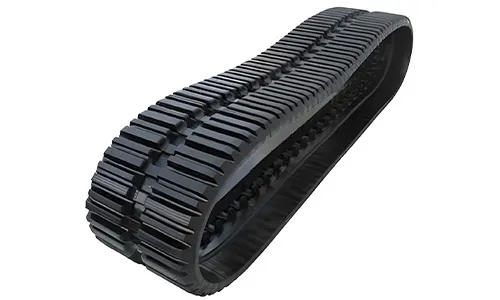
A construction machinery parts manufacturer contacted Xinbodi while developing a rubber track based on an imported benchmark product. The customer needed more than basic material identification: the project required a clearer understanding of the rubber compound, reinforcement system, curing chemistry and structural design that contributed to the benchmark’s performance.
Xinbodi combined rubber material testing, formulation analysis and structural characterization to support formulation development and pilot production.
Rubber Compound and Formulation Analysis
The first step was to characterize the rubber compound used in the benchmark track.
FTIR and thermogravimetric analysis (TGA) indicated a rubber matrix based mainly on natural rubber and chloroprene rubber, together with a reinforcing system containing carbon black and silica.
Further formulation analysis was used to investigate key functional components, including the sulfur/accelerator curing system and antidegradants such as 6PPD and TMQ.
TGA is particularly useful in rubber material comparison because it can help separate major organic, carbon-black and inorganic fractions. ASTM D6370 – Rubber Compositional Analysis by Thermogravimetry describes the use of TGA for compositional analysis, material screening and comparison of rubber compounds.
For similar elastomer projects, Xinbodi’s polymer testing and analysis services combine chemical composition analysis with material characterization to investigate both formulation and performance.
Reinforcement Structure and Curing Process
The track’s performance depended not only on its rubber formulation but also on the internal reinforcement structure and curing process.
Cross-sectional electron microscopy was used to examine the arrangement of the reinforced layers within the track. This provided additional information on how the rubber compound and internal structure worked together under mechanical loading.
DMA and thermal-analysis results were also evaluated to support the selection of suitable curing conditions.
The analysis was then translated into recommendations covering:
- base rubber selection and blend ratio;
- carbon black and silica reinforcement;
- sulfur and accelerator system;
- antioxidant and antiozonant package;
- reinforced-layer structure;
- vulcanization and processing conditions.
This type of benchmark development is closely related to Xinbodi’s polymer deformulation and formulation analysis, where the objective is to understand both the composition of the original material and the functional role of its formulation components.
Rubber Material Testing and Performance Comparison
The benchmark track was also evaluated for key performance characteristics, including tensile properties and abrasion resistance.
These measurements gave the customer practical reference targets during compound adjustment and pilot production.
Abrasion resistance is particularly relevant for rubber tracks because their surfaces are continuously exposed to friction and wear. ASTM D5963 – Rubber Abrasion Resistance by Rotary Drum Abrader provides a standardized method for comparative abrasion testing of vulcanized rubber and thermoplastic elastomers. ASTM also notes that such testing is useful for comparison and R&D, while laboratory abrasion results should not automatically be treated as a direct prediction of field service life.
Xinbodi’s materials testing services can be combined with formulation analysis when a project requires both material identification and performance verification.
From Benchmark Analysis to Pilot Production
Based on the formulation analysis, structural observations and process recommendations, the customer worked with a rubber manufacturer to produce pilot samples.
The resulting rubber track achieved approximately 90% of the benchmark product’s overall performance. According to the customer’s project feedback, overall cost was reduced by approximately 35%.
The project showed why rubber reverse engineering cannot rely on polymer identification alone. For a reinforced engineering product such as a rubber track, the final result depends on the interaction between:
rubber formulation + reinforcing system + curing chemistry + internal structure + manufacturing process + final material performance
By connecting these factors, the analysis provided the customer with a practical technical basis for formulation adjustment and localized production.