
A weaving machinery manufacturer approached Xinbodi Lab during the development of rubber shuttle wheels for high-speed circular looms. The goal was to understand the formulation and processing design of a high-performance benchmark product and use the findings to guide independent production.
Because shuttle wheels operate continuously under high-speed friction and repeated loading, the project focused not only on rubber identification, but also on wear resistance, heat build-up, vulcanization behavior, dynamic stability, and rubber-to-metal bonding.
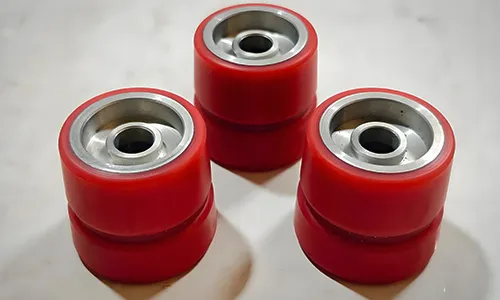
Benchmark Formulation Analysis
Xinbodi used FTIR and thermogravimetric analysis (TGA) to characterize the benchmark material.
The results indicated that the rubber matrix was based on a natural rubber (NR) / butadiene rubber (BR) blend. The reinforcing system combined high-structure carbon black and silica, together with an antioxidant system and a specialized rubber-to-metal adhesion system.
This formulation was designed to balance the performance requirements of a high-speed shuttle wheel, particularly abrasion resistance, heat build-up control, and dynamic durability.
For similar elastomer projects, Xinbodi’s polymer testing and analysis services combine composition analysis with material characterization to evaluate both formulation and performance.
Vulcanization and Rubber-Metal Bonding
Composition alone could not explain the benchmark product’s performance, so the investigation also focused on processing conditions.
Based on dynamic mechanical analysis and the material response, Xinbodi recommended the following two-stage vulcanization conditions:
| Stage | Recommended Condition |
|---|---|
| Pre-vulcanization | 150°C × 10 min |
| Final vulcanization | 160°C × 8 min |
Cross-sectional electron microscopy was also used to examine the interface between the metal core and rubber layer, helping the manufacturer evaluate and improve the bonding treatment.
Vulcanization characteristics are an important part of rubber compound development and quality control. ASTM D5289 describes the measurement of vulcanization behavior using rotorless cure meters and is commonly used for rubber R&D and manufacturing evaluation.
This type of project is representative of Xinbodi’s polymer deformulation and formulation analysis, where formulation composition and processing behavior are evaluated together.
Wear Resistance and Formulation Adjustment
Heat build-up and abrasion behavior were evaluated to support further adjustment of the carbon black system and dispersant level.
Abrasion resistance is especially important for rubber components operating under continuous friction. ASTM D5963 provides a standardized method for comparing the abrasion resistance of vulcanized rubber using a rotary drum abrader.
The test results, together with the formulation analysis, were used to refine the reinforcing system and processing conditions.
Optimization Results
After formulation and process adjustments, the developed shuttle wheel showed improved wear resistance, while the deviation in dynamic balance was reduced. Its service life reached the manufacturer’s target for comparable imported products.
According to customer feedback after application:
- Yarn breakage rate decreased by approximately 60%.
- Overall cost was reduced by approximately 40%.
The project showed that reproducing a rubber component successfully requires more than identifying the base polymer. Reinforcing fillers, additive systems, vulcanization conditions, interfacial bonding, and final performance need to be evaluated together.
Xinbodi’s materials testing services can be combined with formulation analysis when benchmark development requires both material identification and performance verification.
Project Summary
In this project, Xinbodi combined:
rubber composition analysis + filler system evaluation + DMA + interfacial analysis + vulcanization optimization + performance testing
The results gave the manufacturer a practical basis for formulation adjustment and independent production, rather than simply providing a list of detected ingredients.