
Coating problems are rarely explained by one performance test alone. A coating may meet initial hardness, appearance or adhesion requirements but later develop blistering, peeling, yellowing, corrosion, cracking or curing problems in production or field use.
Coating analysis connects these performance symptoms with the material itself. By combining chemical composition analysis, microscopy, thermal analysis, surface characterization and performance testing, a laboratory can help determine:
- what the coating is made of;
- how two formulations differ;
- whether a supplier or batch has changed;
- why a coating failed;
- which formulation variables R&D should investigate next.
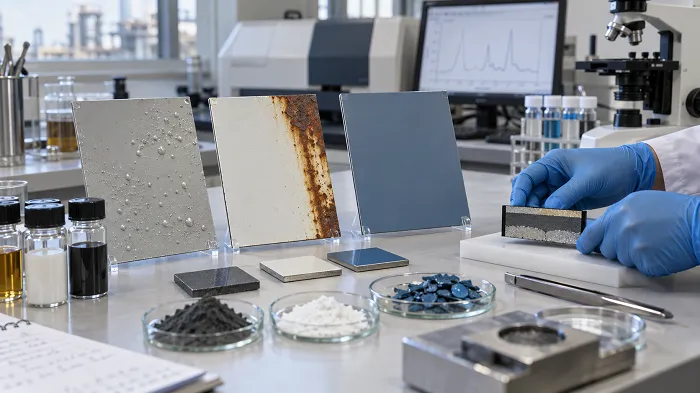
Xinbodi provides coating analysis for industrial paints, protective coatings, powder coatings and other formulated coating systems. Projects may involve composition analysis, supplier comparison, formulation benchmarking, failure investigation and product development.
For broader chemical characterization, see our chemical composition analysis services.
What Can Coating Analysis Determine?
A coating is not simply a resin film. Commercial formulations can contain binders, curing agents, solvents, pigments, fillers, corrosion inhibitors, flow modifiers, coupling agents, stabilizers and other functional additives.
A useful coating analysis program therefore begins with the customer’s technical question.
Binder and Resin Identification
The binder controls many of the coating’s fundamental properties, including adhesion, flexibility, chemical resistance, curing behavior and durability.
Depending on the sample, analysis may help identify or differentiate resin systems such as:
- epoxy;
- polyurethane;
- acrylic;
- polyester;
- phenolic;
- silicone;
- hybrid resin systems.
For cured or crosslinked coatings, techniques such as FTIR, Py-GC/MS, thermal analysis and solvent extraction may need to be combined because the original ingredients are no longer present as freely separable components.
Pigments, Fillers and Inorganic Components
Coating analysis can also investigate:
- zinc powder;
- titanium dioxide;
- calcium carbonate;
- silica;
- talc;
- barium sulfate;
- phosphate pigments;
- other inorganic fillers and functional particles.
The type, loading and morphology of these materials can affect opacity, corrosion resistance, hardness, rheology, cost and coating integrity.
Solvents and Functional Additives
GC-MS, LC-MS and related methods may be used to investigate selected:
- solvents;
- plasticizers;
- flow modifiers;
- dispersants;
- catalysts;
- antioxidants;
- UV stabilizers;
- corrosion inhibitors;
- defoamers;
- coupling agents.
In many formulation problems, minor additives are critical even though they represent only a small percentage of the total coating.
Layer Structure, Surface and Interface Condition
When the problem involves adhesion, peeling, contamination or localized corrosion, chemical composition alone may not be enough.
Microscopy and surface analysis can help evaluate:
- coating thickness;
- cross-sectional structure;
- coating-substrate interface;
- particles and inclusions;
- local elemental distribution;
- surface contamination.
When Do Manufacturers Need Coating Analysis?
The strongest coating projects usually begin with a practical manufacturing or R&D problem rather than a request for a specific instrument.
Supplier or Batch Differences
A previously stable coating may suddenly show changes in viscosity, color, curing behavior or corrosion resistance even though the supplier’s routine certificate remains within specification.
Comparative analysis can help determine whether differences exist in:
- resin chemistry;
- fillers or pigments;
- solvent package;
- additives;
- curing-related components;
- contaminants.
A qualified reference sample is especially useful for this type of investigation.
Adhesion, Peeling and Delamination
Poor adhesion can result from coating chemistry, substrate condition, contamination, incomplete curing or interface incompatibility.
For adhesion-related screening, ASTM D3359 provides a standardized tape-test approach for rating coating adhesion on metallic substrates. The standard also notes that substrate condition and surface preparation can strongly influence adhesion results.
Chemical and surface analysis can then be used when the customer needs to understand why adhesion is poor.
Premature Corrosion
Protective coatings may fail even when pigment loading or film thickness appears acceptable.
Possible causes include:
- poor film integrity;
- inadequate corrosion-inhibitor system;
- weak interface adhesion;
- improper filler or zinc morphology;
- insufficient curing;
- coating defects.
For protective paint systems on steel, ISO 12944-6 specifies laboratory performance test methods and notes that such testing supports paint-system selection rather than directly predicting exact field durability.
Yellowing, Chalking and Aging
Outdoor or high-temperature coatings can lose color, gloss, flexibility or adhesion because of:
- resin degradation;
- insufficient antioxidant protection;
- UV exposure;
- pigment instability;
- additive depletion.
Aging studies become more useful when physical changes are interpreted together with chemical evidence.
Competitor Benchmarking and Formulation Development
When an imported or competitor coating performs better, deformulation and reverse engineering can help identify major formulation systems and determine which differences may be technically important.
The objective is not simply to copy a recipe.
The more useful outcome is:
What is different, why might it matter, and which formulation variables should R&D investigate?
Coating Chemical and Composition Analysis
For composition-focused projects, coating samples are often separated before instrumental analysis.
A typical workflow may include:
- solvent extraction or fractionation;
- separation of low-molecular-weight additives from polymeric material;
- analysis of organic and inorganic fractions;
- comparison with a reference sample;
- interpretation of the results in relation to coating performance.
Common analytical techniques include:
| Method | Typical Role in Coating Analysis |
|---|---|
| FTIR | Binder chemistry, functional groups, cured coating comparison |
| Py-GC/MS | Cured and crosslinked polymer characterization |
| GC-MS | Solvents and selected volatile or semi-volatile components |
| LC-MS / HPLC | Selected non-volatile additives |
| TGA | Organic/inorganic fractions and filler comparison |
| DSC | Cure-related and thermal transitions |
| SEM-EDS | Morphology, defects, interfaces and elemental distribution |
| ICP-OES / XRF | Inorganic pigments, fillers and elemental composition |
| Rheology | Viscosity, flow, thixotropy and application behavior |
The final method combination depends on whether the customer needs identification, quantification, comparison or failure diagnosis.
Coating Testing and Performance Evaluation
Chemical analysis is most useful when it is connected to real coating performance.
Depending on the coating type and project, testing may investigate:
- adhesion;
- hardness;
- color and color difference;
- gloss;
- rheology;
- thermal behavior;
- coating thickness;
- corrosion resistance;
- aging behavior;
- selected chemical resistance.
For projects involving broader physical and performance requirements, Xinbodi also provides materials testing services.
Coating Failure Analysis
Coating failure usually requires several types of evidence.
A blistered coating, for example, may be caused by moisture penetration, poor curing, interface contamination or formulation imbalance. A yellowed coating may indicate resin degradation or insufficient stabilization. Early corrosion may involve defects in both the coating chemistry and the coating-substrate interface.
For more complex investigations, coating characterization can be combined with material failure analysis.
The following Xinbodi cases illustrate how coating analysis can be used in different industrial scenarios.
Case 1: Anti-Corrosion Coating Analysis for Premature Corrosion
A domestic heavy corrosion-protection coating manufacturer developed an epoxy zinc-rich primer for port steel structures.
The customer’s coating contained approximately 80% zinc powder and initially met routine production requirements, but neutral salt-spray testing showed blistering and rust after approximately 480 hours. An imported benchmark remained free of red rust for around 1,200 hours.
Simply increasing zinc content did not solve the problem.
Comparative coating analysis identified several important differences:
- the benchmark used a higher-molecular-weight epoxy resin, while the customer used a lower-molecular-weight grade;
- benchmark zinc powder was predominantly spherical, while the customer sample used irregular flaky zinc;
- a phosphate-type corrosion inhibitor was present at approximately 3.2% in the benchmark but was not detected in the customer formulation;
- a silane coupling agent was present at approximately 0.3% in the benchmark but was not detected in the customer sample;
- the customer actually contained more zinc powder, about 81% versus 77.5% in the benchmark.
The key finding was therefore:
More zinc did not mean better corrosion protection.
The customer’s coating had weaker film integrity, less effective interfacial adhesion and lacked the complementary corrosion-inhibitor system used in the benchmark.
After targeted formulation adjustment, neutral salt-spray performance improved from approximately 480 hours to 1,120 hours. The revised coating also showed no obvious blistering or rust during an 18-month field application, while raw-material cost was approximately 35% lower than direct use of the imported material.
Case 2: Powder Coating Formulation Comparison for Appliance Finishes
A home-appliance manufacturer was developing an exterior polyester/TGIC powder coating to benchmark an imported product.
The self-developed coating had several practical problems:
- heavy orange peel;
- inconsistent edge coverage;
- frequent manual rework after spraying.
Both the benchmark and customer coatings were submitted for comparative analysis.
The imported product used a more suitable polyester resin system together with a coordinated flow-control package and fine precipitated barium sulfate filler.
The customer formulation relied on a more generic high-acid-value resin, a simpler flow-control package and conventional micron-scale calcium carbonate.
The main problem was not one defective ingredient. The resin–additive–filler combination produced poorer melt flow and leveling.
After the resin and additive system was adjusted:
- surface finish reached approximately LS3 level;
- edge coverage improved by about 25%;
- appearance-related reject rate decreased by approximately 18%;
- raw-material cost was approximately 22% below the imported powder coating.
This case shows how coating analysis can support formulation benchmarking even when the problem first appears to be only an appearance or spraying issue.
Case 3: UV Coating Analysis for Premature Yellowing
An electronics manufacturer used a UV-curable coating on PC plastic housings.
After approximately three months of storage, the coating developed visible yellowing and reduced adhesion. The customer initially suspected the UV-curing process.
Chemical analysis of new and aged samples showed a different root cause.
The formulation lacked an effective hindered amine light stabilizer (HALS) and relied mainly on a small amount of UV absorber. The selected photoinitiator system was also associated with long-term yellowing under light exposure.
The coating therefore had an incomplete stabilization system rather than a simple curing-process defect.
After the formulation was redesigned with a more complete light-stabilization package and a lower-yellowing photoinitiator system:
- accelerated light-aging performance improved;
- the coating remained acceptable after approximately 12 months of high-temperature storage;
- color difference remained below approximately ΔE 1.5;
- adhesion remained within the customer’s acceptance range.
This case demonstrates why yellowing problems should not automatically be treated as process issues. Chemical comparison can distinguish curing problems from formulation and aging-protection deficiencies.

Coating Deformulation and Formulation Comparison
When a customer needs to understand a competitor or imported coating, coating analysis can be extended into a deformulation project.
Typical targets include:
- binder or resin system;
- curing agents;
- solvent package;
- pigments;
- fillers;
- corrosion inhibitors;
- coupling agents;
- plasticizers;
- stabilizers;
- other functional additives.
Xinbodi has also applied this approach to solvent-based phenolic coating development, where resin and formulation analysis were used to clarify the development direction for a benchmark coating.
Coating Materials and Products We Analyze
Depending on the analytical objective, projects may involve:
Industrial and Protective Coatings
- anticorrosion coatings;
- epoxy primers;
- zinc-rich coatings;
- chemical-resistant coatings;
- machinery and equipment coatings.
Powder Coatings
- polyester/TGIC coatings;
- epoxy powder coatings;
- epoxy-polyester hybrids;
- pigmented and functional powder coatings.
Automotive and Transportation Coatings
- component coatings;
- protective finishes;
- supplier-comparison samples;
- failed or aged coatings.
Electronics and Functional Coatings
- UV-curable coatings;
- protective films;
- specialty surface coatings;
- coatings on plastics or electronic components.
Paints and Decorative Coatings
- water-based paints;
- solvent-based paints;
- pigmented coatings;
- colored and appearance-critical systems.
How to Select the Right Coating Analysis Approach
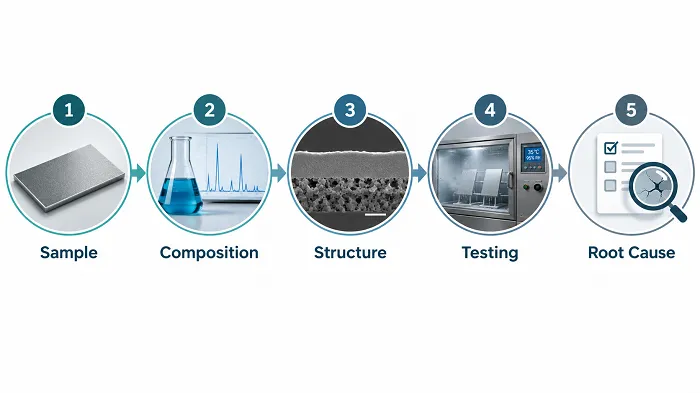
The correct analytical plan depends on the problem.
| Customer Question | Typical Analytical Direction |
|---|---|
| What is this coating made of? | FTIR, chromatography, TGA, elemental analysis |
| Why is the coating peeling? | Composition comparison, microscopy, surface/interface analysis |
| Why is corrosion occurring? | Coating composition, cross-section, corrosion testing |
| Has the supplier changed the formula? | Qualified vs new batch comparative analysis |
| Why does a competitor coating perform better? | Deformulation + performance comparison |
| Why is a coating yellowing? | Polymer/additive analysis + aging comparison |
| Why is powder coating leveling poorly? | Resin/additive comparison + rheology/formulation analysis |
This problem-oriented approach is usually more useful than ordering a fixed list of instruments.
Coating Analysis at Xinbodi Lab
Xinbodi Lab provides coating analysis for manufacturers, coating formulators, material suppliers, procurement teams, quality departments and R&D groups that need to understand both composition and performance.
Typical projects include:
- coating identification;
- chemical composition analysis;
- supplier and batch comparison;
- coating formulation analysis;
- competitor benchmarking;
- deformulation and reverse engineering;
- corrosion and adhesion troubleshooting;
- aging and discoloration analysis;
- coating failure investigation;
- formulation-development support.
Our laboratory can combine chemical analysis with microscopy, thermal analysis, elemental characterization, surface investigation and selected performance testing according to the coating system and technical problem.
For formulation-focused projects, see chemical composition analysis and deformulation and reverse engineering. For failure-related problems, see failure analysis services.
Technical Limits of Coating Analysis
Finished coatings can be chemically complex, especially after curing or aging.
Trace additives may sometimes only be identified by chemical family rather than quantified precisely. Crosslinking reactions can also make it difficult to reconstruct every original raw material from a cured film.
Coating performance may additionally depend on:
- substrate preparation;
- application thickness;
- mixing ratio;
- curing temperature and time;
- coating sequence;
- environmental exposure.
For this reason, coating analysis should be used as technical evidence for formulation development, supplier comparison or failure investigation and followed by appropriate application validation.
Conclusion
Coating analysis provides more than a pass/fail result.
It can help determine what a coating contains, how formulations differ, why adhesion or corrosion performance has changed, whether a supplier has modified the product, and which formulation variables deserve further investigation.
The three examples above show that similar coating symptoms can originate from very different causes:
- premature corrosion from resin, interface and corrosion-inhibitor differences;
- poor powder-coating appearance from resin, flow additive and filler selection;
- UV-coating yellowing from an incomplete stabilization system.
By combining chemical composition analysis, coating testing and failure investigation, Xinbodi Lab helps manufacturers turn coating problems into evidence-based R&D and quality decisions.