
Why Personal Care Products Composition Analysis Was Needed
This project came from a Xinbodi Laboratories customer developing a silicone-free oil-control shampoo to benchmark a premium imported product.
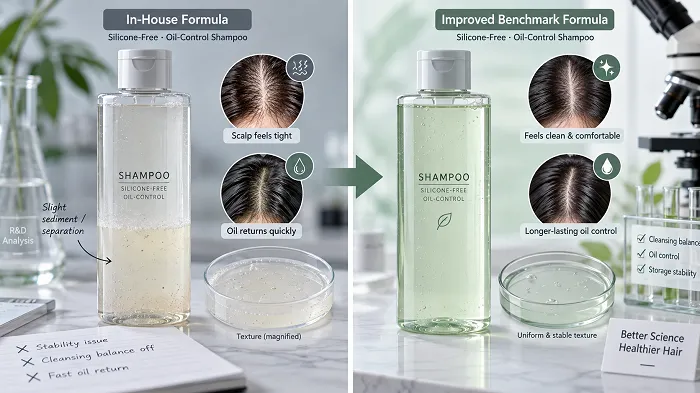
The in-house formula had several recurring problems:
- strong cleansing but noticeable scalp tightness;
- oiliness returned quickly after washing;
- some users reported scalp redness;
- sediment gradually appeared during storage;
- visible separation developed after about one month.
Repeatedly increasing surfactant concentration did not solve the problem.
The customer therefore requested personal care products composition analysis and shampoo formula reverse engineering to understand how the benchmark balanced cleansing, oil control, conditioning and storage stability.
How the Shampoo Formula Was Analyzed
Shampoo is a multi-component system in which surfactants, conditioning polymers, thickeners and functional ingredients interact with each other.
Research on shampoo formulation also shows that surfactants, deposition polymers, structuring polymers and viscosity modifiers all influence final product behavior. See this review of the physicochemical processes behind shampoo formulation.
The benchmark and in-house samples were analyzed using complementary techniques, including:
- HPLC for selected scalp-care and functional ingredients;
- GC-MS for volatile compounds and selected organic additives;
- LC-MS/MS for botanical extracts, peptides and other low-level components;
- ICP-OES for selected elemental components;
- FTIR for polymer and surfactant-related structural information;
- foam, combability and scalp-compatibility testing for performance comparison.
Published analytical research has also demonstrated that different classes of surfactants in shampoo and hair conditioner can be separated and analyzed using HPLC and LC-MS. See this study on simultaneous surfactant analysis in shampoo and hair conditioner.
What the Benchmark Shampoo Composition Revealed
The imported benchmark used a more balanced multi-surfactant cleansing system rather than relying mainly on one strong detergent.
The principal cleansing system included:
- SLES as the main anionic surfactant;
- cocamidopropyl betaine as an amphoteric co-surfactant;
- an additional mild surfactant to improve foam structure and reduce irritation.
This balance helped maintain cleansing performance without creating the same level of scalp tightness observed with the customer’s formula.
Why the Oil-Control System Worked Better
The benchmark did not rely on a single oil-control ingredient.
Its formula combined several components associated with:
- sebum control;
- keratinization management;
- scalp cleansing;
- soothing and conditioning.
The customer’s formula depended much more heavily on one exfoliating ingredient.
As a result, surface oil was removed quickly, but the overall scalp-care system was less balanced.
Why the Customer’s Formula Developed Sediment and Separation

The analysis also revealed an important difference in the conditioning and suspension systems.
The benchmark used a lower-molecular-weight conditioning polymer together with a structured thickening and suspension system.
The customer’s formula relied on:
- a heavier conditioning polymer;
- a simpler salt-thickened system;
- weaker suspension control.
This increased the risk of deposition, scalp heaviness, sedimentation and storage instability.
Research on shampoo technology has similarly shown that changing the surfactant system can affect polymer deposition, viscosity and conditioning behavior. See this review of shampoo surfactant technology.
Root Cause of the Shampoo Performance Gap
The performance difference was not caused by one missing ingredient.
The main gaps were found in four interacting formulation systems:
surfactant balance + oil-control system + conditioning polymer + suspension and thickening system
The customer’s repeated attempts to increase cleansing strength actually moved the formulation further away from the benchmark.
This is why shampoo formula reverse engineering is often more useful than adjusting individual raw materials by trial and error.
Results After Formula Optimization
Based on the analytical findings, the customer adjusted the formulation structure rather than simply copying individual ingredients.
After optimization:
- oil-control duration increased from about 2 hours to approximately 36 hours;
- wet-combing force was reduced by around 61%;
- scalp irritation observed in the original formula was substantially reduced;
- storage sedimentation and separation were no longer obvious;
- foam became finer and the rinsed hair felt lighter;
- raw-material cost was reduced by approximately 30% through ingredient replacement and formulation adjustment.
The revised formula then entered further stability and product-validation testing.
What This Personal Care Products Composition Analysis Shows
A shampoo formula cannot be optimized by looking only at surfactant concentration.
Cleansing, scalp comfort, oil control, conditioning and storage stability depend on how multiple ingredient systems work together.
Personal care products composition analysis can help manufacturers determine:
- why a formula over-cleans or irritates the scalp;
- why oiliness returns too quickly;
- why sediment or phase separation occurs;
- how a competitor balances cleansing and mildness;
- which conditioning or thickening systems are different;
- where formulation optimization should begin.
Shampoo Formula Reverse Engineering at Xinbodi
Xinbodi provides personal care products composition analysis, shampoo formulation analysis and cosmetic formula reverse engineering for brands, ODM/OEM manufacturers and R&D teams.
Depending on the sample and project objective, analysis may cover:
- surfactant systems;
- conditioning polymers;
- oil-control ingredients;
- botanical and functional components;
- preservatives;
- thickeners and suspension systems;
- fragrances and selected minor additives.
For competitor benchmarking, submitting both the reference product and your own formulation usually provides the clearest basis for identifying formulation differences and planning the next optimization step.
For broader formulation projects, see our cosmetic formulation reverse engineering service.