
Acrylic coating formulation reverse engineering is used to determine how an existing paint or coating is built, including its polymer binder, pigments, fillers, water or solvents, coalescing agents, dispersants and other functional additives.
For coating manufacturers, the objective is rarely limited to identifying a few ingredients. A useful reverse engineering project should explain how the formulation is structured, which components are likely driving performance, and how the analytical results can support formulation reconstruction, competitor benchmarking or troubleshooting.
This case involved a white waterborne acrylic topcoat that initially showed acceptable gloss and hiding power but developed chalking and gloss loss after 300 hours of accelerated aging. A higher-performing benchmark coating was analyzed in parallel to determine which formulation differences were most relevant.

What Is a Water-Based Acrylic Coating Made Of?
A water-based acrylic coating is typically a multi-component system consisting of a polymer dispersion, pigments, mineral fillers, water and low-level functional additives.
The binder itself is usually an acrylic copolymer dispersion. Depending on the application, this may be an all-acrylic, styrene-acrylic, vinyl-acrylic or modified acrylic system. The exact polymer architecture influences film formation, hardness, flexibility, adhesion, water resistance and weathering behavior.
A typical formulation contains:
| Formulation component | Main function |
|---|---|
| Acrylic polymer dispersion | Forms the continuous coating film |
| Titanium dioxide | Provides whiteness and hiding power |
| Mineral fillers | Adjust cost, rheology and mechanical behavior |
| Dispersants | Keep pigments and fillers uniformly dispersed |
| Wetting agents | Improve pigment and substrate wetting |
| Defoamers | Control foam during manufacture and application |
| Thickeners | Control viscosity, leveling and application |
| Coalescing agents | Support latex-particle film formation |
| UV stabilizers | Help protect the polymer system from light-induced degradation |
| Water | Continuous phase and processing medium |
Modern waterborne coating systems use a wide range of acrylic and styrene-acrylic dispersions, and their performance depends on much more than simply choosing one resin family. Polymer composition, glass-transition temperature, particle design and formulation balance all influence final properties. A recent review in RSC Sustainability discusses the chemistry and development of waterborne polymer dispersions for coating applications.
This is why acrylic coating reverse engineering must look at the formulation as a system, rather than searching for a single ingredient responsible for performance.
Why Does Acrylic Binder Chemistry Matter in a Coating Formulation?
The acrylic binder creates the continuous polymer film that holds pigments and fillers together and bonds the coating to the substrate.
Commercial acrylic emulsions are copolymers. By changing the monomers and their ratio, manufacturers can tune properties such as:
- glass-transition temperature;
- hardness and flexibility;
- minimum film-forming temperature;
- adhesion;
- water resistance;
- blocking resistance;
- gloss retention;
- outdoor durability.
An all-acrylic binder is made primarily from acrylic and methacrylic monomers, while a styrene-acrylic binder incorporates styrene into the copolymer structure.
It would be incorrect to say that every all-acrylic coating automatically has better durability than every styrene-acrylic coating. Modern styrene-acrylic polymers can provide excellent water resistance and exterior performance when properly designed.
However, when two finished coatings show very different aging behavior, binder chemistry is an important variable to investigate together with pigment selection, additives and film structure.
How Is an Acrylic Coating Formulation Reverse Engineered?
Acrylic coatings cannot normally be reverse engineered with a single analytical instrument because the formulation contains both organic and inorganic components.
Xinbodi uses a multi-technique approach in coating and chemical deformulation projects.
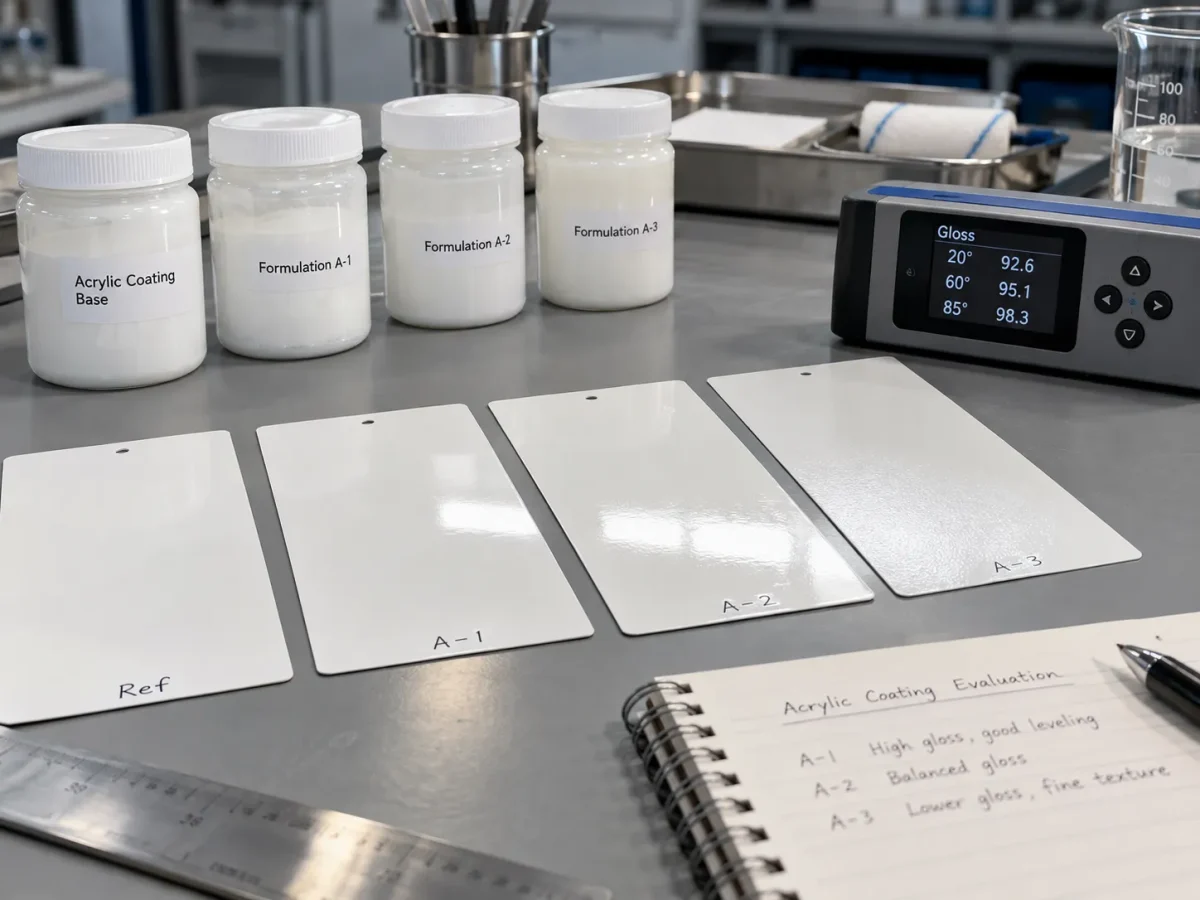
For this project, the analytical workflow included FTIR, TGA, GC-MS, XRF, DSC and comparative formulation experiments.
FTIR Identifies the Main Polymer and Organic Material Types
FTIR provides information about functional groups and polymer chemistry and can help distinguish broad binder families such as acrylic, styrene-acrylic, polyurethane or other resin systems.
It can also provide useful information about certain fillers and organic ingredients.
TGA Helps Estimate Polymer, Volatile and Inorganic Fractions
Thermogravimetric analysis measures mass loss as the sample is heated.
For a coating, different mass-loss regions can provide information about:
- water and volatile material;
- organic resin and additives;
- thermally decomposable components;
- final inorganic residue.
TGA therefore supports mass-balance calculations, but the residue should not automatically be assigned to one specific pigment or filler without complementary analysis.
GC-MS Investigates Volatile and Semi-Volatile Additives
GC-MS can help characterize components such as certain coalescing solvents, residual organic compounds and suitable low-molecular-weight additives.
However, the absence of a GC-MS peak does not prove that a coating contains no UV stabilizer or other functional additive. Some additives have low volatility or require different analytical methods.
XRF Screens the Inorganic Elemental System
XRF can identify elemental differences associated with pigments and mineral fillers.
For example, titanium signals support the presence of TiO₂, while other elements can help characterize extender pigments or inorganic additives.
XRF cannot, however, distinguish rutile TiO₂ from anatase TiO₂ by itself. If crystalline phase identification is required, techniques such as XRD or Raman spectroscopy should be used, or the pigment grade should be confirmed from raw-material information.
Combining these techniques is more reliable than attempting to reconstruct an acrylic coating from one spectrum. Xinbodi’s chemical composition analysis services use the same multi-method principle for complex industrial formulations.
What Did the Benchmark Acrylic Coating Formulation Reveal?
The higher-performing benchmark and the customer’s existing coating showed a similar overall architecture but important differences in the binder, pigment and additive systems.
The following figures represent the working formulations reconstructed and used for comparative formulation validation, rather than claiming that each percentage was obtained directly from a single instrument.
Reconstructed Benchmark Formulation
| Component | Approx. wt% | Function |
|---|---|---|
| All-acrylic emulsion | 45.2% | Main film-forming binder |
| Weathering-grade TiO₂ pigment | 22.5% | Whiteness and hiding |
| Talc | 8.6% | Mineral extender |
| Dispersant | 1.1% | Pigment dispersion |
| Coalescing agent | 2.3% | Supports film formation |
| Defoamer, wetting and rheology additives | 2.0% | Processing and application control |
| Deionized water | 18.3% | Continuous phase |
| Total | 100% |
Original In-House Formulation
| Component | Approx. wt% | Observation |
|---|---|---|
| Styrene-acrylic emulsion | 44.8% | Different binder architecture |
| TiO₂ pigment | 21.9% | Different pigment grade |
| Talc | 8.4% | Similar mineral loading |
| Dispersant | 0.5% | Lower addition level |
| Coalescing solvent | 2.2% | Different coalescing system |
| Other additives | 1.1% | Different additive package |
| Deionized water | 21.1% | Higher water fraction |
| Total | 100% |
The comparison showed that the problem was unlikely to come from one missing ingredient alone.
Instead, the two coatings differed across several interacting formulation variables.
Why Did the Original Acrylic Coating Lose Gloss and Develop Chalking?
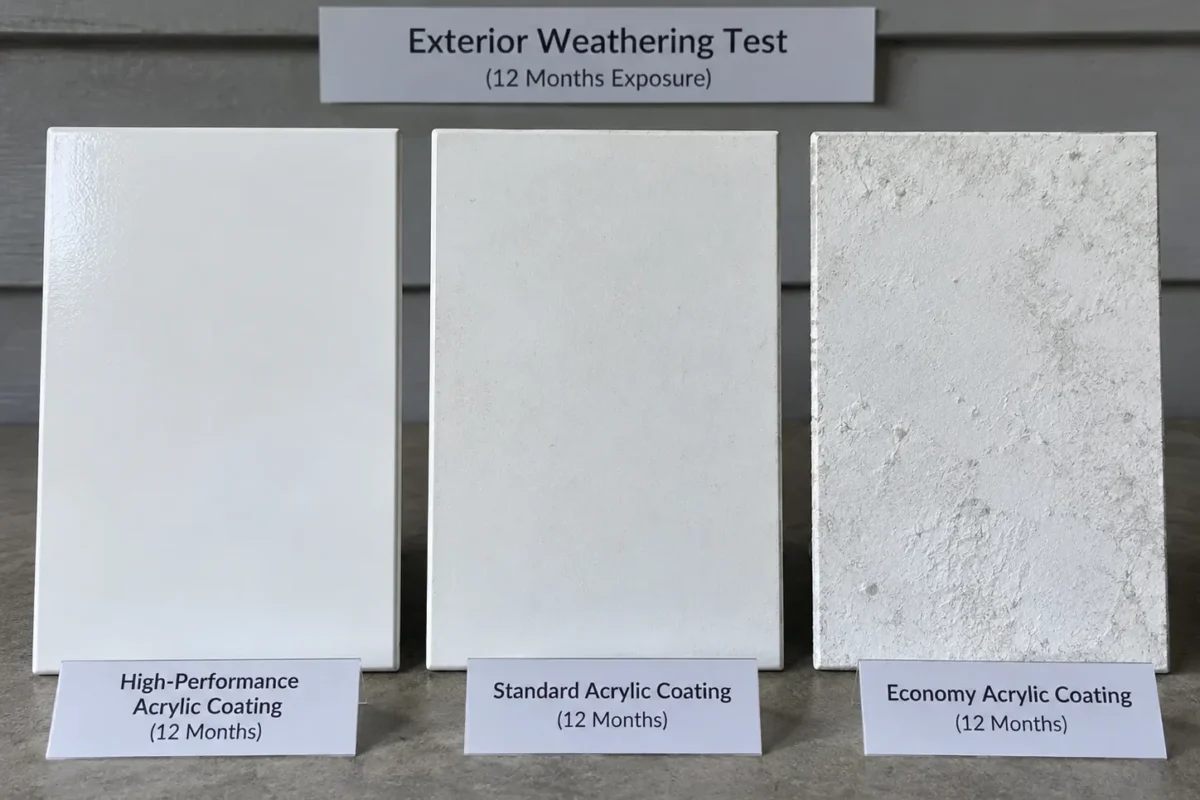
The 300-hour accelerated-aging comparison indicated that the original coating’s poor durability was most likely associated with a combination of binder, pigment and additive-system differences.
Three areas were particularly relevant.
Binder Chemistry Was Different
The benchmark used an all-acrylic binder while the original formulation used a styrene-acrylic system.
This does not mean styrene-acrylic coatings are inherently unsuitable for outdoor use. However, changing binder architecture changes the polymer’s response to UV exposure, oxidation, water and temperature.
Binder degradation can progressively weaken the surface matrix that holds pigment particles in place, producing loss of gloss and eventually visible chalking.
The TiO₂ Pigment System Was Not Equivalent
The project records also indicated a difference in TiO₂ grade between the benchmark and the original formulation.
TiO₂ is not merely a white pigment. Its crystal structure, particle size, surface treatment and dispersion can influence both optical properties and the interaction between UV radiation and the surrounding polymer.
Research published in Progress in Organic Coatings demonstrates that the interaction between TiO₂ and different waterborne polymer binders is complex; pigment polymorph, dispersion and binder chemistry all need to be considered rather than treating “rutile versus anatase” as a universal explanation for coating durability.
For practical coating reverse engineering, the more useful question is therefore:
Is the pigment grade, surface treatment and dispersion system appropriate for the selected acrylic binder and intended exposure environment?
The Dispersion and Stabilization Packages Were Also Different
The benchmark formulation used a higher dispersant level and a different overall additive package.
The lower dispersant concentration in the original coating was therefore treated as a formulation difference worth investigating, rather than proof by itself that pigment dispersion was inadequate.
To establish poor dispersion directly, additional evidence such as particle-size analysis, grind gauge results, microscopy or dispersion-stability testing would be preferable.
Similarly, the available analysis did not identify an equivalent UV-protection package in the original formulation. Because some stabilizers are difficult to detect at low concentrations, this was treated as a formulation variable to verify during reconstruction rather than proof that the product contained absolutely no UV stabilizer.
How Was the Acrylic Coating Formulation Reconstructed?
The reconstruction strategy focused on correcting the formulation system rather than simply increasing one additive.
The development direction included:
- replacing the original binder with an acrylic resin system closer to the benchmark;
- selecting a TiO₂ pigment grade appropriate for weather-resistant coating applications;
- improving pigment and filler dispersion;
- rebalancing the dispersant and other functional additives;
- adjusting the coalescing system to maintain reliable film formation;
- introducing an appropriate light-stabilization strategy where required.
The reconstructed formulation was then prepared and subjected to the same internal accelerated-aging comparison used for the original sample.
This distinction is important:
Deformulation identifies what is in the benchmark. Formulation reconstruction tests whether that analytical interpretation can actually reproduce the required coating behavior.
That is why materials testing should be used together with composition analysis when the objective is product reproduction rather than ingredient identification alone.
Did the Reconstructed Acrylic Coating Improve Aging Performance?
Yes. Under the project’s 300-hour accelerated-aging comparison, the adjusted formulation no longer showed the obvious chalking and gloss-loss behavior observed in the original coating.
Gloss and adhesion performance were brought closer to the benchmark under the evaluated conditions.
These results supported the conclusion that the original failure was not simply caused by “too little dispersant” or one missing additive.
The more likely explanation was an overall mismatch between binder chemistry, pigment selection, dispersion and the weathering-protection strategy.
The case therefore demonstrates why successful acrylic coating formulation reverse engineering requires both analytical chemistry and formulation validation.
What Can Acrylic Coating Formulation Reverse Engineering Determine?
For manufacturers comparing a competitor paint, troubleshooting a failed coating or developing an alternative formulation, acrylic coating reverse engineering can help answer questions such as:
- What type of acrylic binder is being used?
- Is the coating all-acrylic, styrene-acrylic or another copolymer system?
- What pigments and mineral fillers are present?
- What is the approximate organic-to-inorganic balance?
- Which coalescing solvents or suitable additives can be identified?
- How does the benchmark formulation differ from an existing product?
- Which formulation differences may explain gloss, adhesion, weathering or chalking problems?
- What formulation framework should be evaluated during reconstruction?
A reliable result should not be presented as an exact proprietary recipe generated automatically by an instrument.
The more realistic objective is to reconstruct a technically supported formulation architecture, validate it experimentally and determine whether it can reproduce the important performance characteristics of the benchmark product.
Project Summary
| Project Item | Finding |
|---|---|
| Product | Water-based white acrylic topcoat |
| Customer problem | Chalking and gloss loss after 300 h accelerated aging |
| Comparison sample | Higher-performing benchmark coating |
| Analytical approach | FTIR, TGA, GC-MS, XRF, DSC and formulation comparison |
| Major formulation differences | Binder chemistry, TiO₂ grade, dispersant level and additive system |
| Reconstruction direction | Acrylic binder, weathering-oriented pigment system, improved dispersion and additive balance |
| Validation | Comparative accelerated aging, gloss and adhesion |
| Result | Chalking and severe gloss-loss behavior were eliminated under the evaluated test conditions |
Acrylic Coating Reverse Engineering Is More Than Ingredient Identification
Acrylic paints are formulation systems in which polymer structure, pigments, fillers, dispersion chemistry, film formation and stabilizers interact with each other.
Two coatings can contain broadly similar ingredients and still behave very differently after months of outdoor exposure or accelerated aging.
For this reason, effective acrylic coating formulation reverse engineering should connect:
composition identification → formulation structure → benchmark comparison → reconstructed formulation → performance validation
That approach gives manufacturers more useful information than a simple ingredient list and provides a stronger technical basis for competitor benchmarking, formulation improvement and product redevelopment.