
When a flotation reagent from a new supplier produces different recovery, selectivity or froth behavior, the product name alone may not explain the problem.
Differences in active ingredients, solvents, carriers, inorganic components, impurities or formulation additives can affect how a reagent performs in a mineral-processing system. Even products sold under the same general chemical name may differ in concentration, composition and production quality.
Flotation reagent analysis helps identify these differences and supports:
- Raw material verification
- Supplier comparison
- Batch consistency evaluation
- Unknown reagent identification
- Process abnormality investigation
- Product development and formulation comparison
Xinbodi Laboratories provides customized analytical workflows for collectors, frothers, modifiers and other mineral-processing chemicals.
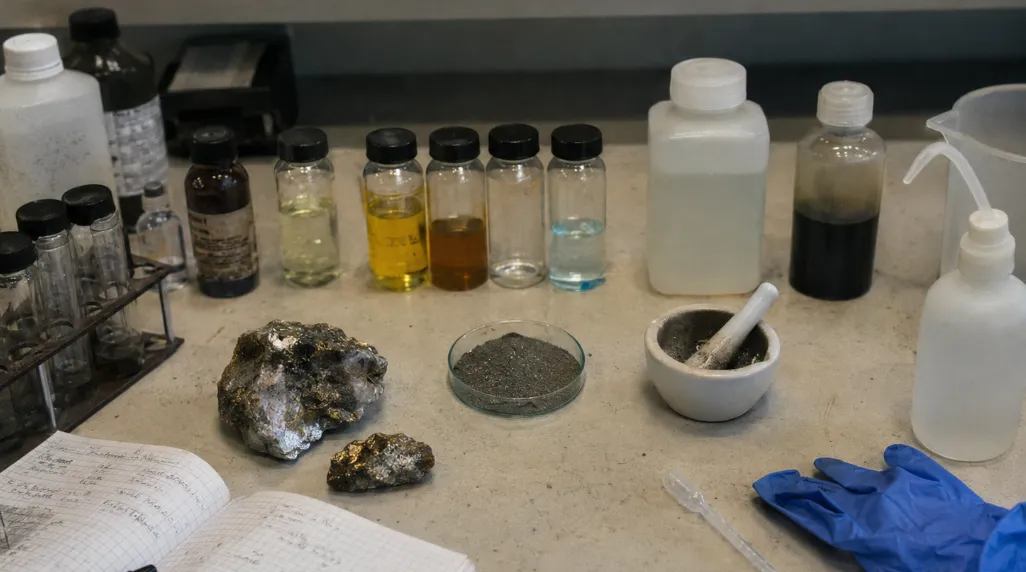
Why Analyze Flotation Reagents?
Flotation performance depends on the interaction between mineral surfaces, water chemistry and chemical reagents. When one of these factors changes, the separation result may also change.
A recent review of flotation reagents for phosphate ore beneficiation examines the roles of collectors, frothers, depressants and regulators, illustrating how reagent chemistry is closely connected with flotation selectivity and process performance.
Common situations requiring flotation reagent analysis include:
- A new supplier’s reagent produces lower recovery
- Froth becomes excessively stable or collapses too quickly
- A collector shows different selectivity between batches
- The active ingredient concentration is uncertain
- An unknown reagent needs to be identified
- A replacement product must be compared with the original
- Unexpected impurities or precipitates appear in the process
- A reagent formulation needs to be investigated for product development
Laboratory analysis cannot reproduce every operational condition in a flotation plant, but it can reveal meaningful compositional differences that support process troubleshooting and supplier evaluation.
What Can Flotation Reagent Analysis Identify?
Depending on the sample type and project objective, an analytical program may investigate:
- Main active ingredients
- Organic functional components
- Solvents and carrier materials
- Surfactants and formulation additives
- Inorganic salts and mineral components
- Major and trace elements
- Impurities and degradation products
- Relative differences between samples
- Possible formulation or concentration changes
Because flotation reagents may contain both organic and inorganic components, multiple analytical techniques are often required for reliable identification and cross-verification.
Analysis of Flotation Collectors
Collectors selectively adsorb onto target mineral surfaces and increase their hydrophobicity, allowing mineral particles to attach to air bubbles and rise into the froth phase.
Different mineral systems require different collector chemistries.
Sulfide Mineral Collectors
Xanthates and dithiophosphates are commonly associated with the flotation of copper, lead, zinc and other sulfide minerals.
Collector analysis may help evaluate:
- Collector type
- Main active component
- Alkyl-group or structural differences
- Active ingredient concentration
- Solvents and diluents
- Inorganic components
- Degradation products
- Differences between suppliers or batches
This type of analysis is useful when two collectors have similar product descriptions but produce different selectivity or recovery.
Non-Sulfide Mineral Collectors
Fatty acids such as oleic acid may be used in the flotation of phosphate minerals, fluorite and other non-sulfide minerals.
A commercial fatty-acid collector may contain a mixture of related organic components rather than one pure compound. Analysis can therefore focus on:
- Fatty-acid composition
- Chain-length distribution
- Unsaturated and saturated components
- Solvent or carrier content
- Oxidation or degradation products
- Comparison with a reference formulation
Non-Polar Collectors
Kerosene, diesel and related hydrocarbon products are commonly used for coal and naturally hydrophobic minerals.
For these samples, analysis may compare:
- Hydrocarbon distribution
- Boiling-range-related composition
- Aromatic and aliphatic components
- Light and heavy fractions
- Additives or contaminants
- Batch-to-batch differences
The analytical objective is usually comparative rather than the identification of every individual hydrocarbon.
Analysis of Flotation Frothers
Frothers reduce water surface tension and help form bubbles with suitable size and stability. Their composition can influence froth structure, mineral transport and flotation control.
Common frothers include:
- Pine oil
- Terpineol-based products
- Methyl isobutyl carbinol, or MIBC
- Alcohol-based frothers
- Glycol-based frothers
- Mixed commercial formulations
Frother analysis may help answer questions such as:
- Is the product primarily MIBC, terpineol or a mixed formulation?
- Are solvents or diluents present?
- Has the concentration changed?
- Are there high-boiling impurities?
- Do two suppliers use different frother compositions?
- Could degradation or contamination explain abnormal foam behavior?
GC-MS and related organic-analysis techniques are often useful for examining volatile and semi-volatile frother components.
Analysis of Flotation Modifiers
Modifiers control the chemical conditions of the slurry and influence how collectors interact with mineral surfaces.
Unlike collectors, modifiers do not normally cause particles to float directly. Their role is to improve selectivity, activate target minerals, depress unwanted minerals or control slurry conditions.
pH Regulators
Common pH regulators include:
- Lime
- Sulfuric acid
- Other alkaline or acidic process chemicals
Analysis may verify the main component, concentration, inorganic impurities or differences between supplied products.
Activators
Activators help make certain mineral surfaces more responsive to collectors.
Examples include:
- Copper sulfate
- Sodium sulfide
The role of sodium sulfide can vary with the mineral system and process conditions. In some applications, it may also contribute to mineral depression.
Analytical projects may evaluate:
- Elemental composition
- Main salt content
- Counter-ions
- Insoluble impurities
- Concentration differences
- Contamination or degradation
Depressants
Depressants prevent collectors from adsorbing onto selected minerals, helping unwanted minerals remain in the slurry.
Examples may include:
- Sodium silicate
- Starch-based materials
- Other organic or inorganic depressants
For formulated depressants, analysis may investigate polymer type, inorganic composition, molecular characteristics and comparison with reference samples.
Flocculants and Dispersants
Flocculants promote the aggregation of fine particles, while dispersants help separate particle clusters and stabilize the slurry.
Common examples include:
- Polyacrylamide
- Sodium silicate
Analysis may focus on:
- Polymer identity
- Molecular-weight-related differences
- Ionic characteristics
- Inorganic content
- Active material concentration
- Product consistency
Defoamers
Defoamers are used when excessive or persistent foam interferes with flotation or downstream processing.
Commercial defoamers may contain oils, silicones, surfactants, particles and carrier materials. Their analysis often requires a combination of organic and inorganic techniques.
Supplier and Batch Comparison
One of the most common flotation reagent analysis projects is the comparison of two or more samples.
Typical comparisons include:
- Original supplier versus replacement supplier
- Approved batch versus suspect batch
- Imported reagent versus local alternative
- Normal-performing reagent versus abnormal reagent
- Reference formulation versus developed product
- New reagent versus aged or stored material
A comparison project may evaluate:
- Whether the main ingredients are consistent
- Whether active component levels differ
- Whether solvents or carriers have changed
- Whether additional additives are present
- Whether inorganic impurities have increased
- Whether degradation products are detectable
- Which differences may be technically significant
Submitting a known reference sample together with the suspect sample generally improves the quality of the comparison.
Analytical Methods for Flotation Reagents
Xinbodi selects methods according to the reagent type, sample matrix and analytical objective.
Potential techniques include:
FTIR
Used for functional-group screening and identification of major organic components, polymers and certain inorganic substances.
GC-MS
Suitable for volatile and semi-volatile components, including solvents, alcohol-based frothers, hydrocarbons and selected collector ingredients.
LC-MS
Used for non-volatile or thermally sensitive organic compounds, surfactants and formulation additives.
NMR
Provides molecular-structure information and may support the confirmation of selected collector, frother or additive components.
GPC
May be used for molecular-weight distribution analysis of polymeric depressants, flocculants and dispersants.
XRF and ICP Analysis
Used to evaluate inorganic elements, metallic components, salts and trace elemental impurities.
SEM-EDS
Useful for insoluble particles, precipitates and localized elemental analysis of solid residues.
No single method can identify every component in a complex commercial reagent. A multi-method workflow is therefore often more reliable than relying on one instrument result.
What Clients Receive
Depending on the project scope, the final report may include:
- Identification of the reagent type
- Main organic and inorganic components
- Solvent and carrier information
- Active ingredient information where technically feasible
- Qualitative or semi-quantitative composition
- Supplier or batch comparison
- Identification of significant differences
- Impurity or degradation-product findings
- Instrument spectra and supporting data
- Technical interpretation of the results
- Recommendations for further verification
Quantification depends on the sample matrix, target compound, analytical method and availability of suitable reference standards.
Flotation Reagent Analysis at Xinbodi Laboratories
Xinbodi Laboratories provides customized flotation reagent analysis for collectors, frothers, modifiers and other mineral-processing chemicals.
Our projects can support:
- Unknown chemical identification
- Composition analysis
- Supplier qualification
- Batch consistency investigation
- Formulation comparison
- Deformulation and reverse engineering
- Impurity investigation
- Mineral-processing troubleshooting
Each analytical plan is developed according to the sample type and the client’s technical question rather than applying the same fixed test package to every reagent.
Need Flotation Reagent Analysis?
Send us the reagent name, sample form, known composition, application background and analytical objective.
Xinbodi Laboratories will review the information and recommend a suitable workflow for ingredient identification, supplier comparison, batch-difference analysis or formulation investigation.
FAQ
Can Xinbodi identify an unknown flotation reagent?
Yes. Multiple analytical techniques may be combined to identify the reagent category, major organic components, inorganic materials, solvents and formulation additives.
Can two flotation reagents from different suppliers be compared?
Yes. The samples can be analyzed under the same conditions to compare active ingredients, solvents, additives, inorganic components and impurity profiles.
Can the active ingredient concentration be measured?
It may be possible when the target compound is known and suitable analytical methods and reference standards are available. Some complex samples may only support qualitative or semi-quantitative results.
What samples should be submitted for comparison?
Ideally, submit both the reference product and the suspect or replacement product. Product specifications, safety data sheets and information about observed performance differences are also helpful.
Can you reverse engineer a flotation reagent formulation?
Xinbodi can provide deformulation and composition-analysis support. The level of detail depends on formulation complexity, component concentration and analytical feasibility.