
A polyurethane structural adhesive can show good initial bond strength and still fail severely after prolonged exposure to heat and humidity.
In one Xinbodi Laboratories customer project, a composite materials manufacturer was developing a two-component, room-temperature-curing polyurethane adhesive for bonding glass-fiber-reinforced polyurethane panels to aluminum profiles.
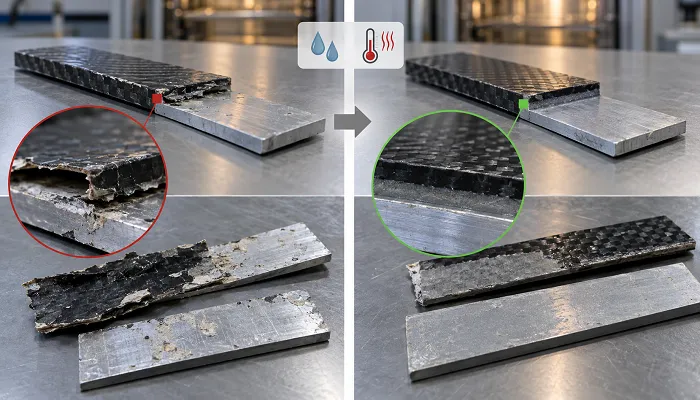
The in-house adhesive initially achieved a lap-shear strength of 5.2 MPa. However, after the customer’s accelerated hygrothermal condition of 85°C/85% RH for 7 days, the strength dropped to 1.8 MPa, while large areas of the adhesive separated from the aluminum surface.
The R&D team initially suspected insufficient curing and increased the B-component dosage. The failure remained.
The customer therefore asked Xinbodi to perform polyurethane adhesive testing, formulation comparison and failure investigation against an imported benchmark adhesive.
This project demonstrates why adhesive testing sometimes needs to go beyond a single bond-strength value. Performance testing, formulation chemistry and fracture-surface evidence must often be interpreted together to understand why an adhesive fails.
For broader adhesive and sealant projects, Xinbodi’s adhesives and sealants testing and analysis capabilities cover material characterization, performance comparison and failure investigation.
The Problem: Good Initial Adhesion, Poor Hygrothermal Durability
The customer’s adhesive was a two-part polyurethane system.
Part A contained hydroxyl-functional polyether components, inorganic filler and functional additives. Part B used an MDI-based isocyanate curing system.
Under initial conditions, the adhesive bonded successfully.
The problem only became obvious after heat and moisture exposure:
| Performance | In-House Adhesive |
|---|---|
| Initial lap-shear strength | 5.2 MPa |
| After 85°C/85% RH, 7 days | 1.8 MPa |
| Strength retention | ~35% |
| Main post-aging failure mode | Adhesive–aluminum interfacial debonding |
The loss of strength was important, but the change in failure location was equally significant.
The failed specimens showed extensive separation at the aluminum interface instead of fracture predominantly within the adhesive layer.
This indicated that simply increasing bulk adhesive strength would not necessarily solve the problem.
Published research on polyurethane adhesive-bonded aluminum joints under different temperature and humidity conditions has similarly shown that increasing temperature and humidity can reduce bond strength and change the failure mode of polyurethane-bonded aluminum joints.
Samples and Testing Strategy
The customer supplied:
- imported benchmark polyurethane adhesive, Parts A and B separately sealed;
- the customer’s own polyurethane adhesive, Parts A and B;
- bonded specimens that had failed after hygrothermal aging.
Having both the benchmark and failed product was important.
Testing only the failed joint could show where separation occurred, but comparing the reference formulation, in-house formulation and fracture surface made it possible to investigate why the two adhesive systems behaved differently.
The analysis combined several methods.
| Method | Main Purpose |
|---|---|
| FTIR-ATR | Identify major polymer and functional-group differences |
| GPC/SEC | Evaluate molecular-weight characteristics of suitable soluble polyol components |
| Karl Fischer titration | Measure water in Part A and assess moisture-related NCO consumption risk |
| TGA | Compare polymer, additive and inorganic filler fractions |
| GC-MS | Identify selected low-molecular-weight organic components |
| ICP-OES | Characterize selected inorganic elements |
| SEM-EDS | Examine fracture morphology and local elemental distribution |
| Lap-shear testing | Compare initial and post-aging bonding performance |
The objective was not simply to generate a list of detected chemicals.
The purpose of the investigation was to connect formulation differences with the loss of wet-heat bonding performance.
What the Imported Benchmark Formulation Revealed
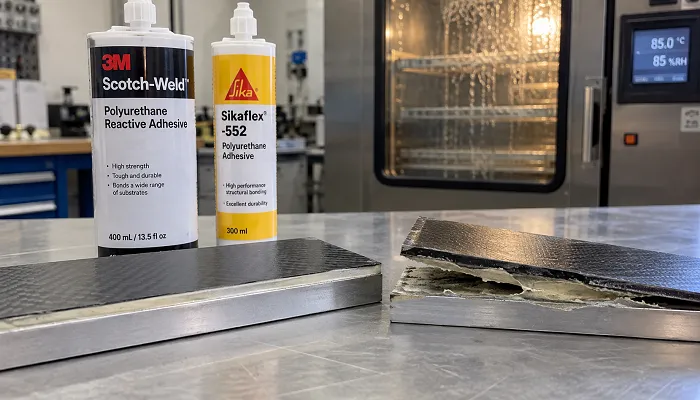
Analytical reconstruction showed that the imported benchmark used a more complex A-side polyol and filler system.
Its major A-side components included approximately:
- 46.2 wt% PPG-2000;
- 12.5 wt% polyether triol;
- 30.1 wt% surface-treated heavy calcium carbonate;
- 10.0 wt% low-molecular-weight polyether polyol;
- small amounts of antioxidant and processing additives.
The B component consisted mainly of modified liquid MDI, together with a smaller amount of polymeric MDI and a trace stabilizing component.
These values represent an analytical reconstruction rather than the manufacturer’s original batch sheet. Minor components and analytically unresolved ingredients may not be represented individually.
The important point was not simply the individual percentages. The benchmark used a different polyol architecture, filler surface treatment and MDI balance from the customer’s adhesive.
For complex formulation projects, this type of analysis falls within Xinbodi’s chemical composition analysis services, where multiple analytical techniques can be combined to characterize organic, inorganic and functional components.
The Benchmark Retained Bond Strength After Aging
The imported adhesive provided a useful performance reference.
| Performance | Imported Benchmark |
|---|---|
| Initial lap-shear strength | 5.3 MPa |
| After 85°C/85% RH, 7 days | 4.6 MPa |
| Strength retention | ~87% |
| Main post-aging failure mode | Predominantly cohesive |
Unlike the customer’s original adhesive, the benchmark did not show large-area clean separation from the aluminum.
Fracture occurred mainly within the adhesive layer.
This indicated that the adhesive–aluminum interface remained comparatively robust after the same hygrothermal exposure.
The broader effect of moisture and temperature on adhesive joints is also well documented. A study in The Journal of Adhesion exposed aluminum-alloy adhesive joints to 80°C/95% RH and found that hygrothermal aging reduced failure strength and changed fracture-surface characteristics over time. See the peer-reviewed study on hygrothermal aging of aluminum alloy adhesive joints.
What Was Different in the In-House Formula?
The customer’s formulation differed from the benchmark in several important areas.
A-Side Differences
The in-house Part A contained approximately:
- 48.3 wt% PPG-2000;
- 4.0 wt% 1,4-butanediol;
- 32.0 wt% untreated heavy calcium carbonate;
- 10.5 wt% DOP plasticizer;
- antioxidant and calcium stearate.
B-Side Differences
The in-house Part B contained approximately:
- 92.0 wt% polymeric MDI;
- 7.97 wt% modified liquid MDI;
- a trace stabilizing component.
The comparison can be summarized as follows:
| Formulation Feature | Imported Benchmark | In-House Formula |
|---|---|---|
| Polyol system | PPG + polyether triol + reactive low-MW polyether | Mainly PPG + BDO |
| Filler | Silane-treated CaCO₃ | Untreated CaCO₃ |
| Flexibility adjustment | Reactive polyether component | DOP |
| B-side MDI balance | Mainly modified liquid MDI | Mainly polymeric MDI |
| Post-aging failure | Predominantly cohesive | Severe aluminum-interface failure |
These differences provided several technically plausible explanations for the durability gap, but they needed to be interpreted together rather than assigning the failure to one ingredient alone.
Why Increasing the B Component Did Not Solve the Failure
Before laboratory investigation, the development team increased the mix ratio from approximately A:B = 100:32 to 100:36, assuming that additional isocyanate would improve curing.
It did not solve the hygrothermal failure.
This is an important lesson in polyurethane adhesive development.
The NCO/OH balance influences network formation, but long-term adhesive performance also depends on:
- network flexibility and toughness;
- filler–polymer compatibility;
- moisture sensitivity;
- substrate wetting and surface condition;
- internal stress;
- formulation additives;
- processing and curing conditions.
Increasing isocyanate dosage cannot correct every interfacial adhesion problem.
In some formulations, increasing functionality or crosslink density can also produce a stiffer network, which may be less able to accommodate differential thermal and moisture-induced deformation between dissimilar substrates.
Therefore, the investigation shifted from “Is there enough curing agent?” to “Why does this formulation lose interfacial durability under wet heat?”
Filler Surface Treatment Was an Important Difference
One of the clearest formulation differences was the calcium carbonate.
The benchmark used silane-treated heavy calcium carbonate, while the customer’s formulation contained untreated calcium carbonate.
Appropriate silane treatment can improve compatibility between inorganic filler surfaces and an organic polymer matrix. This may improve filler dispersion and reduce weak filler–polymer interfaces.
Under humid conditions, poorly compatible interfaces and microvoids can provide pathways for moisture penetration.
The filler difference was therefore considered an important contributor to the formulation’s overall moisture durability.
However, the analytical evidence did not demonstrate that calcium-carbonate treatment alone caused the adhesive–aluminum separation.
The final joint failure occurred at the aluminum interface, so filler treatment should be regarded as one part of a broader formulation and interfacial stability problem.
SEM-EDS Confirmed Predominantly Interfacial Failure
SEM examination of the failed customer samples showed large exposed regions of the aluminum substrate after aging.
EDS measurements on these regions were dominated by aluminum-related signals and showed comparatively little adhesive residue.
This supported classification of the fracture as predominantly adhesive/interfacial failure, rather than cohesive failure inside the polyurethane.
That distinction matters.
If the polyurethane itself had fractured throughout the adhesive layer, increasing cohesive strength might have been the primary development direction.
Instead, the evidence showed that the adhesive–substrate interface had become the weak link after hygrothermal exposure.
The Polymer Network Also Differed from the Benchmark
The customer’s formulation relied on 1,4-butanediol as a small-molecule chain extender and used a B component dominated by higher-functionality polymeric MDI.
The benchmark contained additional reactive polyether components and a different modified-MDI/polymeric-MDI balance.
These differences are consistent with different hard-segment content, crosslinking behavior and network flexibility.
For bonding aluminum to a fiber-reinforced polymer panel, an adhesive must provide adequate cohesive strength while still accommodating thermal expansion, moisture-induced dimensional change and interfacial stress.
A network that is unnecessarily rigid may concentrate stresses at the bonded interface.
Because direct crosslink-density measurements were not part of this investigation, this mechanism was treated as an engineering interpretation supported by the formulation comparison, rather than as a directly measured crosslink-density result.
DOP and Antioxidant Content Were Secondary Formulation Risks
The customer’s formulation also contained approximately 10.5 wt% DOP, while the benchmark used a reactive low-molecular-weight polyether component for flexibility adjustment.
DOP is a non-reactive plasticizer. Unlike a reactive polyol, it does not become chemically incorporated into the polyurethane network.
Under prolonged thermal exposure, migration or redistribution of a non-reactive plasticizer can become a formulation concern.
The in-house adhesive also contained less antioxidant than the benchmark.
These differences were relevant to formulation optimization, but neither plasticizer migration nor oxidative degradation was independently quantified in this project.
They were therefore treated as secondary formulation risks, not as individually proven root causes of the failure.
Formulation Optimization Strategy
The optimization strategy focused on improving the overall network and interface durability rather than simply adding more B component.
The main changes were:
- Replace untreated calcium carbonate with silane-treated calcium carbonate.
- Remove DOP and use a reactive low-molecular-weight polyether for flexibility adjustment.
- Reduce the amount of 1,4-butanediol to limit unnecessary network rigidity.
- Rebalance modified liquid MDI and polymeric MDI.
- Increase antioxidant content from approximately 0.10% to 0.20%.
- Return the mixing ratio to approximately A:B = 100:32, based on the revised formulation and NCO/OH balance.
The objective was not to duplicate every component of the imported adhesive.
It was to understand and reproduce the formulation logic responsible for better wet-heat durability.
For projects where an existing commercial adhesive must be understood and reconstructed, Xinbodi also provides deformulation and reverse engineering services to support competitor benchmarking, supplier substitution and formulation development.
Performance After Optimization
The optimized adhesive was evaluated under the same hygrothermal condition.
| Result | Original Formula | Optimized Formula | Imported Benchmark |
|---|---|---|---|
| Initial lap-shear strength | 5.2 MPa | 5.1 MPa | 5.3 MPa |
| After 85°C/85% RH, 7 days | 1.8 MPa | 4.4 MPa | 4.6 MPa |
| Strength retention | ~35% | ~86% | ~87% |
| Main failure mode | Interfacial debonding | Predominantly cohesive | Predominantly cohesive |
The most important result is easy to miss:
The initial strength did not increase.
It changed only from 5.2 MPa to 5.1 MPa.
What improved dramatically was durability after hygrothermal aging.
Residual strength increased from 1.8 MPa to 4.4 MPa, while the failure mode changed from large-area aluminum-interface debonding to predominantly cohesive fracture within the adhesive.
This showed that the original development problem was not insufficient initial bond strength.
It was inadequate wet-heat interface and formulation durability.
What This Polyurethane Adhesive Testing Project Demonstrates
This case illustrates why a single mechanical test cannot always explain an adhesive problem.
Lap-shear testing identified the performance loss.
SEM-EDS established where the joint failed.
Chemical and formulation analysis revealed significant differences between the benchmark and in-house systems.
The combined evidence showed why simply increasing the curing-agent ratio was not addressing the underlying problem.
For manufacturers developing structural adhesives, the more useful question is often not:
“How can we make the initial strength higher?”
but:
“Which part of the adhesive system becomes the weak link under actual service conditions?”
That distinction can significantly reduce trial-and-error formulation work.
Polyurethane Adhesive Testing at Xinbodi
Xinbodi Laboratories supports adhesive manufacturers, materials companies and industrial users with polyurethane adhesive testing and analysis for problems including:
- loss of bond strength;
- wet-heat aging failure;
- adhesive–substrate debonding;
- formulation differences;
- incomplete or inconsistent curing;
- supplier and batch comparison;
- competitor benchmarking;
- imported adhesive replacement.
For failure investigations, the most useful submission usually includes the failed bonded component, a normal reference, unused adhesive components and relevant processing or aging information.
When a benchmark product is available, combining performance testing with formulation comparison can help identify not only how the products differ, but which differences are technically relevant to the customer’s product-development problem.