
Why Polyurethane Sealant Deformulation Analysis Was Needed
A sealant manufacturer was developing a two-component polyurethane sealant for photovoltaic modules, industrial buildings and structural joint applications.
The product met basic production requirements but remained significantly behind an imported benchmark in three areas:
- joint movement capability reached only about ±20%, below the ±35% target;
- after 500 hours of UV aging, adhesion retention was below 45%, with whitening and chalking;
- after high-temperature and high-humidity exposure, interfacial peeling occurred and waterproofing performance deteriorated.
Repeated adjustments to individual additives did not solve the problem.
The customer therefore commissioned polyurethane sealant deformulation analysis to understand how the benchmark formulation achieved better flexibility, UV resistance and wet-heat adhesion. For complex polymer formulations, polymer deformulation and reverse engineering can help reveal differences in resin systems, fillers, plasticizers and functional additives that are difficult to identify through routine testing alone.
Why Trial-and-Error Formulation Adjustments Were Not Enough
Two-component polyurethane sealants are not controlled by one ingredient alone.
Performance depends on the interaction between:
- polyurethane prepolymer chemistry
- polyol and chain-extender system
- plasticizer level
- filler loading
- antioxidant and UV stabilizer package
- coupling agents
- catalyst system
- interfacial reinforcement
Increasing one additive without understanding the overall formulation may improve one property while reducing another.
For this reason, the project focused on comparative formulation analysis rather than simply identifying individual raw materials.
Research on polyurethane sealants has shown that formulation variables such as fillers, plasticizers and silane-related components can significantly influence tensile properties, elongation, curing behavior and interfacial performance. See this study on polyurethane sealant formulation and performance.
Samples Compared
Three material groups were evaluated:
- imported two-component polyurethane benchmark — Component A
- imported benchmark — Component B
- customer’s self-developed polyurethane sealant as the comparison sample
Analyzing both benchmark components separately was essential because the resin side and curing side play different roles in the final crosslinked structure.
Analytical Strategy for Polyurethane Sealant Reverse Engineering
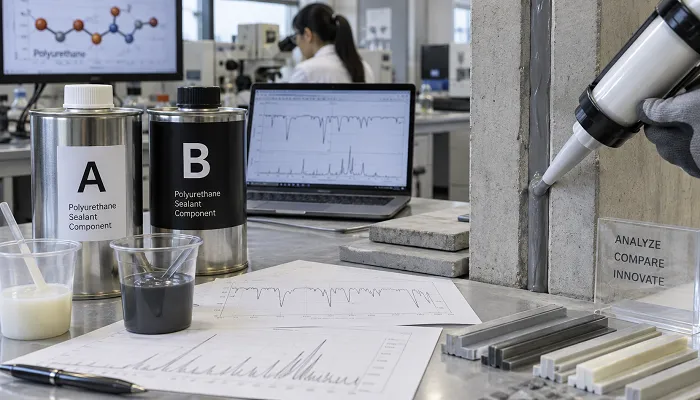
The analysis combined separation with multiple complementary techniques.
Polymer and Prepolymer Identification
FTIR analysis was used to characterize the polyurethane backbone, functional groups and isocyanate-related chemistry.
Residual NCO content and hydroxyl-related data were also used to support interpretation of the prepolymer and curing systems.
Organic Additive Analysis
GC-MS analysis and LC-MS were used to investigate:
- plasticizers
- antioxidants
- UV absorbers
- defoaming additives
- other low-level organic components
Molecular Characterization
GPC analysis was used to examine the molecular characteristics of polymeric components and support interpretation of the polyol or resin system.
Inorganic Filler Analysis
SEM-EDS, together with thermal and elemental information, was used to evaluate fillers and inorganic components.
Quantitative Cross-Checking
TGA was used to estimate the inorganic fraction and cross-check the formulation balance obtained from the separation and instrumental results.
The objective was not simply to list ingredients, but to reconstruct how the formulation was designed. This type of project is closely related to chemical composition analysis, but goes further by interpreting how individual components work together within the formulation.
What the Benchmark Sealant Formulation Revealed
The imported benchmark showed several formulation features that were missing or underrepresented in the customer’s product.
Component A: Flexible Prepolymer and Additive System
The benchmark Component A contained approximately:
- MDI-based polyurethane prepolymer: 42.0%
- DINP plasticizer: 18.0%
- calcium carbonate filler: 32.0%
- fumed silica: 2.5%
- silane coupling agent: 0.8%
- phenolic antioxidant: 0.4%
- UV absorber: 0.3%
- minor defoaming and moisture-control components
The polyurethane prepolymer contained residual NCO groups, while the relatively high plasticizer level helped maintain flexibility and joint movement capability.
The benchmark also used a combined antioxidant + UV absorber system, rather than relying on the polymer matrix alone for weather resistance.
Component B: Crosslinking and Reinforcement System
The curing component contained approximately:
- polyether triol: 55.0%
- 1,4-butanediol: 8.0%
- calcium carbonate filler: 35.0%
- bismuth-based catalyst: 0.5%
- minor defoaming and moisture-control additives
The combination of polyether triol and chain extender provided a balance between crosslink density, elasticity and mechanical strength.
This was an important finding: the benchmark was not designed simply to maximize hardness or curing speed. Its curing system was structured to maintain both network strength and movement capability.
Why the Customer’s Polyurethane Sealant Underperformed
Comparative analysis identified four important formulation gaps.
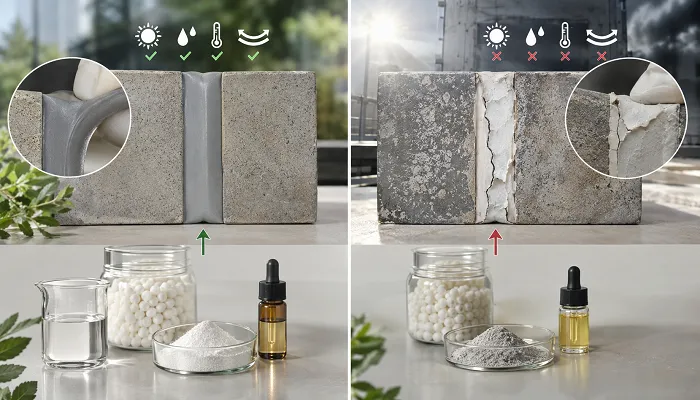
1. The Resin System Was Less Suitable for Long-Term Flexibility
The customer’s formulation used a simpler polyurethane system and did not reproduce the benchmark’s resin design.
The benchmark’s MDI-based system and flexible polyether structure provided a more suitable foundation for long-term elasticity and weather resistance.
2. Plasticizer Level Was Too Low
The benchmark contained approximately 18% DINP, while the customer’s formulation contained about 10%.
The lower plasticizer level corresponded with higher modulus and reduced movement capability.
This helped explain why the customer’s product remained near ±20% joint movement while the benchmark reached approximately ±35%.
3. The Weathering Stabilizer Package Was Incomplete
The benchmark contained both an antioxidant and a UV absorber.
The customer’s formulation did not show an equivalent stabilizer system.
This difference was consistent with the faster whitening, chalking and adhesion loss observed after UV exposure.
4. Interfacial Reinforcement Was Insufficient
The imported benchmark contained a higher level of silane coupling chemistry.
The customer’s product contained much less interfacial modifier.
That difference was especially relevant under 85°C / 85% RH, where poor interfacial stability contributed to peeling and adhesion loss.
Root Cause Identified by Polyurethane Sealant Deformulation Analysis
The performance gap did not come from one missing ingredient.
It resulted from four interacting formulation differences:
prepolymer structure + plasticizer balance + weathering stabilizers + interfacial coupling system
Together, these differences affected:
- flexibility
- joint movement
- resistance to UV degradation
- filler–polymer interaction
- wet-heat adhesion
- long-term sealing reliability
This also explains why simply increasing one additive had failed to reproduce the imported product.
Formulation Optimization and Validation
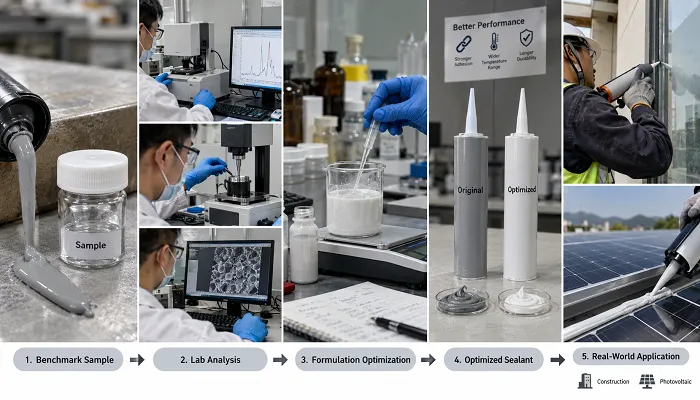
Based on the benchmark analysis, the customer adjusted the formulation architecture rather than copying individual ingredient percentages directly.
After optimization:
- joint movement capability improved from approximately ±20% to ±32%;
- adhesion retention after 500 hours of UV aging improved from about 43% to 79%;
- adhesion retention after 85°C / 85% RH for 1,000 hours improved from approximately 38% to 75%;
- the formulation moved substantially closer to the imported benchmark.
The revised product subsequently passed internal validation and entered customer qualification testing.
What This Polyurethane Sealant Analysis Shows
This project demonstrates why competitor benchmarking for polyurethane sealants requires more than FTIR identification.
Two products can both be described as polyurethane sealants while differing significantly in:
- prepolymer chemistry
- molecular architecture
- plasticizer loading
- filler system
- antioxidant package
- UV stabilization
- coupling-agent strategy
- curing network design
Polyurethane sealant deformulation analysis helps translate those hidden formulation differences into practical R&D direction.
It can be particularly useful when a product meets basic specifications but still falls behind a benchmark in long-term durability, adhesion or environmental resistance.
Polyurethane Sealant Deformulation and Reverse Engineering at Xinbodi
Xinbodi provides polyurethane sealant deformulation analysis and formulation reverse engineering for manufacturers developing or improving:
- two-component polyurethane sealants
- construction sealants
- structural adhesives
- weather-resistant sealants
- industrial bonding materials
- polyurethane coatings and elastomeric systems
Projects can focus on competitor benchmarking, ingredient identification, formulation reconstruction, supplier comparison or performance-gap investigation.
For the most useful comparison, clients are encouraged to provide both the benchmark product and their own formulation, together with the specific performance gap they want to investigate.
If you are developing a polyurethane sealant or trying to understand why your product performs differently from a benchmark, contact our technical team to discuss your samples and analysis goals.