Metal-to-Plastic Conversion
Xinbodi Laboratories supports manufacturers evaluating metal-to-plastic conversion for industrial components. We focus on the material side of the conversion: defining performance requirements, analyzing reference materials, comparing candidate polymers and reinforced compounds, reverse engineering existing plastic references when available, and validating key properties before the project moves forward.
Is Metal-to-Plastic Conversion Right for Your Part?
Replacing metal with plastic is not simply a material swap. The candidate polymer must still meet the functional requirements of the component.
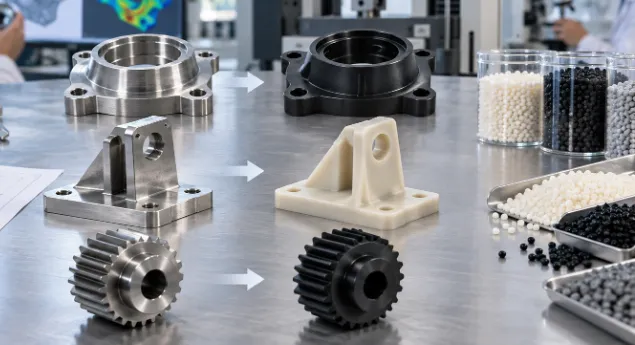
Metal-to-plastic conversion may be worth evaluating when the project involves weight reduction, corrosion or chemical exposure, friction and wear, complex part geometry, part consolidation, material cost, or supply-chain replacement.
Typical projects may include housings, covers, brackets, gears, wear components, bearing-related parts and other industrial components.
Not every metal part should be converted to plastic. The decision should be based on the actual load, operating temperature, environment, dimensional requirements and expected service conditions of the component.
How Xinbodi Supports Metal-to-Plastic Conversion
The analytical route is selected according to the material and project objective. Depending on the question, testing may combine techniques such as FTIR, Py-GC/MS, GC-MS, LC-MS, GPC, DSC, TGA, microscopy, elemental analysis and mechanical testing.
| Project Stage | Key Question | Xinbodi Lab Support |
|---|---|---|
| 1. Define Requirements | What must the replacement material withstand? | Review operating temperature, mechanical load, wear, chemical exposure, dimensional requirements and known failure risks. |
| 2. Analyze Reference Materials | What is the existing or benchmark material made of? | Polymer identification, composition analysis, filler and reinforcement analysis, thermal characterization and comparative testing. |
| 3. Reverse Engineer the Material System | Why does an existing plastic component or imported reference perform differently? | Deformulation and reverse engineering can investigate resin systems, additives, fillers, reinforcing materials and formulation differences. |
| 4. Evaluate Candidate Plastics | Which material direction should be investigated? | Compare engineering plastics and reinforced polymer systems based on the required mechanical, thermal, chemical and physical properties. |
| 5. Validate Performance | Does the candidate material meet the target requirements? | Mechanical, thermal, chemical and physical testing can be used to compare candidate materials against specifications or reference samples. |
Metal-to-Plastic Conversion Services
Composition Analysis & Reverse Engineering for Material Replacement
When a reference plastic component, imported material, competitor sample or failed replacement is available, laboratory analysis can provide a much stronger starting point than selecting a new polymer from datasheets alone.
Xinbodi can investigate the base polymer, polymer blend, glass or carbon fiber reinforcement, mineral fillers, additives, thermal behavior, molecular characteristics and important differences between samples.
This information can support:
- identifying an unknown reference material;
- comparing original and replacement materials;
- investigating why a domestic or alternative material performs differently;
- reverse engineering an imported plastic component;
- supporting formulation development or material modification;
- reducing trial-and-error during material replacement.
Engineering Plastics and Reinforced Materials
The correct material depends on the application rather than on a single “best” polymer.
Candidate systems may include engineering and high-performance plastics such as PA, POM, PC/ABS, PPS, PEEK, as well as glass-fiber or carbon-fiber reinforced polymer systems.
Material evaluation may consider properties such as stiffness, strength, impact resistance, temperature behavior, dimensional stability, friction and wear, chemical resistance and processability.
For projects requiring a modified material rather than a standard commercial grade, formulation and material-development requirements can be discussed according to the project scope.
Validate the Material Before Moving to the Part
A candidate plastic should be evaluated against the actual performance requirements of the component before a conversion decision is made.
Xinbodi’s materials testing capabilities can support comparison of mechanical, thermal, chemical and physical properties between the original requirement, candidate materials and reference samples.
Where appropriate, testing can also follow relevant customer specifications or recognized methods. For example, ISO 527-1 defines general principles for tensile testing of plastics and plastic composites, while ISO 178 covers flexural properties of rigid and semi-rigid plastics.
If a prototype or replacement material shows cracking, deformation, brittleness or unexpected performance loss, failure analysis can be used to investigate the difference before further development.
From Material Analysis to Replacement Development
For some projects, laboratory analysis is only the first step.
After the material system and target properties are clarified, the project may continue into formulation development, material preparation, sample evaluation, prototype development and downstream manufacturing coordination, depending on the required scope.
What Components Can Be Analyzed?
Polymers and Resin Systems
Compositional analysis may investigate:
- Polymer and copolymer families
- Resin and binder systems
- Cured and crosslinked materials
- Molecular-weight distribution
- Polymer degradation
- Supplier and batch differences
- Blended or filled polymer systems
Organic Ingredients
Organic analysis may cover:
- Solvents and carrier systems
- Oils and lubricating components
- Surfactants and emulsifiers
- Plasticizers
- Antioxidants and stabilizers
- Preservatives
- Residual monomers and reactants
- Volatile and semi-volatile compounds
- Selected active ingredients
- Extractable organic components
Inorganic and Elemental Components
Relevant components include:
- Mineral fillers
- Pigments
- Metals and trace elements
- Catalysts and catalyst residues
- Crystalline inorganic phases
- Ionic species
- Flame-retardant elements
- Inorganic impurities
- Metallic and mineral contaminants
Surface and Layer Components
Surface-sensitive analysis may investigate:
- Surface residues
- Thin coatings
- Oxidation layers
- Interface contamination
- Transferred materials
- Multi-layer films
- Coating and substrate differences
- Components concentrated at the outermost surface
Why Xinbodi Lab for Metal-to-Plastic Conversion?
Material-first evaluation
We start with the technical requirements and material evidence rather than assuming that a specific plastic will work.
Analysis + Reverse Engineering
Xinbodi combines polymer composition analysis, material identification, deformulation and comparative analysis to understand both the material and the differences between reference and candidate samples.
Performance Validation
Chemical analysis can be combined with thermal, mechanical, physical and failure testing to support a more informed replacement decision.
Useful for Existing and Imported Components
If you already have a reference part, imported material, competitor sample or unsuccessful replacement, we can use the physical sample as the starting point for investigation.
Industries We Serve

Chemicals
Agrochemicals, Industrial Chemicals, Dyes, Lubricants, Polymers, Plastics, Adhesives, Coatings, Rubber, Inks

Energy
Aerospace, Semiconductors, Oil & Gas, Minerals, Biofuels, Battery Materials

Food & Healthcare
Food, Medical Devices, Pharmaceutical

Cosmetics & Personal Care
Cosmetics Disinfection Products
Standard projects: 5–10 working days
Rush service may be available depending on scope.
Our Compositional Analysis Process
Define Performance Requirements
We review the part function, operating conditions, mechanical load, temperature, wear, chemical exposure, dimensional requirements and target performance.
Analyze the Reference Material or Part
When reference samples are available, we use composition analysis, material identification and reverse engineering to understand the polymer matrix, reinforcement, fillers, additives and other relevant material characteristics.
Develop the Replacement Formulation
Based on the analytical results and target requirements, our team develops candidate material formulations, including resin selection, reinforcement systems, fillers and functional additives where required.
Conduct Lab-Scale Trials
Candidate formulations can be prepared and evaluated through small-scale formulation trials and sample preparation. Formulations are adjusted according to processing behavior and test results.
Test and Optimize Performance
Mechanical, thermal, physical and chemical properties are tested against the target requirements or reference material. The formulation can be further optimized based on identified performance gaps.
Support Prototype Development
Depending on project scope, Xinbodi can continue supporting material preparation, compounding, prototype molding, sample evaluation and downstream manufacturing coordination.
What You Will Receive
Material Analysis Results
Identification and comparison of the reference material, including relevant polymer, reinforcement, filler, additive and performance information.
Developed Material Formulation
A replacement formulation or material system developed around the required mechanical, thermal, wear, chemical and processing performance.
Lab-Scale Trial Samples
Small-scale prepared material or test samples produced during formulation development for performance evaluation and optimization.
Performance Test Data
Experimental results used to compare developed materials against the reference sample, customer specification or agreed target requirements.
Formulation Optimization Results
Adjustment of the material system based on testing, processing behavior and identified performance gaps.
Prototype Development Support
Where required, the project can continue into compounding, molding trials, prototype parts and further validation before manufacturing transfer.
Why Choose Xinbodi Laboratories
7×24 Customer Support
Fast technical response within 24 hours.
Fast 5–10 Day Delivery
Efficient project turnaround after sample receipt.
Advanced Lab Capacity
4,000+ m² R&D labs and 1000+ precision instruments.
Cost-Efficient Analytical Services
Comparable analytical capabilities at typically 50–60% of U.S. and European laboratory pricing for similar project scopes.
100+ Master’s- and PhD-Level Experts Team
Extensive experience in solving complex material challenges.
Practical R&D Support
Actionable solutions and production guidance with protected formulas and sample data.
China Supplier Comparison
Evaluate materials and sourcing alternatives.
FAQs
Can every metal component be replaced with plastic?
No. Suitability depends on mechanical load, temperature, dimensions, environment, wear conditions and other application requirements. A conversion should be evaluated against the actual performance requirements of the component.
What if we do not know which plastic material to use?
Xinbodi can help define the required material properties and compare candidate polymer systems. If reference or competitor samples are available, material analysis and reverse engineering can provide additional information for material selection.
Can you reverse engineer an existing plastic component?
Yes. Depending on the material and project goal, analysis can investigate the base polymer, additives, fillers, reinforcing materials, thermal properties and other formulation characteristics that may influence performance.
How much sample is required?
Sample requirements depend on the material, part size, and project scope. For basic composition analysis, a small representative sample may be sufficient. Reverse engineering, formulation development, lab-scale trials, and performance validation typically require more material.
Please send us a photo, approximate sample size, and your testing or development goals. Our technical team will confirm the required sample quantity before shipment.